Showing posts with label Libby Fischer Hellmann. Show all posts

Sunday, August 28, 2016

Not One For The Ladies? Women in the spy genre


A month or so ago, I came across a piece in one of the national UK newspapers, The Daily Telegraph, detailing the ‘twenty greatest spy novels of all time’.

The books dated from Rudyard Kipling’s KIM from 1901 and Eskine Childers’ RIDDLE OF THE SANDS (1903) up to SLOW HORSES by Mick Herron, published in 2010.

Monument to Yulian Semyonov in Yalta
In between are the likes of Joseph Conrad, Eric Ambler, Ian Fleming, Graham Green, John Le Carré, Robert Ludlum and Len Deighton, among others. There’s the odd more unusual choice, such as Russian author Yulian Semyonov’s SEVENTEEN MOMENTS OF SPRING from 1969, apparently written at the urging of the chief of the KGB as a propaganda exercise that became greater than the sum of its parts. Fascinating to see the Cold War from the other side of the curtain.

But, only one female author’s work makes the cut – Helen MacInnes’ ASSIGNMENT IN BRITTANY from 1942. Interesting that in the short paragraph describing each entry on this list, more lineage is given to Ms MacInnes’ husband, (an Oxford classicist and MI6 agent) than to Ms MacInnes’ own background.

Helen MacInnes and her 1968 novel, THE SALZBURG CONNECTION
Is it truly the case that women don’t, won’t, or can’t write in this genre? Or that the quality of what they do is not up to the standard of the men? I do hope not. But, if not, why isn’t their work more highly regarded?

Some of the first espionage thrillers I remember reading were those by Evelyn Anthony. She started writing mainly historical novels in 1949, but later switched to spy thrillers, including those featuring the female head of British Intelligence, Davina Graham.

More latterly, Gayle Lynds has enjoyed enormous success in the espionage genre, after her first novel, MASQUERADE, was apparently accepted then rejected by the female president of a New York publishing house as it “couldn’t possibly have been written by a woman”.


Libby Fischer Hellmann writes in the crime thriller field, but has branched out in more recent years with standalones such as THE INCIDENTAL SPY, set during the early years of the Manhattan Project.


And when the Robert Ludlum estate were looking for a writer to continue his work, the job went to Jamie Freveletti.


I don’t claim to be enormously widely read in this genre, but surely that can’t be it? Can it?

Any suggestions welcome!

And another point I noted from the ‘twenty greatest’ list – only one book featured a female protagonist. Peter O’Donnell’s Modesty Blaise is the only woman given centre stage, with others relegated to the usual love interest/damsel in distress/femme fatale role. Indeed, in John Buchan’s original novel, THE THIRTY-NINE STEPS, the character of Pamela/Victoria/Miss Fisher (depending on which of the movie adaptations you’ve watched) is missing altogether.

Peter O'Donnell's MODESTY BLAISE.
I can only hope the novels are better than the dire 1966 movie of the same name ...
Reading the jacket copy synopsis for many books being published today, I would have said there were far more female protags about – I do wonder why they all seem to have to be beautiful, however. Do all male protags have to be mind-bendingly handsome?

OK, I’ve had my rant. Time for you to have your say.

This week’s Word of the Week is goya, an Urdu word meaning ‘as if’ and often used to describe the suspension of disbelief or transportation that comes through good storytelling.


Tuesday, April 8, 2014

Post partum LCC for April

Memories of Left Coast Crime in Monterey 

A selfie with Laurie R. King, Craig Johnson et moi before our panel
Laurie R. King and I signing at the book table.
A great panel with William Kent Krueger, Libby Hellmann, Janet Dawson moderated by Fan Guest of Honor Sue Trowbridge
Jordan Foster of PW and my editor Juliet Grames
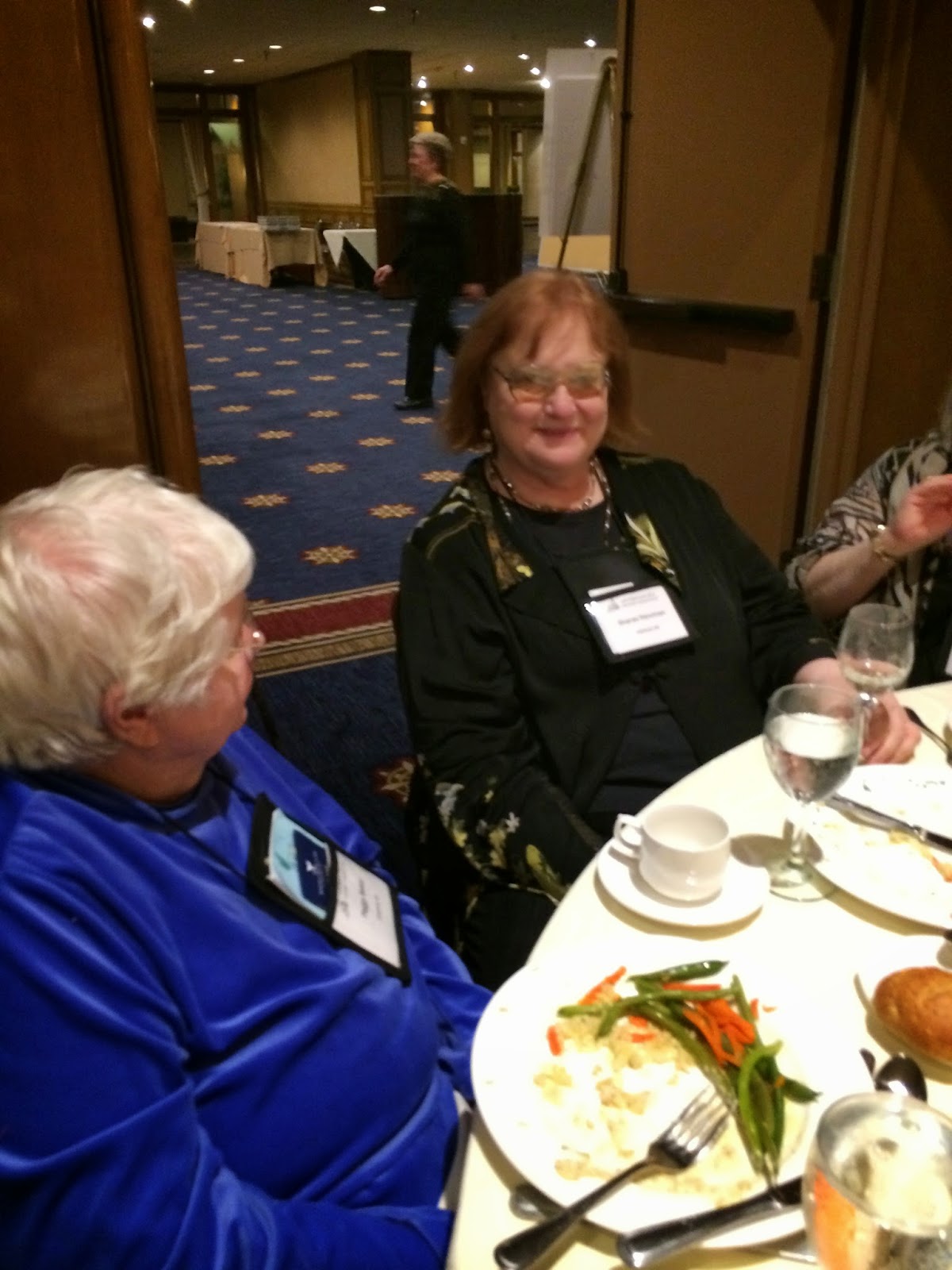
Sharan Newman at the banquet
Chantelle Osman and Kris Neri at the banquet
Sue Trowbridge receiving her Fan Guest of Honor award from Brad Parks
Cara - Tuesday

Tuesday, October 1, 2013

Guest Author Libby FIscher Hellmann: The Depression America Doesn't Know About.


Libby Fischer Hellmann, while DC born has deep roots and keeps her heart in Chicago. Most of the time. Libby's an award nominated writer, former President of the Sisters in Crime, killer tour traveling companion who I call my friend. She's also a killer writer - not only does she write two series but standalones and her new book, Havana Lost, is the third in what she calls her 'Revolution Trilogy'. In Havana Lost, she gets the smells, the textures, the politics and those tiny cups of Cuban espresso just perfect. Please welcome Libby, who's the Thelma to my Louise, and give her a warm MurderisEverywhere welcome!

As I’ve been out and about promoting Havana Lost, I’m struck by how little Americans really know about Cuba. Pretty much all the information over the past 30 years has been filtered through the lens of the Cuban-American exile community, who, although they’re dying out, are still bitter and don’t have a kind word to say about Cuba or Fidel Castro. But since their allies continue to be a powerful lobby in Congress, I suppose we shouldn’t be surprised by the vitriol.

Btw, just to set the record straight, I’m not here to defend Fidel or what he’s done. He decimated the middle class that had been thriving in the 1950’s. And he turned out to be just as cruel and dictatorial and territorial as Fulgencio Batista, his predecessor.


In fact, there are persistent rumors that Castro was responsible for the death of both his revolutionary comrades Camilo Cienfuegos and Che Guevara. It wouldn’t surprise me if the rumors were true.

What does surprise me, though, is how little Americans know about Cuba’s “Special Period” in the 1990’s. It was so dire that I wonder why the exile community didn’t jump on it for propaganda purposes. Or the pretext for another invasion attempt. But apparently, they didn’t, so the Special Period remains the depression nobody knows about.

A little history here: you probably remember the collapse of Berlin wall in 1989. That was followed by the dissolution of the USSR in 1991. What you might not know, however, was the impact on Cuba. In a word, it was catastrophic. Cuba sank into a depression so severe it makes our “Great Recession” look like a walk in the park.

The reason? Cuba had been one of the Soviet Union’s largest trading partners, and when it collapsed, so did Cuba’s economy. They lost 90% of their petroleum imports, including oil, gasoline, diesel, fertilizers, and insecticides. With no fuel to power cars, buses, and tractors, the Cuban transportation system collapsed. So did their agriculture and farming. There were severe food shortages, and the average Cuban lost twenty pounds. Industry slowed to a crawl, and Cubans had to do without many consumer goods, including medicines. Eventually, even Fidel had to acknowledge the truth, and, in a move worthy of Joseph Goebbels, labeled it the “Special Period.”  (I describe much more about the Special Period and its impact in Part Two of Havana Lost.)


Cuba has clawed its way out of the harshest parts of the Special Period by adopting organic farming methods, using bicycles and horses as the primary mode of transportation, and bartering goods and services. But there is still desperate poverty.


Outside Havana you see fields being plowed by oxen, people driving horse-drawn wagons, and thatched huts huddled together on muddy roads. Even in Havana, you see people on the streets charging a few Cucs (Cuban currency) to have their photos taken with tourists. And in Havana neighborhoods like Regla and Lawton, you see abandoned factories, dilapidated buildings, and a total absence of commerce.


The government is trying to boost the economy; over the past two decades they’ve amped up tourism, and it has become the number one industry in Cuba—for everyone except Americans. And recently Raoul, Fidel’s brother, has loosened restrictions on buying and selling cars, property, and small businesses. Unfortunately, those businesses are still heavily taxed, and most of the investment cash for those activities is reportedly coming from Cuban- American relatives.

I suppose we could analyze why most Americans don’t know about Cuba’s woes, but I suspect a third of the US population would think it’s the result of a conspiracy; another third wouldn’t care; and still others might feel the Cubans got what was coming to them.  But how can the suffering of innocent people ever be justified?


It’s hard to admit this, but Cuba’s economy was more stable back in the 1950’s when the Mafia ran Cuba. I’m certainly not advocating for a return to that era, and I’m wary of what’s going to happen when the US finally does lift the embargo (which they will undoubtedly do after Fidel dies). The last thing Cuba needs is another super-power trying to exploit whatever resources it still has.


At the same time, though, almost sixty years has passed, and Americans need to know more about one of their closest neighbors. The right kind of investment in a country 90 miles from us might yield more tangible benefits than a military strike in the Middle East, don’t you think?

Libby for Cara—Tuesday