|
| Sam |
This coming Wednesday, the 2nd of September, will
be the seventieth anniversary of the Japanese surrender in Tsingtao. My father Samuel Puglise was there. He had fought on Guadalcanal, Saipan,
Okinawa, and Guam, and then after VJ Day, his unit was sent to China.
 |
| The surrender ceremony. Sam is in there somewhere. |
The Japanese had invaded China in 1937. With more advanced war materiel, they soon
overwhelmed the Chinese, despite their home territory advantage. By the time my father joined the fight to
rout them from the islands of the Pacific, the Japanese were firmly entrenched
in China. After the 1945 surrender,
there were hundreds of thousands of Japanese soldiers who needed to be
repatriated. Naturally, this was an
operation that would take some time. The
Japanese troops were kept in holding areas while the available ships were used
to transport them home. American Marines
were put on guard duty to keep them in custody until they left.
 |
| Japanese after the surrender. |
But there was a big problem.
The Chinese had reasons (one of which I wrote about last week) to want
revenge on the Japanese. During the
night, Sam told me, local people would crawl under the barbed wire and kill the
Japanese. And there were not enough
Americans to properly patrol the perimeter and keep the inmates safe. The solution enacted boggled Sam’s
mind. The American commanders rearmed
the Japanese officers and had them walk guard duty with the Americans. “Think of it, Sweetie,” Sam said. “A few weeks beforehand, we were trying to
kill one another. And then, there we
were, armed and walking guard duty together.”
 |
| Card Sam sent to my mother at Christmas 1945 |
After the repatriation was complete, Sam and his fellow
Marines were kept on for a while, guarding Cheng Kai-shek’s supply lines in his
war against Mao Zedong.
 |
| Sam in China |
Sam’s time in China was not without challenges. His group—a contingent of the 6
th
Marines—was attached to the 1
st Marine regiment. On the one side, assumptions were made that
the 6
th would continue to supply them and on the other that the 1
st
would. For a while, nothing arrived, not
even rations. At one point, they managed
to trade with the Chinese for a cow, which they butchered and ate. Sam made a chewing motion when he described
this. “It was old and TOUGH. We named it ‘Confucius’ calf.”
 |
| Confucius' Calf |
 |
| Sam on the extreme right, dining on tough meat. |
He made friends with a Dutch missionary priest, who later
escaped the religious cleansing after the Communist victory. I wish I could remember his name. He came and visited us in Paterson, on his
way home to the Netherlands. For years
after the war, Sam corresponded with a doctor and his wife named Pfister. I found their address on Pei Tai Road in the
blue notebook shown in this collection of memorabilia:
 |
| Sam's memorabilia |
 |
| Sam's souvenir photos of Chinese he served with. |
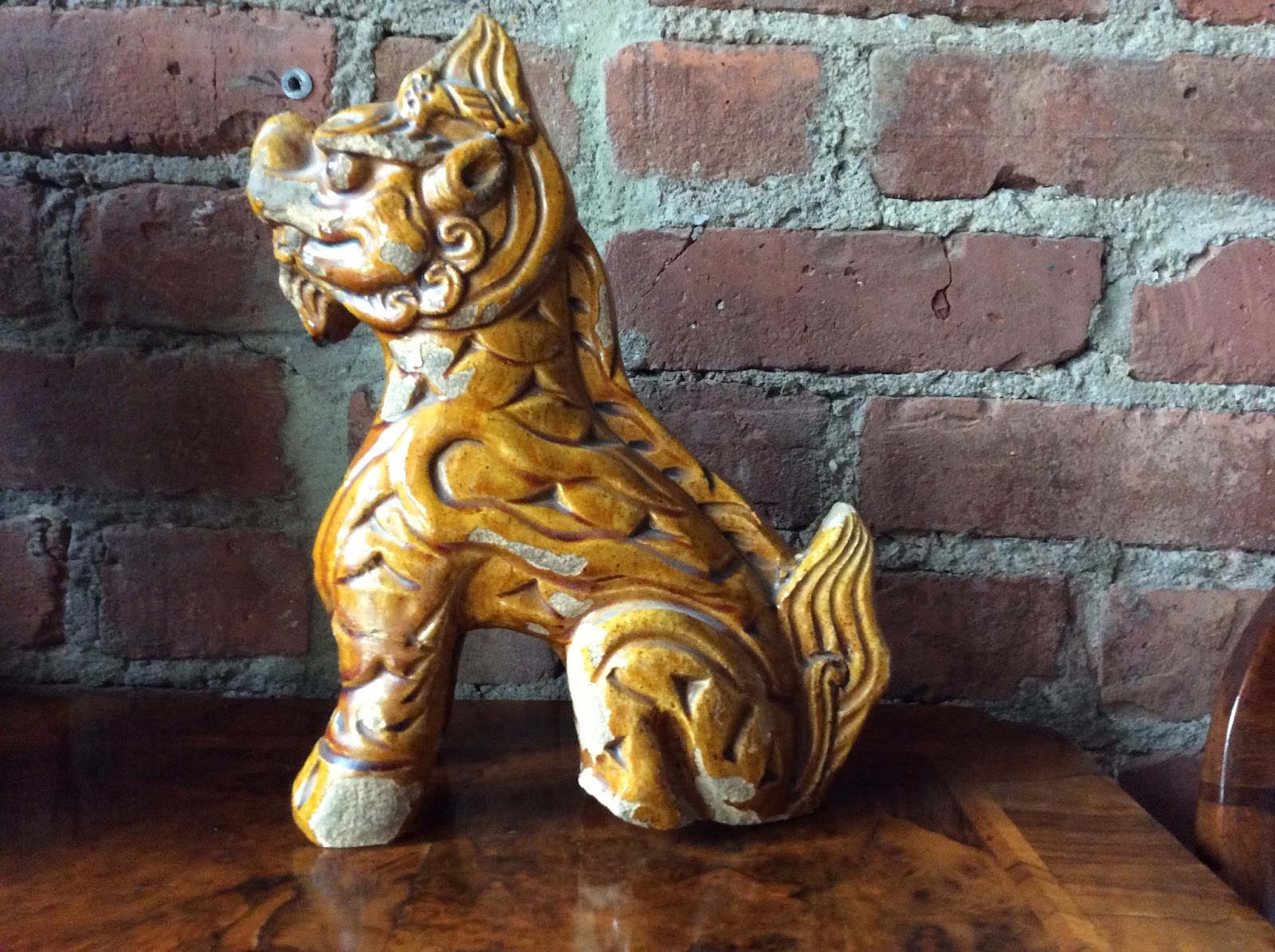
Sam rescued a monk from a bombed out Buddhist temple. As they left, the man reached down into the
rubble and took up a roof ornament and gave it to Sam. He kept it, and brought it home when on 1
April 1946, the 6
th Marine Division was disbanded, and Sam was finally
shipped Stateside. By “slow boat from
China,” he said, and then train from San Diego to NYC, and them by inter-city
bus to Paterson, and then by city bus to home.
 |
| Coming home! |
He told me much later that people at the Paterson City Hall bus stop
looked askance at him and asked why he was still wearing his uniform more than
six months after the war ended. When he walked
into the house, I was alone, sitting on the sofa where my mother told me to stay
and not move until she got back from the store.
I had turned five the month before.
For more than a year I had been begging for a dog. My mom told me I had to wait until my father
got home. She had written of this to
Sam. He opened his duffle bag and gave
me a dog, one that used to occupy the roof of a temple in China. Here it is:
 |
| My dog. |
 |
| Sam brought home this Buddha carved from coal. |
 |
| A few of the items Sam collected in China |
During the first fifty years after coming home, Sam did not
talk much about his war experiences. I remember only two rather benign
stories. Here they are as accurately as
I can recall them:
My mother had sent my father a package that contained pairs
of socks, a cake, and a box of raisins thrown in at the last minute. The socks were something Sam had requested. He and his buddies had found that in the
soggy climate of the South Pacific, in unrelenting battle, they often did not
take off their boots for a week at a time.
When they did, their socks were gone.
With endangered supply lines stretching back to San Diego, there were
often no replacement socks to be had.
 |
When I saw this last year in London, it resonated with me. It was part of
an exhibition at the British Library about World War I |
The cake was a mess of moldy crumbs. But the raisins! Drinking alcohol, except for wine at dinner,
was not part of my father’s culture. His
best buddy, a guy of Scottish descent from Connecticut, however, saw a
marvelous opportunity. They were, at
that time on a beach getting a few days of R&R. Sam climbed a palm tree and came down with
five coconuts. They used their bayonets
to cut off the tops, put a handful of raisins in each one, recovered them, and
buried them in the warm sand. Three days
later they dug them up and drank the fermented coconut milk. Sam laughed out loud when he recounted how after
their “cocktail hour” he could not stand up, but had to crawl through the trees
and underbrush to get back to his tent that night.
On Okinawa, after the last major battle, they were “mopping
up.” Sam and two other Marines were patrolling a rocky part of the island pockmarked
narrow caves, some of which went straight down into the ground. Snipers were hiding in these as well as in
caves on the sides of the mountains.
American patrols investigated the holes in the ground by shouting for
anyone hiding in them to come out. If no
one did, they dropped in a grenade to make sure no sniper would pop up later
and kill them. Sam and two others from
his platoon were on such a patrol after weeks of jungle fighting without any
let up. "We did not look very spiffy," he said. At one such hole, they stood poised and
ready, with rifles pointed down and called for any one inside to come up. To
their astonishment, a gray-haired gentleman in a perfectly clean linen Panama
suit, complete with white shirt, tie, and vest emerged, followed by two equally
pristine young women in silk dresses, wearing white gloves and fashionable little
hats. "I never felt so filthy and
smelly in my life," Sam said, laughing.
 |
| Uncle Paul in his Seabees uniform |
In true Sicilian fashion, even with the war raging, Sam
managed to wangle transportation to visit family members who were also at the
front. His older brother, who was beyond
combat age, joined the SeaBees (Construction Battalions). When Sam was still on Okinawa after the
conquest of the island, he found out that Paul was with a group building an
airstrip on Saipan. Sam talked his CO
into letting him hitch a ride on a transport plane and spent a day with his brother. He learned that my mother’s youngest brother
Joe was on Peleliu. Following that
battle, Sam found a way to get there and spend some family time. Sam could do that sort of thing. He was a modest, but thoroughly engaging and
charming man. Whoever you were, his
sincerity made him irresistible.
It was not until a few months before he died that Sam told
the horror stories. The only family
members he talked to about the awful parts were me and David. When you read them you will see why he did
not want to talk about it.
During that mopping up operation on Okinawa, those same
three who found the pristine people in the hole in the ground, on another day, emerged
from the jungle toward a cliff overlooking the ocean. Scores of Japanese had been driven to the
edge, but no one knew they were there.
“Though there were only three of us, they must have thought we were
leading a large force coming through the trees,” Sam said. “As soon as they saw us, some of them threw
themselves off the cliff onto the rocks below.”
Some killed themselves by falling on grenades. Pairs of them pulled the pin on a grenade
held between them, embraced, and went over the edge headfirst.
This last story made Sam weep with anger and sadness when he
told it to us more than sixty years after it happened. He and a member of his platoon were having a
smoke under a tree. There was no enemy
action anywhere in the area, and no one else was around. An elderly Japanese man, resident of Okinawa,
came along the road walking with great difficulty with a cane, making very slow
progress. The Marine sitting there with
Sam picked up his rifle, aimed it at the old man, and killed him.
At ninety-four, Sam looked at us through his tears. “I spent my life trying to forget these
things, Sweetie,” he said to me. “But I
never could.”
Annamaria - Monday