Showing posts with label James Bond. Show all posts

Wednesday, May 11, 2022

I’ve seen that movie before: 10 hackneyed movie tropes


 Wed--Kwei

I watch a lot of mystery and thriller movies (I wonder why) and over the years have noticed repeated themes, scenes, and tropes in different movies from all over the world. Sometimes, I get the feeling the screenwriter didn’t honestly know what should come next. Here are 10 hackneyed movie scenes that come to mind. You probably have some of your own.

  1. The “splashing-face-then-look-in-the-mirror” scene. Often after a stressful event in the movie, the character goes to a bathroom sink at home or elsewhere, splashes their face, and then looks contemplatively in the mirror. This is the “calm down” scene, or sometimes, “What am I doing here? Who am I?” I might try this when next I’m stressed.
I’ll look in the mirror in a second (Shutterstock)


2.  The “crashing-through-the-market” scene. This happens in Bond, James Bond types of movies during a climactic chase in the setting of a “poorer” country where the fleeing party is being hotly pursued by the protagonist in a car, boat, helicopter, etc., and feel it necessary to destroy the local/street market, a reflection of the disdain felt by the screenwriters and film-makers for the indigenous people.

Helicopter chase scene from TOMORROW NEVER DIES (Twitter)
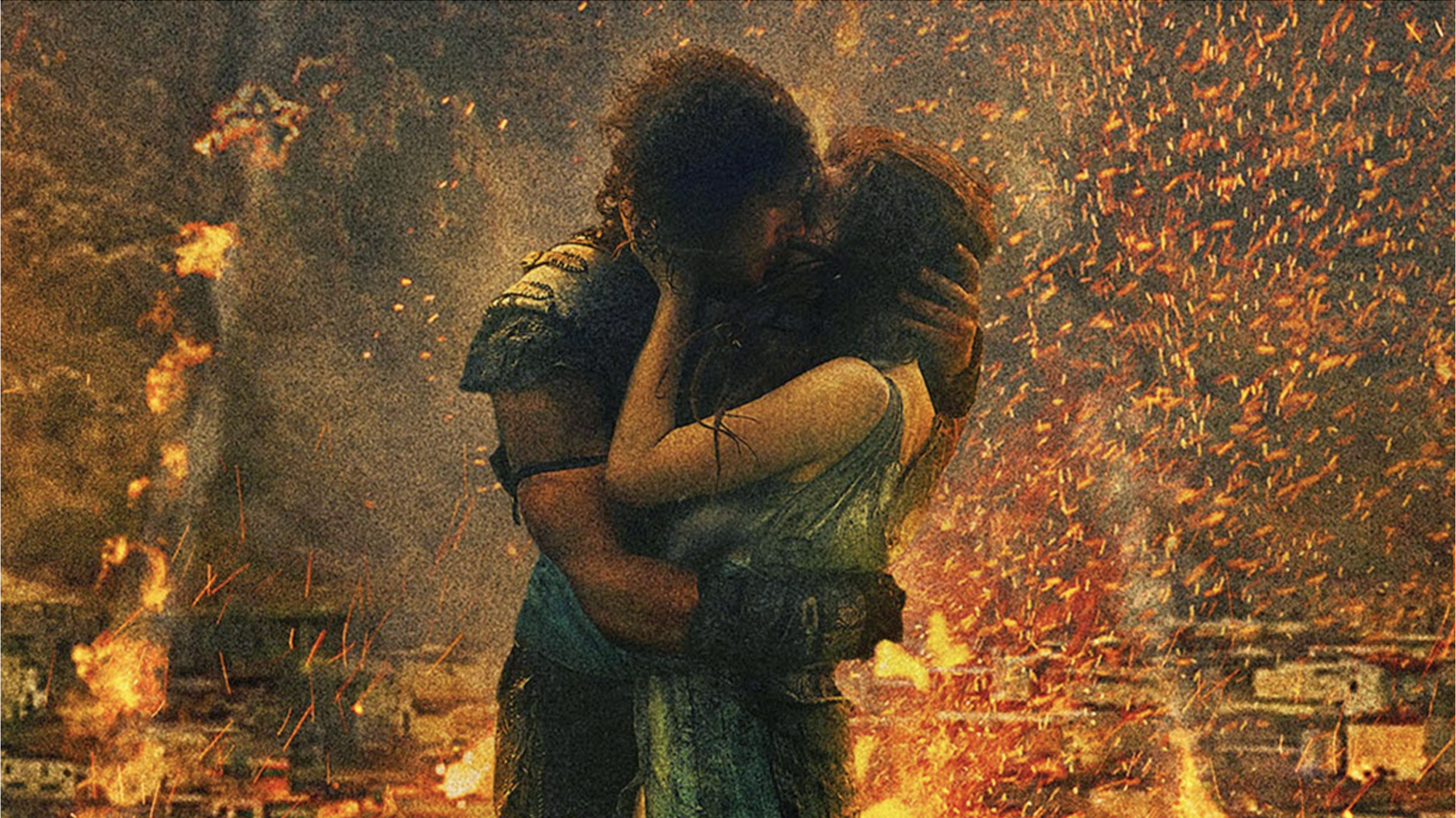
3. The “last-kiss-during-the-apocalypse” scene. Here, the world is exploding and crashing around the two main characters, who pause to say they will always love each other no matter what, and then embrace with a soulful kiss.

Last kiss: Pompeii, 2014 disaster movie (from pagesoncinema.com)

4. The “no-way-you’re-going-into-that-foreboding-haunted-house” scene. In this one, a girl(s), usually blond, sees a dark, creepy house, and instead of giving it a wide berth, which is what any reasonable person would do, they enter, squeaky door and all. The door, by the way, always slams shut behind them. And they keep going deeper, and deeper into the house, opening every creepy, whining door. 

Nooo, don’t do it! (Image: Shutterstock)


Seriously, woman? Get the hell out of there! From Crimson Peak
                                                   (Image: Pinterest) 


5.  The “little-girl-on-the-swing” scene. If you see a girl on a swing (which usually squeaks in rhythm), be afraid, be very afraid. Many times, after the camera returns to the swing from another scene, the girl has gone but the swing is still going back and forth. This is a really bad sign, but I’ve never been able to understand why.

Girl on a swing in a haunted forest (Shutterstock)

6. The sex scene. To be honest, a lot of these are pretty bad and unconvincing and the audience can tell there’s absolutely zero chemistry between the participants. There are usually uninspiring flashes of body parts rubbing against each other, some of which might even be stock footage. Some people think that the love scene between Ben Affleck and Jennifer Lopez (“Bennifer”) is among the worst in one of the worst movies.

The infamous “gobble, gobble” scene with Affleck and Lopez in Gigli (Image: grunge.com)


7. The “White savior/noble savage movie: here, an unlikely white person takes up the cause of some helpless but noble people of color, either saving them from a terrible ending or teaching the poor savages how to become civilized, better people. One of the worst/best examples of this is “The Blind Side,” which is just an awful, truth-based movie in which Sandra Bullock plays Leigh Anne Tuohy, a trophy wife who, out of the kindness of her southern belle heart, took in a homeless Black teenager named Mike Oher. The movie is cringingly bad, and I barely got through it. Other white savior movies are, Glory, Dangerous Minds, Amistad, and To Kill a Mockingbird.

Sandra Bullock in "The Blind Side."

8. A 
completely level-headed male protagonist of the tale breaks up with a woman, only for her to turn into a crazy stalker/murderess/generally insane ex bent on destroying the beloved hero’s life. One example is, Gone Girl. Wait a minute, that’s another Ben Affleck film! I felt this movie began well but collapsed in the final one-third.

Gone Girl (in more ways than one) Image: Wikipedia


9. The “get-the-gun” scene. The protagonist and villain are fighting and one of them drops the gun. Now they are both inches away from the gun and one is trying to reach it while the other is trying to prevent the hand from succeeding. This is an overdone and ludicrous scene.

If only I could reach the gun...(Image: Shutterstock)


10. The mirror scare: Very predictable, the character looks in a mirror, bathroom or otherwise,  and there’s a scary reflection that wasn’t there before. This is one of the most predictable scenes and a very cheap thrill indeed. If I were a screenwriter, I would be embarrassed to write such a scene.

Gasp! Cheap scare (Image: Industrialscripts.com)


And a bonus: walking away from a massive explosion without any ill effects whatsoever. We all know this one. It's a huge eye-roller and makes no sense whatsoever.

Why am I doing this? Just because I’m badass. (Image: industrial scripts.com)


Actually, there are dozens more of these tropes. There’s nothing new under the sun, but screenwriters should be very careful about not repeating these tropes, because they cheapen the movie. As an aside, there’s a lesson in here for us novelists: we should watch out for familiar scenes and phrases in our writing. We too, sometimes fall into the trope trap.

                                                                            ~~~


Sunday, June 27, 2021

Cars As Character

Zoë Sharp


The kind of car driven by the main protagonist of a novel is, for me, a snapshot into the mind of that character. And for the author, it’s often a quick way to give information about the type of person your hero or SHEro is, without having to spell it out.


Dashing characters have a habit of driving equally dashing cars, where the quirkier types of detectives often drive classics. Occasionally, they are both. In the first of Ian Fleming’s novels to feature James Bond, Casino Royale, published in 1953, 007 drives a supercharged Bentley 4.5 litre that is already more than twenty years old.


Purely from a practical point of view, I can see the attraction of using a classic. By dint of it already being out of date at the start of the novel, it can hardly become an anachronism as the series goes on. In the three TV series of Spender, shown in the early 1990s and starring Jimmy Nail, he drives a Ford Sierra Sapphire Cosworth. A very In car at the time, but not one that’s stood the test of time as well as the original three-door Cosworth with its huge whale-tail rear spoiler.


Colin Dexter’s Inspector Morse is noted for the MkII Jaguar he used in the TV adaptations, but in the books, he originally rumbled around the streets of Oxford in a Lancia Aurelia saloon.


Leslie Charteris, on the other hand, decided there wasn’t a vehicle quite dashing enough to suit his debonair thief, Simon Templar, alias The Saint. So, he invented one. In fact, he invented several, but the most notable of these was the Hirondel. The Saint was noted to drive this at speeds exceeding a mile a minute—not to be sniffed at in the 1930s!


(artist's impression of a Hirondel, by Ted Lodigensky)

I suppose this was also a very good way of never being caught out with the technical details about a particular model. 


When I began writing about Charlie Fox, I knew very early on that she would be a motorcyclist, and thought it best to give her a model I was very familiar with. Hence the fact in the earlier books she rides a 250cc Suzuki RGV, which I can promise was plenty quick enough to get her into trouble—and preferably out of it again.


When the Suzuki eventually bites the dust, which it does through very little fault of Charlie’s, she fortunately has another bike waiting in the wings, in the form of a Honda FireBlade. I knew I needed to give her a bigger bike because, quick as the Suzuki was, doing a road trip through Ireland in the company of people riding bigger, faster bikes, she’d need to be able to keep up.


And in the first of the Lakes books, I wanted to give my CSI, Grace McColl, something practical for reaching off-road crime scenes. A Nissan Navara pick-up seemed just the thing. There was even room for her dog in the back.


Whereas her colleague, Detective Nick Weston, needed something that hinted he hadn’t quite grown out of his boy racer years. A Subaru Impreza—the STi WRX model—fitted the bill.


Both vehicles said something about their owners, and using them seemed a quick way to build character. Drivers of certain makes of car do seem to behave in predictable ways on the road these days. (And not always predictable in a good way.)


Are there any types of cars you would or would not like to see a character driving, and what do they say to you about the people who drive them?


This week’s Word of the Week is immane, meaning huge, vast, but also monstrous in character, cruel or savage, from the Latin immanis.

Friday, April 19, 2019

The Road More Travelled


At the moment of typing this, I am at the top of a Glen,  heading down towards the sea. I was looking for a setting for my new book. and I wanted an old oak forest, a really ancient forest  where the bark has been nibbled by many generations of deer.
 And by the snaggle toothed haggis.

 This blog was supposed to be about the Falls Of Lora, but there was an incident with a dog, slippy seaweed, a sea loch and a memory card. Let's just leave that  there.  

So where is here....

Here is definitely along this way,  many, many miles of single track road, with passing places worn out with traffic. Lots of traffic.
So where am I? 

I bet all of you have seen this place, witnessed its beauty on a big screen.
 A very big screen on a very big budget?
 Any ideas yet?

I will give you some clues.

The young haggis around here eat broccoli.
 The haggis cubs, in plural when living in familial  herds are called Cubbys.

We saw this tent but didn't want to spy on them.
 The sky was so heavy, even though the sun was shining, it looked like it mighty fall at any moment.

the rocks are interesting here,  craigs jut out from the already bare out crops. Sorry, did I say craigs, I meant crags, no bare Craigs here....
Water fall, not sky fall so we are ok at the moment.

And yes, intrepid Scottish blogger goes where no film crew has gone before.


So famous, they blocked it off to stop people looking.
I can't say how stupid it looks, a fence in the middle of no where.


Snow peaked mountains through the fir trees. There will be a skier with a parachute along in a minute, delicately raising one eyebrow  sardonically as he looks across Rannoch Moore, sorry Moor.

Oh Deer. It was unfazed by the car, a little shaken maybe but not stirred. 

worthy of panoramic widescreen


 peaceful until folk start blowing things up.


 the snaggle toothed haggis emerging from the loch, this is the golden eyed, snaggle toothed haggis, 

Edelweiss?
 No it can't be, wrong film.

This is a clear picture of Nessie ( in the wrong loch but her Sat Nav might have been faulty ).
We stayed here for a while, in contemplative silence, after all, you only live once... or twice.

                                        There has been rumours that they are bringing back haggis hunting in the Glen. I'd rather live and let live,
These huge fissures in the rocks were caused by volcanic activity, huge thunderballs.
 there a post box here in fact, the Royal Mail will get through, on Her Majesty's Service.


I sat here and wrote a few letters  with my fountain pen on  really good paper.
It was Basildon Bond.

Well to me, despite the fence it looks as though it  is still standing.


 Octopussy?

Sunday, January 10, 2016

Music to Write By: the soundtrack of the novel


Well, Christmas is over and January always seems a bit of a lacklustre month. The days are starting to lighten fractionally, but I know full well that we have not yet seen the coldest part of winter. Even if the daffodils are somewhat optimistically poking up green shoots, spring seems a long way off.

It’s not just the length of the days, however, it’s the quality of the light when it does finally put in an appearance. Dull and gloomy, requiring a desk lamp even at midday, and the fire lit by three o’clock in the afternoon.

The roads are perpetually plastered in mud, and so are the sides of my car. The bike is tucked away in the garage. There’s rain on every forecast, and if we make it through to March without snow it will be a first. In fact, as I write this the news is predicting snow and sub-freezing temperatures in the next week.

Perfect time of year, then, to be curled up inside, next to the aforementioned fire, with a book.

And I’ve been doing plenty of reading, both for research and for pleasure.

It’s also a good time to be indoors writing a book. I have a full schedule of work ahead of me that should last well past the rough weather and into the smooth. I’ve recently invested in a daylight lamp to banish the winter blues while I’m at my desk, and I’ve rediscovered one what has been in the past my strongest writing tools.

Music.

Although I no longer have my CD collection, I do have an external hard drive with most of the music contained on them loaded onto it. And in a lot of ways that’s even more conducive to writing. I’ve created a playlist of all my favourites, which I play in full Shuffle mode. Hours of music without having to get up to change a disc! The segues from one style to another are sometimes startling, but as these are all my favourites, there’s nothing I don’t like.

Some people have to have a place of tranquillity and complete silence while they write. Others can work quite happily in a busy café with all kinds of hubbub going on around them. Back when I still had a day-job as a photographer, I used to get a lot of scribbling done in the car on the way to shoots. Music on the car stereo, and no distractions of the Internet, or just nipping to the kitchen to make another brew.

(I was in the passenger seat for most of these trips, I ought to add, just in case you were wondering.)


I’ve always found that music conveys atmosphere almost instantly. It’s why it’s the constant backdrop to movies, TV and advertising. What would James Bond be without that distinctive John Barry score?


Or Jaws without the foreboding John Williams music to go along with it?


Cyndi Lauper’s ‘True Colors’ has found its way into many adverts as well as an anti-bullying campaign because the melody is as haunting the lyrics.


When I first heard Rachel Platten’s ‘Fight Song’, there was something about her voice from the moment she starts to sing. But as she goes into the chorus, it brings the hairs up on the back of my neck, the prickle in my chest. Instant emotion.


And I’ve been watching quite a bit of freestyle Grand Prix dressage recently, including the qualifier for the 2016 Olympics which was held at Olympia in London just before Christmas. But this older test by Edward Gal of the Netherlands, on the great Moorlands Totilas shows how music can emphasise and accentuate something that is already stunning. They call it dancing horses, and you’d swear the horse is listening to and keeping time with the music.


For me, listening to music while I write helps me to plug straight into an emotion or the kind of atmosphere I want to create. As long as the music is on low enough that it permeates my brain on an almost-subliminal level. I’ve found I can’t work well with headphones. It’s too immediate. I need a little distance in order for it to have its greatest effect.

What about you? Do you listen to music while you write, or work, or do you prefer the sound of silence? And, if you listen while you type or scribble, what are your favourites?

This week’s Word of the Week is cuckquean. I hadn’t come across this before, although its male equivalent, cuckold is far more common. Where a cuckold is the unwitting husband of an adulterous wife, so a cuckquean is the unwitting wife of an adulterous husband. Both have their roots from the cuckoo bird, which lays its eggs in other birds’ nests and leaves them to bring up young not their own. Sometimes shortened to cuck, it came into use in the mid 13th century. The important part is that the spouse should be deceived. A related word, for instance, is wittol, meaning a man who is aware of his wife’s infidelity and accepts it.