Showing posts with label Catching Fire. Show all posts

Thursday, November 26, 2015

Catching Fire revisited

Michael - Thursday

Happy Thanksgiving everyone!

I woke this morning wondering where I was. The last two months of travel around the US - Raleigh, Bethlehem, New York, Minneapolis, Chicago, Ann Arbor, Milwaukee, Madison, San Diego, Los Angeles and Reno - combined with leaving Minneapolis on Sunday afternoon and arriving in South Africa on Tuesday morning (via London and Philadelphia), had left me confused. After a while I came to the conclusion that I was in my bed in South Africa and that it was 4AM. There was every reason to be in bed at 4AM, but not a single one for being awake. (It was 8PM in Minneapolis so why not be getting ready for sleep rather than wide awake?) I confidently expect to be awake at 5AM tomorrow and so on.

Another revelation came to me. It's Thursday. The other Thursday. My Thursday. And I have absolutely no idea of what to write about and a packed day ahead.

Homo naledi fossils displayed at the Cradle of Humankind

I've been boring everyone with my enthusiasm for Catching Fire, a book by Professor Richard Wrangham. I've been thinking about it again recently because of one of the big mysteries around Homo naledi, the new hominid discovered near Johannesburg. The mystery is why did the paleoanthropologists find more than fifteen different skeletons in one cave? How did they come to be there? There are some obvious explanations all of which can be eliminated. They were the victims of a predator who lived down there. Well, not unless you believe in prehistoric trolls who ate nothing but these hominids and did so without cracking or gnawing the bones. They were washed there. No, that doesn't work; there is no geological evidence of water transport through the cave. What about a natural disaster? They were living down there and trapped? That doesn't seem right. The fossils are not all at the same depth in the clay, which would suggest a single event. So John Hawks of the University of Wisconsin Madison proposed that this was actually a burial chamber. This is fascinating because no other species except our own has a ritual associated with death in this sort of way.

However, there is a problem. This cave is not easy to get to - even for a small hominid such as naledi. It would require challenging climbing while carrying a corpse. And in the pitch dark. That seems very unlikely too. Two possibilities are suggested. The first - suggested by Richard Leakey - is that there was another - easier - entrance to the cave in those days. No one has discovered anything suggesting that to date. The second is that these hominids possessed fire. Then they would be able, at least in theory, to light their way into the chamber. The last would suggest that they are a relatively recent species - perhaps of the same age as early members of homo sapiens. Yet they seem to combine the features of Homo and Australopithecus in a very intriguing way. The other possibility is that the use of fire goes back much further than is usually accepted. That is the thesis of Catching Fire and it could also explain why naledi might have had the leisure to engage in something like formal disposal of their dead in the first place.

Below is the original blog about the book from about a year ago:

I am arguably the world’s worst cook, so I avoid it as much as possible.  I do, however, love to eat good food, and I suppose I always thought that the purpose of cooking was to turn tasteless and chewy raw ingredients into something delicious.  To the extent that I thought about it at all, I assumed that cooking was something that developed somewhere in our evolutionary past when one of our distant ancestors dropped a chuck of raw meat into the fire and it took him a while to fish it out.  I visualized a Neanderthal or the like doing this.  

Maybe this just displays my general ignorance.  Recently, on a long plane trip, I read a book that had a very different interpretation of events and one I found fascinating.  It’s an African story; wherever this happened, it was somewhere in Africa. And with the Cradle of Humankind up the road from where I live, it might have been quite close by.


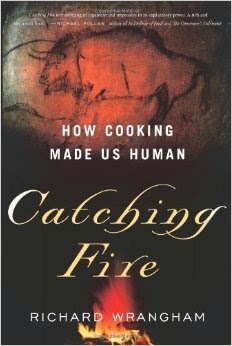
The book is CATCHING FIRE: How cooking made us human by Richard Wrangham. The author is the Ruth Moore Professor of Biological Anthropology at Harvard and an expert on Chimpanzees on the side. This guy knows his stuff. It is sometimes said that we are what we eat. The thesis of this book is that it’s not what we ate that mattered, but that we cooked it first.

Professor Wrangham and friends
Compare the teeth!
The book starts out gently explaining that raw food is great except that it takes a long time to chew up and a lot of energy to digest.  Much of the food value is wasted. What you need is big, strong teeth, heavy jaw muscles, and plenty of lower intestine.  My neighbors up the road here had all that. They were much smaller than humans but had bigger teeth.  I did know that.  I suppose I just thought that our smaller teeth resulted from our larger overall size and changed diet.  Well, right.  Professor Wrangham points out that it's diet that drives evolution, never the other way around.  It was when our ancestors started cooking their food that two things happened, probably over quite a short space of time in evolutionary terms.  The one was that they were now getting much more nutrition from the same amount of food. That’s because breaking down the cellular structure with heat makes the nutrients more easily accessible. The other was that we could eat more quickly. The food was softer, less chewing was required, and less digestion.  Over time our teeth changed to reflect that situation and our guts changed appropriately too.

Australopithecus Sediba
The archaeological record shows that humans controlled fire about half a million years ago and maybe much earlier. At Swartkrans in South Africa and at locations in Kenya, there are sites dating back one and a half million years with suggestions of fire use. This physical evidence is disputed so Wrangham turns to biology instead, seeking the change in anatomy that would link with the cooked food.  

Over the last two million years, there were only three periods when our ancestors’ evolution was fast and strong enough to justify a change in species names.  The crucial one occurred some 1.8 million years ago when Homo erectus emerged from the australopithecines.  ‘Suddenly’ we had a much larger creature, one that walked and ran and was probably not well suited to climbing, had smaller teeth, and probably differently structured guts.  It had to be fire that allowed the erectus part.  The African savanna was not a safe place to be on the ground at night with saber tooth cats all over the place.  The australopithecines were probably excellent climbers and slept in trees as all modern apes do.  But if you were cooking around a cheerful bonfire, sleeping around it – presumably with a watchman to keep the fire fed – would be safe and comfortable.  So the implication is that it was the possession of fire and the rudimentary art of cooking that drove the development of Homo.
Skull of Homo Erectus
That in itself is a pretty intriguing idea.  But there’s more.  If we were happily eating roasted meat and broiled vegetables all that time ago, why did our brain size develop?  It turns out that the development of brain tissue is very expensive in terms of energy demands. Wrangham believes that what we think of as intelligence was needed for social interaction rather than for food gathering.  It was the excess of nutrition from the cooked food that allowed the extra resources to feed and develop our brains. Thus it was cooking that led to our intelligence, rather than the other way around.  


Wrangham has one final twist. He observes that universally in hunter-gatherer communities, the women do the cooking. (The exceptions are a few instances when men do some culturally significant form of cooking and he dismisses those.) Men do the hunting – or whatever else they want to do – and leave the vital cooking task to the women.  In a few societies, it's much more significant for a woman to feed a man than to have sex with him.  If she gives him dinner, they're married.

Wrangham toys with the idea that as cooking developed, females could be set upon and have their food stolen, so they made alliances with males, not for sex and procreation as is the conventional wisdom – generally apes don't do that - but for shared food and resources and for defense against food thieves.  So much for ‘family values!’  It’s all about food!  Wrangham obviously feels very uncomfortable that this prehistoric motivation has settled into modern times as an excuse give women a subservient role.  He concludes this chapter with:

 “The idea that cooking led to our pair-bonds suggests a worldwide irony. Cooking brought huge nutritional benefits. But for women, the adoption of cooking also led to a major increase in their vulnerability to male authority. Men were the greater beneficiaries. Cooking freed women’s time and fed their children, but it also trapped women into a newly subservient role enforced by a male dominated culture. Cooking created and perpetuated a novel system of male cultural superiority. It is not a pretty picture.


Michael - Thursday

Thursday, March 12, 2015

The Well-informed Cook

Two weeks ago I wrote about a book – Catching Fire by Richard Wrangham – which postulated that the discovery of cooking greatly improved the food success of the hominid species and led to the evolutionary change that produced us.  Many side issues arise as a result of this premise. A very important one is that pairing of males and females may have been driven by a need to protect cooked food rather than primarily for sexual or reproductive reasons; another was that this led to the male domination of women.

The issue that seemed to raise the most interest was how this relates to the issue of obesity in the modern first world. Caro pointed out some scary statistics. Wrangham notes that at the start of the 21st century, 61% of Americans were “overweight enough to begin experiencing health problems as a direct result.”  He notes that fifty years after the observation was first made, more people in the US die from too much food rather than too little.  Diet conscious people wonder around the supermarket reading calorific values on food packages.

I don’t pretend to have any expertise whatsoever in this area, but Wrangham makes some points and observations that seem at least plausible.  In his book's epilogue – titled The Well-Informed Cook – he discusses the way in which food value is measured, which, in broad brush-stroke terms, goes back to Atwater’s meticulous and pioneering work in the nineteenth century.  Sparing you the details, he found that food could roughly be divided into three components – proteins, fats, and carbohydrates – and that within these components the available energy was fairly uniform.  He also estimated how much of the food material was absorbed by the body.  So a mass/energy balance tells you how much energy is available from each food group.  Nice and simple and basically the way in which foods are labelled and treated to this day.

Wrangham points out two major flaws in this. Firstly, it doesn’t take into account how much energy it requires to digest the foods.  Thus highly processed, soft, cooked foods are rapidly and easily broken down by the digestive enzymes and take little energy to absorb.  Conversely, rough-milled and raw foods are much more difficult to digest, and while the body works hard at doing so, much more energy is used in the process.  Thus the same amount of calories in different forms leads to a substantially different net gain.  Protein costs more to digest than carbohydrates and fats have the lowest digestive cost of the three. A study in 1987 showed that people on a high fat diet achieved the same weight gain as people eating around five times that number of calories in carbohydrates. This suggests that the Atwood system is far too simple to be useful in the modern environment, yet it is still the basis for food labeling.

The second related issue with the system is that the state of the food – liquid, soft cooked solid, meat, raw food – makes a large difference to the cost of digestion. The latter items lead to a much higher excretion rate, which Atwood had assumed to be essentially constant at around 10%. Detailed data on this is hard to obtain for multiple forms of multiple foods and so it is expressed only in qualitative terms like “eat less processed foods,” “roughage is good for you,” “eat fresh salads.”  None of this is really helpful, and certainly doesn’t appear in the nutritional food labels. What you see is what you get, but it isn’t very meaningful.

Richard Wrangham with non-cooking friend
This is how Richard Wrangham concludes his discussion:
“The human ancestral environment was full of uniform problems: how to get fuel, how to regulate feeding competition, how to organize society around fires. The big problem of diet was once how to get enough cooked food, just as it still is for millions of people around the world. But for those lucky enough to live with plenty, the challenge has changed. We must find ways to make our ancient dependence on cooked foods healthier.”

If Wrangham is right, we now need to avoid the very foods we have evolved to seek.  The problem is that those are therefore exactly the ones we like.


Michael – Thursday.

Thursday, February 26, 2015

The Naked Cook


I am arguably the world’s worst cook, so I avoid it as much as possible.  I do, however, love to eat good food, and I suppose I always thought that the purpose of cooking was to turn tasteless and chewy raw ingredients into something delicious.  To the extent that I thought about it at all, I assumed that cooking was something that developed somewhere in our evolutionary past when one of our distant ancestors dropped a chuck of raw meat into the fire and it took him a while to fish it out.  I visualized a Neanderthal or the like doing this.  

Maybe this just displays my general ignorance.  Recently, on a long plane trip, I read a book that had a very different interpretation of events and one I found fascinating.  It’s an African story; wherever this happened, it was somewhere in Africa. And with the Cradle of Humankind up the road from where I live, it might have been quite close by.


The book is CATCHING FIRE: How cooking made us human by Richard Wrangham. The author is the Ruth Moore Professor of Biological Anthropology at Harvard and an expert on Chimpanzees on the side. This guy knows his stuff. It is sometimes said that we are what we eat. The thesis of this book is that it’s not what we ate that mattered, but that we cooked it first.

Professor Wrangham and friends
Compare the teeth!
The book starts out gently explaining that raw food is great except that it takes a long time to chew up and a lot of energy to digest.  Much of the food value is wasted. What you need is big, strong teeth, heavy jaw muscles, and plenty of lower intestine.  My neighbors up the road here had all that. They were much smaller than humans but had bigger teeth.  I did know that.  I suppose I just thought that our smaller teeth resulted from our larger overall size and changed diet.  Well, right.  Professor Wrangham points out that it's diet that drives evolution, never the other way around.  It was when our ancestors started cooking their food that two things happened, probably over quite a short space of time in evolutionary terms.  The one was that they were now getting much more nutrition from the same amount of food. That’s because breaking down the cellular structure with heat makes the nutrients more easily accessible. The other was that we could eat more quickly. The food was softer, less chewing was required, and less digestion.  Over time our teeth changed to reflect that situation and our guts changed appropriately too.

Australopithecus Sediba
The archaeological record shows that humans controlled fire about half a million years ago and maybe much earlier. At Swartkrans in South Africa and at locations in Kenya, there are sites dating back one and a half million years with suggestions of fire use. This physical evidence is disputed so Wrangham turns to biology instead, seeking the change in anatomy that would link with the cooked food.  

Over the last two million years, there were only three periods when our ancestors’ evolution was fast and strong enough to justify a change in species names.  The crucial one occurred some 1.8 million years ago when Homo erectus emerged from the australopithecines.  ‘Suddenly’ we had a much larger creature, one that walked and ran and was probably not well suited to climbing, had smaller teeth, and probably differently structured guts.  It had to be fire that allowed the erectus part.  The African savanna was not a safe place to be on the ground at night with saber tooth cats all over the place.  The australopithecines were probably excellent climbers and slept in trees as all modern apes do.  But if you were cooking around a cheerful bonfire, sleeping around it – presumably with a watchman to keep the fire fed – would be safe and comfortable.  So the implication is that it was the possession of fire and the rudimentary art of cooking that drove the development of Homo.
Skull of Homo Erectus
That in itself is a pretty intriguing idea.  But there’s more.  If we were happily eating roasted meat and broiled vegetables all that time ago, why did our brain size develop?  It turns out that the development of brain tissue is very expensive in terms of energy demands. Wrangham believes that what we think of as intelligence was needed for social interaction rather than for food gathering.  It was the excess of nutrition from the cooked food that allowed the extra resources to feed and develop our brains. Thus it was cooking that led to our intelligence, rather than the other way around.  


Wrangham has one final twist. He observes that universally in hunter-gatherer communities, the women do the cooking. (The exceptions are a few instances when men do some culturally significant form of cooking and he dismisses those.) Men do the hunting – or whatever else they want to do – and leave the vital cooking task to the women.  In a few societies, it's much more significant for a woman to feed a man than to have sex with him.  If she gives him dinner, they're married.

Wrangham toys with the idea that as cooking developed, females could be set upon and have their food stolen, so they made alliances with males, not for sex and procreation as is the conventional wisdom – generally apes don't do that - but for shared food and resources and for defense against food thieves.  So much for ‘family values!’  It’s all about food!  Wrangham obviously feels very uncomfortable that this prehistoric motivation has settled into modern times as an excuse give women a subservient role.  He concludes this chapter with:

 “The idea that cooking led to our pair-bonds suggests a worldwide irony. Cooking brought huge nutritional benefits. But for women, the adoption of cooking also led to a major increase in their vulnerability to male authority. Men were the greater beneficiaries. Cooking freed women’s time and fed their children, but it also trapped women into a newly subservient role enforced by a male dominated culture. Cooking created and perpetuated a novel system of male cultural superiority. It is not a pretty picture.


Michael - Thursday