Craig - Tuesday
Today, Murder Is Everywhere is going to start offering its readers something new - in fact, at least two things that are new.
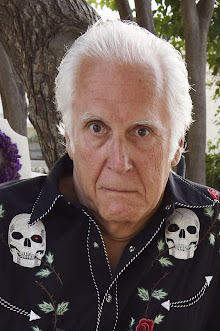
To start off, I'd like to introduce our new blogger, Craig Sisterson, a gentleman that many of us have known for some time, usually from hanging around bars at crime and mystery conventions.
First, he fills a void on the map that we've tried on several occasions to fill, namely what the Brits started calling The Antipodes because it is on the other side of the planet. Craig hails from New Zealand, where he's been intimately involved in the world of mystery writing. He'll tell us more about that. I'm sure he will introduce us to writers we don't know but will enjoy reading.Second, although a prolific writer, he hasn't written any mysteries or thrillers. Nor has he penned any romances. Craig is best known as a critic and reviewer of our genre. And a good one he is. He has also written the definitive treatise on crime writing in New Zealand and Australia, titled Southern Cross Crime: The Pocket Essential Guide to the Crime Fiction, Film & TV of Australia and New Zealand, which came out about six months ago.
I'm very excited to have Craig on board because he will provide a foil to those of us who are occasionally (and sometimes not so occasionally) prone to toot our own horns. I'm hoping he will keep us all grounded.Please give Craig a big welcome and feel free to bombard him with questions and comments.
Stan
__________________________________________
24-hour bus rides and libraries 7,000 miles apart
Kia ora and gidday everyone.
First off, thanks so much for that lovely introduction Stan. You're too kind. It's still a little strange seeing someone writing about me, when I'm so used to writing about others. Ditto being interviewed rather than being the interviewee. I'm also far more used to introducing others (including onstage at crime writing festivals, as a panel chair or festival founder), than being introduced myself. In fact several years ago I was notorious at New Zealand book festivals for introducing all the authors on my panels then diving straight into the conversation, forgetting to introduce myself to the audience!
It happened more than once. Still, probably not the most embarrassing thing I've done at a writers festival. Stories for other times.
I've been thinking about writing festivals a little bit lately, with the recent news that the terrific team behind the Theakston Old Peculier Crime Writing Festival in Harrogate are hoping to have some sort of in-person festival this northern summer, given the vaccination process underway in the UK.
It's a strange mix of emotions to contemplate all gathering together again in public - hopeful, unsure, excited, too soon? There's such a wonderful vibe in the crime fiction community, and I've certainly missed that in the past year. Last week was actually the one-year anniversary of the final public gathering I attended before we, like much of the world, went into varying degrees of (rolling) lockdowns and social distancing. That was "Fearless Female Protagonists", a book launch for three terrific crime writers - Steph Broadribb, Simone Buchholz, and Vanda Symon - in central London.
 |
| Steph and Vanda at their book launch, London March 2020 |
While we did chat on the night about the growing news of a troubling virus spreading across the world, none of us had any clue that a year later we'd still be living with a global pandemic. So much has been lost by so many, at times it's felt trite to worry about books and events. Yet at the same time stories on page and screen have been such a comfort - even more than usual - to millions during these tough times. Books connect us to the wider world, build empathy, expose us to issues, put us in others' lives.
I'm absolutely thrilled to join the crew at Murder is Everywhere. Soon after I began my own blog, Crime Watch, in late 2009, this became one of my favourite blogs to read. I love the global perspective.
It's been a real pleasure to get to meet and hang out with several of the Murder is Everywhere team at various crime writing festivals in recent years, from Iceland Noir to Bouchercon to Bloody Scotland, as well as interviewing some onstage or for magazines etc. So it's very humbling to get the opportunity to write for this wonderful website. I'm looking forward to discussing lots of different things in the coming months. For today I thought I'd share a little bit of background on my own journey in crime fiction.
I fell in love with reading as a young child.
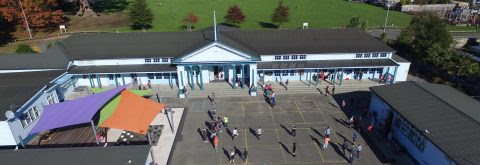
I grew up in a small town at the top of the South Island of New Zealand uncovering mysteries alongside the Hardy Boys and Hercule Poirot. So you could probably blame my parents and the librarians at my school and local public library for kickstarting my life of (literary) crime. New Zealand is a fairly sporty country and my room and our house always had plenty of sports gear, but lots of books too.
 |
| My primary school, with the library in the centre, as it should be |
I just loved reading, and libraries were (and still are) one of my favourite places.
So it's rather appropriate that many years later it was a couple of libraries, separated by 7,000 miles and the Pacific Ocean, that helped change my adult life too. That, and some very, very long bus rides.
While at law school then working as a junior commercial lawyer for a few years I continued to regularly read crime novels, though not as many as when I was a kid. Then in my late 20s I did a yearlong round-the-world backpacking trip which included several months exploring Latin America.
On that trip we had some very long bus rides, plus other downtime waiting around or relaxing between all the exploring and adventuring. Some of the hostels had wee shelves of secondhand books in various languages that you could buy for cheap and/or swap for one or two you already had. As we moved from Peru and Bolivia down into Chile and Argentina, and the transport legs grew longer and longer (eg 12, 18, 24 hours on a bus to get from one place to another), I started reading a lot more again.
I always scoured the book exchanges, secondhand shops and local bookstores or market tables for crime and thriller tales – feeling I’d struck gold when I found books from the likes of Michael Connelly, Robert Crais, John Grisham, Kathy Reichs, Tami Hoag, and Jeffery Deaver to keep me company as my then-girlfriend snoozed away the hours on the bus (she was much better at sleeping anywhere than me).
I was so enjoying being back in the mystery world – reading lots of novels regularly rather than just now and then – that later when we were in Canada I even went along to a Crime Writers Canada event at the Vancouver Public Library when I'd randomly spied a poster about it after a day of exploring.
It was a fun night where they announced the Arthur Ellis Awards shortlistees.
I met some fabulous new-to-me authors, and had a really memorable (and as it turns out, important) conversation at the event and afterwards with the great William Deverell, a doyen of Canadian crime, about what we loved about the genre. Bill and I chatted about how there was really excellent writing in the crime genre (even if it wasn't always appreciated by literary critics or awards), and how Canada, New Zealand, and Australia often seemed to get overshadowed by the UK and USA when it comes to arts and entertainment, even though we have amazing, world-class musicians, writers, film makers etc.
 |
| Catching up with Bill Deverell at Bouchercon Toronto in 2017 (cr Peter Rozovksy) |
Bill asked me about New Zealand crime writing and (embarrassingly, in hindsight), I’d said we didn’t really have much, which was disappointing given our great kids authors (eg Hairy Maclary tales, Margaret Mahy), Oscar-winning and nominated screenwriters, Booker Prize winners, world-renowned short story writers, etc. There was kind of Ngaio Marsh in the Golden Age, Paul Thomas with his outstanding Ihaka series in the 1990s, and a few one-off books here and there. No long series like those from Michael Connelly, Ian Rankin, Val McDermid and the like, since the days of Dame Ngaio.
By the time I got back to New Zealand a few months later I’d cemented the habit of reading several novels a month, like I’d done as a kid, and that continued when I returned to the full-time workforce as a legal journalist. A few weeks into my new job, my editor Darise Bennington asked if I’d read any good books lately, as a review of a law textbook hadn’t made it in for deadline. We had a page to fill.
Funnily enough, my first weekend back I'd popped into the Papatoetoe Library, a suburban library in South Auckland, and stumbled upon two really cracking crime novels from new-to-me Kiwi authors. Thanks recently returned shelves. I'd thoroughly enjoyed the books (Cemetery Lake by Paul Cleave and The Ringmaster by Vanda Symon), so I wrote a review. It was the first book review I’d done since school days, even though I’d written plenty of features and other stories as a uni student and adult.
It was also a bit of a personal revelation: "shit, I was wrong – we do have some really good modern crime writers in New Zealand, this stuff could stand alongside the international stuff I was reading on my travels, why haven’t I heard more people talking about them?"
 |
| My first crime review, November 2008. I had no idea where it would lead |
The crime fiction review seemed to go down well, so I started reviewing more crime novels for NZLawyer now and then, and then pretty quickly started reviewing and doing author interviews for publications like Good Reading in Australia, the Weekend Herald and Herald on Sunday in New Zealand, and others. I began getting sent lots of crime novels from publishers and had my own wee ‘crime library’ on a windowsill at work, that colleagues would comment on then want to borrow from.
It’s funny – crime fiction was just one of many things I wrote about at the start, but it kind of took off and has become a rather big part of my life. I'm very grateful – it's lead to lots of wonderful adventures and experiences. So I’m kind of an accidental crime critic, though I’ve loved the genre my whole life.
In the 12 plus years since that first review my life has changed a lot, and through the rollercoaster events and circumstances crime fiction has continued to provide me both great reading, and some really wonderful opportunities. I've gotten to appear onstage at festivals on three continents, talk about great books on national radio and terrific podcasts, help set up New Zealand's crime writing awards and first-ever crime writing festival (Rotorua Noir in 2019), judge book prizes in Australia and Scotland, interview hundreds of amazing authors, and last year I even published my own first book (though that still doesn't seem entirely real, given all events and festivals were cancelled due to COVID).
 |
| Rotorua Noir opened with a pōwhiri at the Te Papaiouru Marae |
It's a really wonderful genre, full of exciting tales, great writing, and even better people. In many ways I feel like I'm just getting started, while being oh-so-grateful for all that I've already experienced.
So thank you to the team at Murder is Everywhere, for the good times we've shared at writers festivals, the good times still to come, and for welcoming me into the crew. And thank you to all the crime readers out there, who share our passion for tales of mystery and mayhem, and let us do what we do.
Until next time. Ka kite anō.