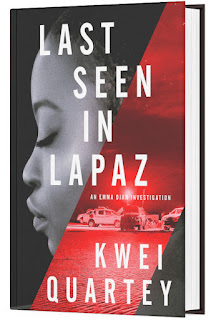
LAST SEEN IN LAPAZ hit shelves on Feb 7, 2023. Originally, it was slated for June 2022 pub date, but another year of Covid severely delayed my trip to West Africa for research.
In LSIL, Ngozi, the daughter of the Nigerian ambassador Ojukwu, runs awaywith her formerly imprisoned convict boyfriend, Femi. After someone spots her in a large suburb of Accra called Lapaz, Ojukwu appeals to Emma and her colleagues at the Sowah PI Agency to find her. Femi’s subsequent and surprising murder raises a crucial question: what’s the connection, if any, between Ngozi’s disappearance and Femi’s death?
Research for LSIL was very wide-ranging and involved some challenges. The novel takes place in these five different countries, in West Africa, involving Nigeria, Niger, Libya, and Ghana, making the plot and sub-plots somewhat complex. For the first time, Emma will travel outside of Ghana to Nigeria, a brand new experience for her (including flying, of which she’s terrified). She will visit Benin City, an ancient city with history that goes back centuries and which is known for brass and bronze sculptures.
Rather than boring you with long descriptions, here are a few annotated, highlight photos for your viewing pleasure.
16th-century, well-preserved Arusha church,
Benin City, Nigeria
How do you fit three grown boys on one motorbike?
Be African. In Africa, nothing is impossible.
With tour guide brothers Evans and Confidence
in front of the National Museum of Benin City, Nigeria
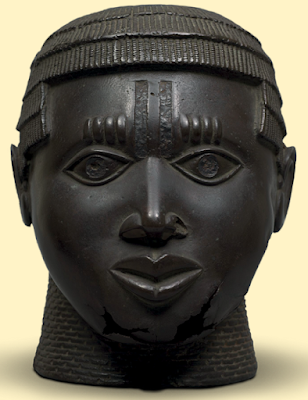
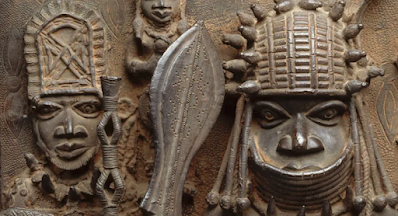
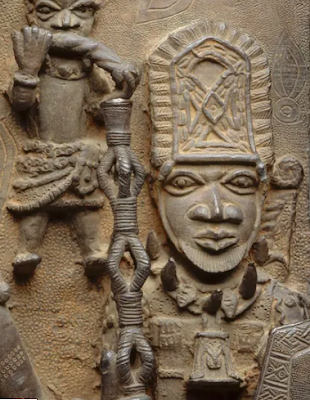
Benin City bronze sculpture, some of which were
looted by the British and Germans.
At the Obasanjo Library. Obasanjo
is an ex-president of Nigeria and one
of the richest men in Africa.
With Evans, Confidence, and Edjin I, a true royal
descendant
But like many cities that are impressive on the service (e.g. Florence, Italy), Benin City has a hidden, dark side. It's arguably Nigeria's ground zero for human and sex trafficking. As Emma investigates, she comes face to face with the brutality of sex work and sex trafficking, both locally and internationally. This is a tough case.
Now, on to Niger. Emma did not go to this country, but it has prominent scenes in the novel. The French government and the US Department of State state that one should not visit Niger unless absolutely necessary because of armed robberies, sectarian fighting, kidnappings, etc. This is an unfair and broad-brush characterization of Niger. Although there are skirmishes with extremists on the borders with Mali and Nigeria, it’s not as if the entire country is engulfed in war. There’s no one on the street with guns, so in that sense, it’s safer than in the US where I could get shot anywhere at all. It’s hypocritical for western countries to lecture developing countries.
Alhassane Ibrahim, my tour guide in Agadez
Hotel Auberge d’Azel--many buildings are constructed
from natural sand and stone, so the scenery can seem
a bit monochromatic
Making friends at the Agadez livestock market--
sheep, cows, camels, donkeys
At the southern edge of the Sahara Desert, Ibrahim prepares
my cot for a very warm night under the stars. I love this pic
for the Pink Panther blanket alone
Ghana was more familiar territory. Here I have two PI friends who guide me to the places featured in the novel. For example, the infamous Alligator “rest-house,” really a brothel
The infamous Alligator Hotel (brothel), featured in LAST SEEN IN LAPAZ
Lapaz, all-night trade including the sex trade
East Legon, an exclusive suburb of Accra where
far less than the 1% live,houses going for up to $1M.
Major location in LAST SEEN IN LAPAZ
At the Legon (Accra) Botanical Gardens, a childhood
Presenting the jacket design for the next Emma Djan Investigation, LAST SEEN IN LAPAZ, to be released in approximately a year. Originally, it was slated for June 2022 pub date, but another year of Covid severely delayed my trip to West Africa for research. The bad timing simply made it unworkable to have the novel ready for the hoped-for date. The publishing schedule works rather like an airport. Every plane has a time slot to push back from the terminal. If the airline misses the slot due to a delay, it must be scheduled for the next available time, and it can’t bump other planes from their spot. All Soho Press 2022 releases are already scheduled, so unfortunately LSIL had to be pushed back to February 2023. I know it’s painful, but I hope to make it worth the wait.
Research for LSIL took place over two months in West Africa, involving Nigeria, Niger, Libya, and Ghana. The novel takes place in these four different countries, making the plot and sub-plots somewhat complex. For the first time, Emma will travel outside of Ghana to Nigeria, a brand new experience for her (including flying, of which she’s terrified). She will visit Benin City, an ancient city with history that goes back centuries. Just one example is the Holy Aruosa Church, founded 1506.
Holy Aruosa Church (Image: Kwei Quartey)
Benin City’s roundabout, called Ring Road or King’s Square, is one of the largest in Africa, and maybe one of the craziest I’ve experienced. Its perimeter is dotted with monuments and statues. In essence, Benin City constantly reminds you of its ancient legacy.
Ring Road, or King’s Square (Image: Shutterstock)
But like many cities that are impressive on the service (e.g. Florence, Italy), Benin City has a hidden, dark side. It's arguably Nigeria's ground zero for human and sex trafficking.
NAPTIP sign in Benin City (Image: Kwei Quartey)
In LSIL, Ngozi, the daughter of the Nigerian ambassador Ojukwu, elopes with her ex-convict boyfriend, Femi. After someone spots her in a large suburb of Accra called Lapaz, Ojukwu appeals to Emma and her colleagues at the Sowah PI Agency to find her. Femi’s subsequent and surprising murder raises a crucial question: what’s the connection, if any, between Ngozi’s disappearance and Femi’s death?
As Emma investigates, she comes face to face with the brutality of sex work and sex trafficking, both locally and internationally. This is a tough case. It’s fair to say that this new adventure has been a challenge for both Emma and me!
Meanwhile, Mom has come to stay with Emma for a while (uh-oh), and Emma takes a new step in her relationship with Courage, her boyfriend.
Here’s hoping for a better 2022 that will have us nicely set for the release of LAST SEEN IN LAPAZ early in 2023.
I could quite easily have titled this blog About time since it would have applied to both stories in the news that have caught my attention.
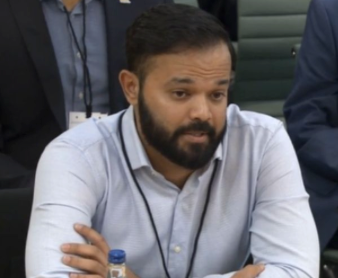
I am not surprised that English cricket is reeling from a series of allegations of racism by well-known cricketer, Azeem Rafiq. It has been a long time coming.
Azeem Rafiq
Azeem Rafiq bowling
Basically Rafiq played for one of the most influential cricket clubs in the U.K., namely Yorkshire. For a number of years, he bore the brunt of racist jokes and attitudes.
In a hearing currently being held on Tuesday by parliament's Digital, Culture, Media and Sport (DCMS) Select Committee, he was asked why he didn't do something about it. I found his answer telling: "For people of colour, to start accepting you're being treated differently, it's very difficult. After that, you're always asking why. Right up to 2017, I didn't believe it. I reported it as bullying. For me to believe I was being treated this way because of my colour, my race, it was difficult for me to digest."
He eventually realised that he needed to do something about it and tried to raise the issues with the club. Nothing was done. Even when a lot of pressure was brought on the club to censure some of its management, nothing was done.
It was then that Rafiq decided he had to pursue the matter further.
Rafiq's evidence to the DCMS Select Committee on Tuesday recounted shocking instances of racist treatment he suffered during two stints at the club from 2008-14 and 2016-18, and even before when, as a 15-year-old Muslim playing local club cricket, he was pinned down and had red wine poured down his throat. Rafiq, who was a hugely promising player, also told the hearing that he believed he had "lost my career to racism".
Cindy Butts, chair of the England and Wales Cricket Board (ECB)-appointed Independent Commission for Equity in Cricket (ICEC), which was established as a result of Rafiq's case, told The Telegraph that more than 1,000 whistleblowers had come forward in the past week to raise potential cases of abuse after the commission issued a "call for evidence" on November 9.
"It is crucial people across the game, many likely inspired by Azeem's bravery, have the chance to be heard," Butts said.
Rafiq's response echoed my own feelings: "The experiences yesterday, it wasn't the first time they heard it," Rafiq said of the ECB. "They've had good notice of it for over a year now. We've heard a lot of stuff from the ECB in terms of PR initiatives and a lot of waffle in my opinion."
I am not optimistic that the entrenched racism is likely to change after the storm has passed, but I can only admire Rafiq's courage in bringing it into the open.
***
On the other hand, I was surprised at an announcement out of Germany.
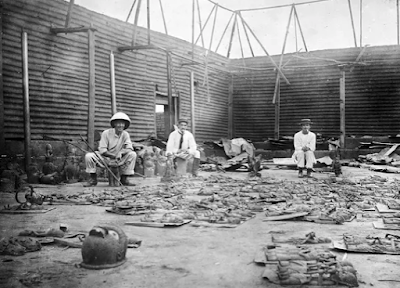
As readers of this blog may remember, I have written often about African (and other) art treasures that have been looted by colonial powers. I have advocated their return to where they were stolen from. However, most museums around the world have continued with their paternalistic, colonial attitudes, arguing that the art may be lost if returned, and so should remain in the West.
Looted
Looters
If it weren't so sad, this attitude would be laughable: that countries motivated by nothing but avarice can accuse countries that had looked after the treasures for hundreds, sometimes thousands, of years, are incapable of doing so again. A bit racist maybe?
However, I felt a glimmer of hope at an article in The Conversation, which claims that Germany has committed to returning hundreds of looted artefacts to Nigeria. There are probably thousands of such items in the country, but returning hundreds is a start. This follows a commitment by the French Parliament to return a couple of dozen of its tens of thousands of items.
And where will they be housed? you may ask.
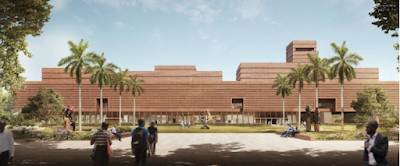
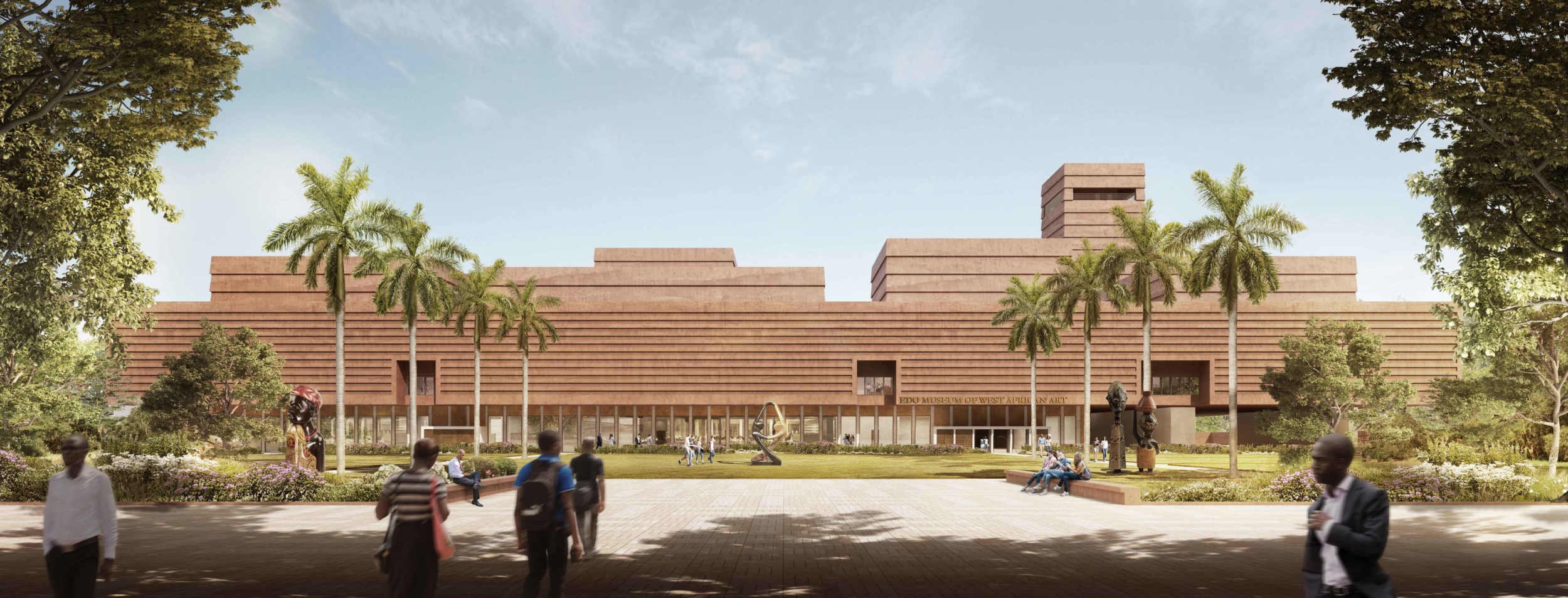
How about here! The Edo Museum of West African Art (EMOWAA), to be built in Benin City. It is being designed by Sir David Adjaye, designer of many spectacular buildings around the world, including the Smithsonian National Museum of African American History and Culture.
The proposed Edo Museum of West African Art
"From an initial glance at the preliminary design concept, one might believe this is a traditional museum but, really, what we are proposing is an undoing of the objectification that has happened in the West through full reconstruction." - David Adjaye
The Adjaye website, adjaye.com, explains the thinking behind the design:
The new EMOWAA draws inspiration from its historical architectural typologies and establishes its own courtyard in the form of a public garden, exhibiting a variety of indigenous flora and a canopy that offers shade – a welcoming green environmen for gatherings, ceremonies and events. The galleries float above the gardens and are articulated by a series of elevated volumes – an inversion of the courtyard typology – within each of which sit pavilions which take their form from fragments of reconstructed historic compounds. These fragments allow the objects themselves to be arranged in their pre-colonial context and offer visitors the opportunity to better understand the true significance of these artefacts within the traditions, political economy and rituals enshrined within the culture of Benin City.
A new dedicated space, EMOWAA will contain the rich, regal and sacred objects of Benin’s past, in a way that allows visitors not just the possibility of “looking in” but “looking out” into the visual landscape of imagining the once historic borders of a restored ancient kingdom.
I can't wait to visit it.
______________________
Upcoming event:
Iceland Noir
The Puffin Panel
Friday 1600 at Kjarval with Will Carver, Lilja Sigurðardóttir & Simone Buchholz, moderated by Karen Sullivan
I'm in Nigeria to research my next novel, LAST SEEN IN LAPAZ, which is about sex and human trafficking (another one of my bright and cheery topics). It takes place in Nigeria, Niger, and Ghana, hence my travel to those three countries--ten days in Nigeria, eight in Niger, and four weeks in Ghana.
Happily or unhappily, depending which way you look at it, Ghana is Shangri-La compared to Nigeria, which is arguably now a failed state. It's quite difficult here, but I'll be gone in a few days while millions remain behind. The abject suffering is what lures Nigerians (primarily) men and women to make a break for Europe via Niger, the Sahara, and Libya. This a tragic trail of tears and blood.
There's an issue with Internet connection--I'm convinced the multinational phone companies in West Africa are price fixing, but that's another story, but the bottom line is I have a limited bandwidth available, so rather than my usual in-depth blogs, I'm just going to post some of my photos and at some point in the future I can perhaps add more detail.
Don't ask what I was trying to prove here
At the moment I'm in Benin City, and as Stan is probably well aware, the Benin Empire is one of the oldest in West Africa with some treasured artwork, sculptures, brass and bronze works, and so on. By the way, Britain still has Benin treasures it looted long ago and refuses to give up, which I find quite disgusting.
Metal works of one of the ancient Benin kings (oba)
With my guides at the National Museum of Benin City
One of the oldest shrines in Benin City
Monument to a soldier
Bronze work--sacrifice to the king (Shutterstock) (in this case, photography in the museum was prohibited, so
I couldn't take the photo myself)
With a young chief (center) who is a direct descendant of the ancient kings
Brass pendant of a chief (this is not a cheap Chinese knock-off!)
If you have any doubts about the authenticity of the pendant, we went to the furnace location where it was made. It's backbreaking work and NOT mechanized in any way.
One of the furnaces to the left
The wood and charcoal furnaces used become red hot as the desired temperature for the brass or bronze work is reached. It's incredibly hot standing near the furnaces.
Now fully vaccinated with the Moderna vaccine, I am once again ready to travel, and this season will be a busy one. Of course, it was impossible to do any travel during 2020 to travel to Ghana to research the third Emma Djan novel called LAST SEEN IN LAPAZ--that's Lapaz, Accra, not La Paz, Bolivia. However, having to stay home in 2020 facilitated my finishing Emma #2, SLEEP WELL, MY LADY in record time, as well as starting on LSIL, which I'm scheduled to turn in to the editor on or before July 1, 2021. The deadline looms large!
Now that I've passed the halfway point writing LSIL, I know which areas of research I need to focus on. In addition to the standard visit to Ghana, I need to travel to Nigeria and Niger, because substantial portions of the novel take place in these countries. You can get an idea of my itinerary from the map below, which is numbered in sequence according to the destinations during the trip.
So, for your reference, I will be in Lagos and Benin City, Nigeria, for ten days in July; Niamey and Agadez, Niger, for eight days; and Ghana for the remaining four weeks or so.
My destinations in West Africa (edited, original image Shutterstock / Porcupen)
I went to Nigeria as a small child but remember little to nothing about the trip, so Nigeria will be a new experience for me, as will Niger. The issue with these two countries is that neither scores high in the safety category. The US Department of State puts Nigeria at its Level 3 warning: reconsider travel; and Niger earns a Level 4: do not travel.
Then, why am I going to these two countries? I considered not doing it, but anyone can do Google and YouTube research. I believe I owe readers a lot more than that. Being "afraid" to travel somewhere is not going to cut it. On the other hand, I'm not throwing caution to the wind. I've secured a guide and escort to be with me at all times in both countries.
The unofficial jacket cover copy will help you understand what I'll be looking into during my travels.
When Nnamdi Ojukwu’s daughter Ngozi elopes with boyfriend Femi, Nnamdi appeals to Emma Djan and her detective agency boss to investigate Ngozi’s whereabouts. Weeks later, Femi is found murdered at his opulent residence in Accra, but Ngozi is still nowhere to be found. How is she connected, if at all, to Femi’s killing? As Emma digs further, she discovers Femi was part of a horrifying network of sex traffickers in Europe and several West African countries. Migrants from Ghana, Nigeria and other West African countries are duped into thinking they are on their way to success and riches in Italy. But once there, they are manipulated into prostitution with little chance of escape.
As successful as Femi has been, he has made a lot of enemies, all of whom have had possible motives to murder him. The question is, which one of them did it? Not only does Emma have to hunt the killer down, she’s in a race against time to find Ngozi—that is, if she’s still alive.
As you can see, LAST SEEN IN LAPAZ tackles the complex and uncomfortable subject of human and sex trafficking with scenes in Ghana, Nigeria, and Niger. The West Africans one sees on TV attempting to cross the Mediterranean, sometimes perishing in the process, depart mostly from the shores of Libya, but they originate primarily from Nigeria, and to a lesser extent from Ghana, Côte d'Ivoire, Burkina Faso, and Mali. Agadez, in Niger, is the legendary transit spot for migrants before they make the hellish trip to Libya across the brutal Sahara desert, which is fraught with danger from armed gangs, the intense heat, and the threat of dehydration. Needless to say, I'm not going to Libya.
Migrants crossing the Sahara packed into a pickup truck (Shutterstock/Torsten Pursche)
Many migrants get stuck in Agadez or Libya because they find they don't have enough money to proceed. Sometimes, it takes months to gather the wherewithal to continue on. During that time, they may be subject to physical and sexual brutality, particularly in Libya. If and when they get to Italy--surprise, surprise. Contrary to the glowing picture painted of making tons of money working in a store or being a travel guide, migrant women discover they will be working as prostitutes for the "madam" who paid for much of their arduous journey. Now they owe her money--lots of it. The madam is often a woman who has been a prostitute herself. The blatant disregard for human life in this trafficking world is quite stunning.
Migratory routes from West Africa to Libya
Regardless of the present, this region of Africa holds a long and storied past--periods of epic achievements in culture and learning on the one hand, but strife on the other. Apart from researching for my novel, I'm hoping to make a connection with aspects of West Africa's history.
In addition, there'll be something new: I will be vlogging my journey, allowing for any slow or absent Internet connections I might encounter in different locales. My vlogs will be on YouTube. It's going to be quite an adventure.


.png)