Showing posts with label Arthur Conan Doyle. Show all posts

Wednesday, September 4, 2024

The Whitewashed Tombs: Reflecting on Medicine, Printing, and Writing as Lifelong Practices

 Wed--Kwei


Writing and Medicine: A Shared Commitment to Lifelong Improvement

As an author and former medical doctor, the release of my latest novel, The Whitewashed Tombs, on September 3, 2024, feels like a moment to reflect on the connection between medicine and the practice of writing. Both professions, after all, share a dedication to continual improvement. It's telling that medicine is one of the few professions referred to as a "practice." We don’t say that pilots are engaged in the "practice" of flying or that civil engineers practice infrastructure design. 


Yet for doctors—and writers—there’s an understanding that there’s always something more to learn, always a way to grow and improve, no matter how experienced one becomes.

This idea of continual refinement is fundamental to medicine, where even the most seasoned doctors are constantly honing their skills, learning new techniques, and updating their knowledge. Similarly, a writer is always flawed in their craft. Each novel, short story, or article is a chance to push boundaries, experiment, and get closer to that elusive goal of writing the perfect piece—just as each patient presents a unique case for a doctor, offering a new opportunity for diagnosis and treatment.


Narrated by the incomparable Bridgerton megastar, Adjoa Andoh


The Intersection of Medicine and Writing: From Doyle to Crichton

Some of the most celebrated authors in history began their careers in medicine. Sir Arthur Conan Doyle, creator of the brilliant detective Sherlock Holmes, was a physician before he turned to writing. His deep knowledge of medicine influenced Holmes' methodical approach to solving crimes, similar to the diagnostic process. Robin Cook, the master of the medical thriller, gave us gripping novels like Coma, drawing on his medical training. A Harvard-educated doctor, Michael Crichton translated his expertise into unforgettable science fiction like Jurassic Park and The Andromeda Strain. Incidentally, it is the legend that Crichton wrote his first novel while an intern, which is baffling.


Then there's Somerset Maugham, a doctor-turned-author, who explored the human psyche with the precision of a surgeon. More recently, Abraham Verghese, author of Cutting for Stone, bridged the gap between medicine and literature, crafting a novel that intertwines healing with storytelling. The Russian writer Anton Chekhov was another doctor who merged medicine and writing, famously saying, "Medicine is my lawful wife, and literature is my mistress." Each of these authors approached writing with the same meticulous care they brought to medicine, knowing that both fields require attention to detail, a deep understanding of the human condition, and the ability to communicate complex ideas clearly and effectively.


Crime Fiction and Medical Diagnosis: A Symbiotic Process

The parallels between writing crime fiction and practicing medicine are more profound than one might think. In crime fiction, solving a mystery is much like diagnosing a puzzling disease. Just as a doctor must question a patient to gather a medical history, a detective questions witnesses to understand the crime. Both are looking for clues—whether it’s symptoms of a disease or evidence at a crime scene.


Once the basic facts are gathered, the doctor performs physical exams or orders lab tests, much like a detective scours the crime scene for overlooked details. And just as some medical findings can be misleading, red herrings can distract detectives and readers in a mystery novel. Finally, the diagnosis process can be compared to a detective’s task of compiling a list of suspects. Just as a doctor works through a differential diagnosis, narrowing down possible illnesses, the detective eliminates suspects until they find the true culprit.


In The Whitewashed Tombs, these parallels between medicine and detective work are more than thematic—they are the story’s backbone. Emma Djan’s process of solving the murder mystery mirrors the diagnostic steps taken by a doctor, with twists and turns that reflect the complexities of both medicine and crime-solving. Both fields require intuition, logic, and the ability to see beyond the obvious.


Printing, Writing, and Medicine: The Evolution of Craft

Finally, as we celebrate the release of The Whitewashed Tombs, it’s also worth reflecting on the printing process—an art form in itself. Printing, like writing and medicine, has evolved continuously, with each advancement representing a step forward in the quest for accuracy, clarity, and beauty. Just as doctors refine their techniques and writers hone their prose, printers have perfected their craft over centuries to bring stories like mine to life in the most vivid and impactful way possible.


The connection between these fields—medicine, printing, and writing—is the pursuit of mastery, the desire to do better with each attempt. Like medicine and printing, writing is a practice. With The Whitewashed Tombs, I hope to take readers on a journey of discovery, where the truths are not always what they seem, and uncovering them is as intricate and rewarding as any medical diagnosis or detective case.


Conclusion

I continue refining my craft with each new story I write, just as doctors refine their skills. One reviewer recently described my writing as “clunky” in parts, and rather than taking offense, I agree! As I have always strived to be a better physician, I still strive to make my writing more elegant and refined with every novel. The Whitewashed Tombs represents a milestone in that ongoing journey, intertwining medicine and crime-solving to bring readers a story filled with intrigue, complexity, and, ultimately, revelation.


As The Whitewashed Tombs hits the shelves September 3, 2024, I invite readers to dive into this mystery and explore the deep connections between these lifelong practices.


Thursday, October 20, 2022

A surprise deep in the ground

 Stanley - Thursday

Twenty-five metres (eighty feet) underground on the University of Minnesota's West Bank is the largest collection of Sherlock Holmes material in the world. 

Sherlock Holmes collection librarian, Tim Johnson in the stacks

Why it is in Minneapolis and not in Edinburgh, where Arthur Conan Doyle was born, is not a mystery. However, it is an interesting story.

The Baker Street Irregulars is a literary society dedicated to all things related to Sherlock Holmes. The name comes from the group of people Holmes used to gather intelligence and convey messages. It was founded in 1934 by American journalist Christopher Morley and continues to thrive today.

The Minnesota branch of the BSI was started in 1948 by a former University of Minnesota librarian, E. W. McDiarmid, and several faculty members. 

The first small collection of Holmes material was purchased in 1974, including some early periodicals as well as first editions.

It was an offshoot of Minnesota BSI group that persuaded the widow of Dr Philip Hench (the discoverer of cortisone) of the Mayo Clinic to donate her husband's amazing Holmes collection to the university in 1978. Although relatively small, it had some exceedingly rare material, such as four of the extant 34 copies of  Beeton’s Christmas Annual that contained A Study in Scarlet, Sherlock’s first adventure.

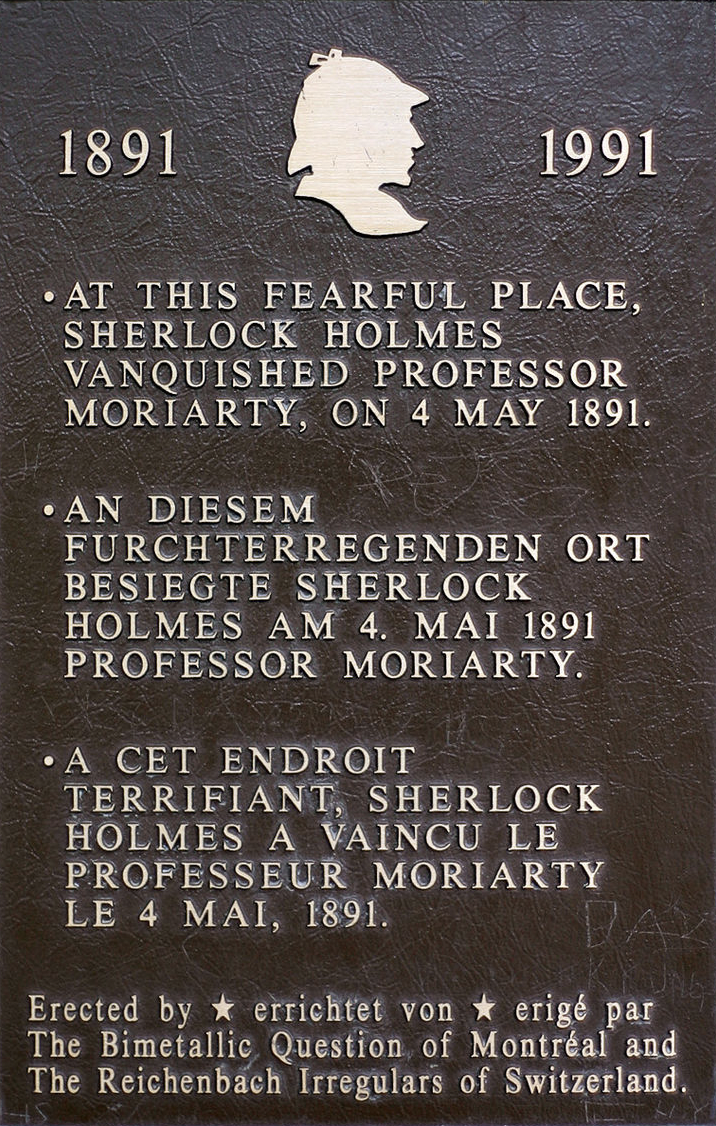
It was Dr Hench who persuaded the Swiss government to install a plaque near Reichenbach Falls, where the evil Professor Moriarty had disposed of Holmes in 1893’s The Final Problem, himself dying in the process. (After a public outcry at his demise, Holmes managed to rescue himself to appear in future ventures.)

Reichenbach Falls

The biggest acquisition came in the 1990s, when the university persuaded a collector in Santa Fe, New Mexico, John Bennett Shaw, to part with his massive, all-encompassing collection, including such diverse objects as rare posters, license plates, and street signs. With that, material started to flood in.

Shaw encouraged  ex-librarian McDiarmid and local newscaster and Homes enthusiast, Don Shelby, to talk to Edith Meiser, who had written all of the Holmes  radio dramas of the 1930s and 1940s. After quizzing them about their knowledge of the Holmes works, she agreed to part with her unique collection of vinyl recordings.

Today, the collection has over 60,000 items, from which a new touring exhibition, Sherlock Holmes: The Exhibition, has been curated, which will open this month at the Minnesota History Center.

I hope I have a chance to see it before I head to warmer climes.


(My thanks to Steve Marsh of the Mpls.St.Paul Magazine whose article Minnesota Has the World's Largest Sherlock Holmes Collection of 10/16/2022 inspired this blog.)


Friday, August 30, 2013

Part Four: The Human Crocodile

The Human Crocodile

When a doctor goes wrong he is the first of criminals. He has the nerve and he has the knowledge. Palmer and Pritchard were among the heads of their profession.’ – Arthur Conan Doyle, The Adventure of the Speckled Band (1892).   


'Trust me, I'm a doctor!'
'Not with that comb over I wouldn't !'

On Friday 28th July 1865, the last ever public execution to take place in Scotland was performed on Glasgow Green. Around one hundred thousand spectators were present to see Edward William Pritchard, an English doctor, dangle at the end of a hangman’s noose. Pritchard blamed a ‘terrible madness’ for his actions yet it was clear that the murders had been carefully planned.

Pritchard was born in Hamsphire in 1825, the son of a captain in the Royal Navy, became a naval surgeon who served on HMS Victory and in 1846 a member of the Royal College of Surgeons. He and his wife had three daughters and two sons before they moved to Glasgow in 1860. Pritchard had left his previous job in Filey in Yorkshire, followed by questions of debt and impropriety towards female patients. There, he had been described as ‘fluent, plausible, amorous, politely impudent and singularly untruthful’.
In 1860, having moved to Glasgow, his applications to join the Faculty of Physicians and Surgeons of Glasgow were rejected – perhaps because of doubt regarding his qualifications – it turns out  his diploma had been bought from the University of Erlangen in Germany. One of his many  detractors commented ,"He spoke the truth only by accident.” For example, it seems he used to claim to be a personal friend of great Italian liberator Garibaldi and carried a walking cane with the inscription: 'Presented by Gen. Garibaldi to Edward William Pritchard' as some kind of proof. He also gave lectures on his travels, describing how he hunted “the Nubian lion on the prairies of North America," which is a great feat of accuracy if you think about it geographically. Once he moved to Glasgow he had the strange habit of ‘walking down the street, handing postcards which contained his own picture to people he thought worthy’.
                                                           
But in 1863, a servant girl died when fire broke out at the Pritchard home in Berkley Terrace which lies round the corner from Madeline Smith’s house.  The procurator fiscal held an enquiry; why did a young healthy girl stay in bed reading while her bedroom went on fire? The answer they failed to come up with was that she was dead already. Pritchard received the insurance money and used it, and a loan from his mother-in-law to move the family to a large house in Sauchiehall Street. The mother-in-law was a terrible judge of character and really admired her son-in-law.

The vacancy for a housemaid was filled by a 15 year old from Islay named Mary McLeod.  Pritchard immediately started an affair with her, later terminating her pregnancy and promising to marry her should his wife die before him.
                                                               
                                                                        The unfortunate wife.

At the same time, Mrs Pritchard (Mary Jane) became ill in October 1864 in the Sauchiehall Street home. Her husband and physician declared it ‘gastric fever’ and another two doctors concurred. Mrs Pritchard briefly recovered while visiting her parents in Edinburgh only to fall ill again upon her return to Glasgow… and her husband. Her concerned mother, Mrs Taylor, came through from Edinburgh to help nurse her only to contract the same ‘illness’ on arrival and die on 25th February 1865. In her will she left £2500 to her daughter who promptly succumbed to her illness on the 17th March. A Dr Paterson refused to sign the death certificates because of his suspicions regarding the illnesses. So Pritchard signed them himself. 
Dr Paterson did not speak out re his suspicions, later testifying at Pritchard’s trial that he had no doubt that Mrs Pritchard was being poisoned by her husband but that medical etiquette meant that it was impossible for him to do anything about it. Instead there was an anonymous letter sent to the procurator fiscal asking for some attention to be brought to the case.
                                     
                                             
Edward Pritchard was devastated by the loss of his wife. While through in Edinburgh preparing for the funeral, he pleaded for the coffin lid to be removed one last time and with a display of fervent feeling, he tearfully kissed the lips of his beloved Mary Jane. It was an act that later gained him the name ‘the Human Crocodile,’ for his crocodile tears.
On his return to Glasgow Queen Street, he was met by a detective superintendent and accused of her murder.
The hearing took place over five days and it took the jury less than an hour to declare Pritchard guilty. The Taylors were still supportive of Pritchard until Mrs Taylor’s body was exhumed and post-mortem showed large quantities of antimony in both bodies. Records proved that Pritchard had bought large quantities of poison over the previous few months - more antimony than the rest of the doctors in Glasgow combined. His motive was clear – his obsession with the servant girl. One paper reported: "No one who saw the intelligent, thoughtful and mild-looking individual seated in the dock on the first morning, could be prepared for anything like the consummate villainy and diabolic cruelty which each day brought to light ... the whole murderous plot." His fondness for young ladies - especially household serving maids – earned him his other nickname; The Poisoning Philanderer.
His only defence was to try and shift the blame to the servant girl, Mary McLeod – a claim which he later withdrew. That did not stop him from calling two of his children to the witness stand, aged fifteen and eleven, to tell the court how much their father had loved their mother. Pritchard cried as the children stood in the witness box.
                                                        
But it was the evidence of his affair with young Mary that ripped his credibility to shreds (not to mention the poison in the dead bodies). It was the beginning of the end for the devilish doctor and despite protestations of innocence, his appointment with death was just weeks away. He was convicted of the murders of both women, he was dispatched to the gallows.
He made several confessions, eventually saying: ‘The sentence is just, I am guilty of the deaths of my mother-in-law and wife. I can assign no motive beyond terrible madness. I alone – not Mary McLeod – poisoned my wife.’ Huge crowds gathered outside the court as he was taken away and Pritchard theatrically bowed to them.
Edward William Pritchard was hanged at 8am on 28th July 1865, his body buried in the South Prison’s Murderer’s Graveyard where plots are only identified by the initials of the dead. Many years later, during building work for the High Court, workmen found a pair of shoes under a stone marked 'EWP'. These were Pritchard's patent leather shoes, perfectly preserved, which he had worn to the scaffold. One of the workmen took the shoes and sold them in a nearby pub.

Caro GB 30th August 2013


Friday, August 23, 2013

Part Three Oscar Slater; The Innocent Man

Oscar Slater
                                           
Glasgow, 1908. Three shopping days before Christmas. Mr Arthur Montague Adams was tying up a Christmas present when he heard a banging noise coming from the flat above. Marion Gilchrist lived upstairs, an 83 year old lady who had made a prior arrangement with the Adams family downstairs – I’ll knock on the floor if I am in trouble.
                                                 
They were uncertain whether this was the signal and Mr Adams, a flautist in the Scottish Orchestra, was sent up to check. He knocked, didn’t receive an answer and went downstairs only to be sent back up by his sister. He met the old lady’s young servant, Nellie Lambie, on the close stairs. She had just popped out for a newspaper and she unlocked the door for Adams to check inside the flat. As they entered the hall, a man appeared from the bedroom. He rushed past them and raced down the stairs, out into the street. It was noted by Mr Adams that Nellie Lambie didn’t seem surprised and he got the impression that she knew the man. That fact was ignored by the following investigation (the fact that a man had got into the flat at all suggested Marion Gilchrist both knew and trusted him). It’s also worth remembering that Mr Adams was very short sighted, and he had left his specs in the flat downstairs. They did agree that the man had the appearance of a ‘gentleman’.
                                      
The pair then found Marion lying in the dining room, a rug thrown over her head and blood everywhere. Mr Adams rushed down the stairs trying to follow the mysterious man but the street was empty. The old woman had been battered around the head and was still alive, but had passed away by the time the doctor arrived. Dr Adams, unrelated to Mr Adams, concluded that the blood-stained chair (complete with handprint) at her side was the murder weapon. Dr Adams was not called as a witness in the trial and had no further bearing on the case. Quite a few relevant witnesses were not called to give their assistance in the case which is one of the reasons why the Oscar Slater case is regarded as one of the biggest miscarriages of justice ever seen in this country, and is a prime example of why every accused needs a robust defence.
                                         
Marion Gilchrist had a good collection of jewellery over £3000. It was sewn into the curtains,  wrapped in the bed linen, secreted all over  the flat.  But there was only one piece missing; a diamond brooch. Statements were taken from Nelly Lambie (didn’t get a clear look at the man but ignored the fact that her initial reaction was she knew him) and Mr Adams (wasn’t wearing his spectacles). Further investigations brought to light a fourteen year old messenger girl Mary Barrowman who had been in the street and said she saw a man flee the scene.  Her description was totally different to that of Lambie/Adams and the police decided they were looking for two different men. When that didn’t fit their suspect, they mashed the two descriptions until they got something that did resemble their suspect.
                                                        
The newspapers were very keen to get the murderer, a respectable old lady had been brutally murdered while her servant slipped out for ten minutes. They published a description of the man they were looking for and asked all pawnbrokers to look out for the brooch.
 A bicycle dealer called McLean said a member of his club, a German Jew called ‘Oscar’ had been trying to sell a pawn ticket for a diamond brooch. The police followed this lead but were upset to find the brooch was not the same one and the one in question had been pawned on 18th November. However, they were delighted that Oscar Slater and his mistress had already left Glasgow for Liverpool to board the Lusitania and sail to New York. He was actually running away from his wife but the cops decided this was a flight from justice.
                                         
                                                                    Oscar Slater
From then on a series of events occurred that if they appeared in a crime novel would have the editor running out of red ink saying this would never happen!  Oscar’s picture was printed all over the newspapers, stories of his flight from justice. He was arrested in New York and all were satisfied that the dastardly deed had been done by a foreigner. The police sent all three witnesses Adams, Barrowman and Lambie to  New York to identify the man even though Adam’s didn’t have his glasses and admits he did not have a good view, and as Barrowman’s and Lambie’s description were so different, they could not possibly apply to the same man. To solve that problem they put the two young girls in the same cabin for the 12 day journey. At the trial they said they never discussed the case! At the ID, a cop pointed at Slater and said ‘is that the man?’  So that was unbiased…..not!
(Later in court Lambie and Barrowman both identified him with confidence, but Adams was still reluctant.)
Slater was extradited. He claimed he was innocent and seemed genuinely happy to get back to Glasgow to clear his name.
Oscar knew so little about the crime he got the date wrong when he gave his alibi. He not only had a strong alibi for the night the murder happened, but also for the night he thought it happened. His only criminal record was a pound fine for being in a fight and a further fine of five shillings for being found in a gambling club. His so called flight from Glasgow had been planned for a long time. Slater didn’t change his behaviour one iota after the murder, going about his usual routine for the Christmas period, sending gifts home to his parents.
On that basis, he was found guilty of murder and sentenced to hang on Thursday May 27th. Slater proclaimed his innocence from the dock. He had been so sure of acquittal he had stayed sitting in the dock and just waited for the jury to come back. One hour ten minutes later they did- with a guilty verdict. Oscar and others in the court were stunned. In that jury (15 in Scotland) nine voted guilty, five not proven, one not guilty. Petition tables were set up on street corners in Glasgow city centre,  20 000 signatures were gathered
Stories started to come out (now well documented) that other witnesses who could prove Slater innocent, were never brought to give evidence. But the death sentence was lifted, Oscar was sentenced to life imprisonment.
 The ‘Trial of Oscar Slater’ was published in 1910 but the prison authorities removed William Rougheads intro when Slater got hold of a copy. He no doubt read the reviews. An injustice had been done, Arthur Conan Doyle got involved.   

                                                        
                             DL Trench, one of the best murder detective Scotland has ever had

But a Glasgow cop was quietly working away behind the scene and become the real hero of the piece. John Trench had attended the initial incident. He deeply suspected that Nellie Lambie had known the man who ran past her, and that it was not Oscar Slater. (Nellie’s boyfriend was Slater’s favourite suspect but it was not him.) As detective lieutenant Trench, he was sent to a murder near Dundee in 1912 and noticed the MO was exactly the same as the Marion Christie case. Trench found documents that had not been made available to the original trial but as he gained evidence of police malpractice, he himself was sacked and discredited. When he died he left the papers to his widow with instructions to pass them on to Conan Doyle thus setting in motion a chain of events that led to some pertinent questions about the Slater’s case to be put in front of the Scottish Secretary of State. Did any witness to the identification on the night of the murder name a person other than Oscar Slater?  Were the police aware this was the case, if so why was the evidence not forthcoming in court? Did Slater fly from justice?
                                               
On June 8th 1928, the appeal was heard and the verdict was quashed on a technicality. Slater wanted a ‘not guilty’. He never got it.
He moved to Ayr, got married and went on to live a happy life. After nearly twenty years in jail for a crime he did not commit.

There is now a John Thompson Trench prize for Civil Law at Glasgow University in honour of the policeman who did so much to bring the injustice to light.