Showing posts with label Archaeological Discovery. Show all posts

Saturday, August 13, 2016

A Greek Skeleton Out of the Closet.


Jeff—Saturday

I bet there are very few of us who don’t have a metaphorical skeleton or two hanging around in some closet. Just look at the US Presidential candidates.  Those two have skeletons dancing all over the place. Though to be fair, one candidate looks to have far more skeletons haunting it than the other, while the other seems hell bent on becoming a skeleton to haunt us all.

I’ll let you work out the appropriate labels for yourselves.

Prescinding from any further discussion of politics, I think we can all agree it’s truly rare when a “skeleton in the closet” turns out to actually exist.

Well, once again Greece has astounded the world.

This week, world newspapers reported on an archaeological find disclosed by Greece’s Minister of Culture. The headline in Ekathimerini—Greece’s equivalent of The New York Times—read, “Ancient Teenage Skeleton Unearthed on Mountaintop Could Confirm Darkest Greek Legend.”  Here’s a photo of the discovery.
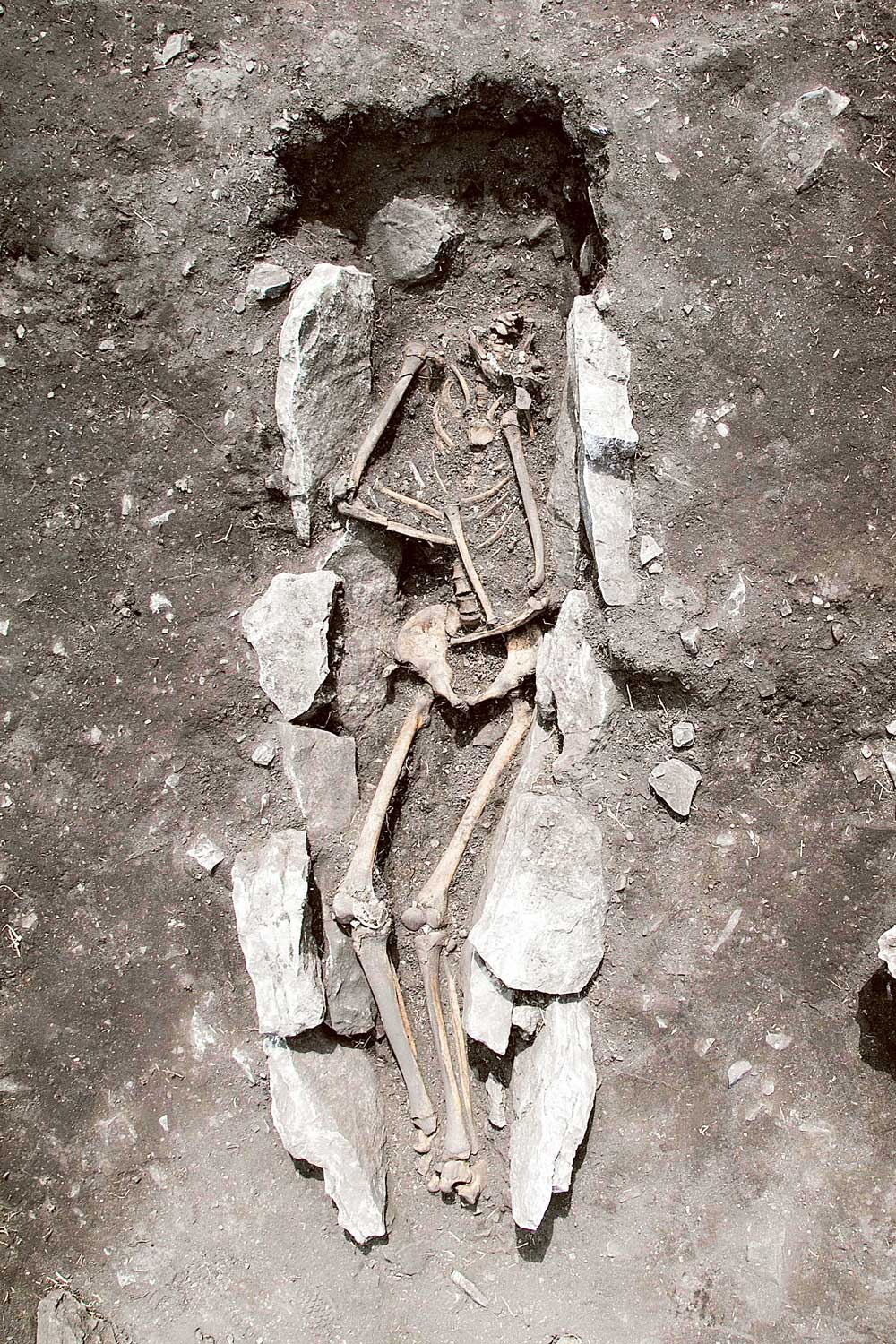

That headline caught my eye, because up until that moment I thought the darkest Greek legend was being written this year on Mykonos.  Just goes to show what I knew.

That discovery undoubtedly will further fuel a long raging debate over the role of classical writings in evaluating archaeological evidence.   And here’s why (quoting from Ekathimerini):

“Excavators say it’s too early to speculate on the nature of the teenager’s death but the discovery is remarkable because the remote Mount Lykaion [in central Peloponnese] was for centuries associated with the most nefarious of Greek cults: Ancient writers — including Plato — linked it with human sacrifice to Zeus, a practice which has very rarely been confirmed by archaeologists anywhere in the Greek world and never on mainland Greece.”


A dig site on Mount Lykaion

Human Sacrifice in Greece! Wow, imagine all the stories that will spawn. Forget Game of Thrones and vampires, a whole new genre of Hellenic Horror fiction awaits! 

This is not the first time archaeologists have unearthed what’s been claimed to be evidence of human sacrifice here, but alternative explanations always seemed to spring up to send those theories off into the shadows, and supporting literary references were dismissed as just that—fiction; even though archaeologists such as the legendary Heinrich Schliemann used Homer and Virgil as engines for some of his most spectacular discoveries. 


Heinrich Schliemann
What makes this week’s announcement so remarkable is that the literary and physical evidence appears to strongly support one another. 

According to legend, a boy was sacrificed with the animals and all the meat was cooked and eaten together. Whoever ate the human part would become a wolf for nine years.

“Several ancient literary sources mention rumours that human sacrifice took place at the altar, but up until a few weeks ago there has been no trace whatsoever of human bones discovered at the site,” said excavator David Gilman Romano, professor of Greek archaeology at the University of Arizona.

“Whether it’s a sacrifice or not, this is a sacrificial altar ... so it’s not a place where you would bury an individual. It’s not a cemetery,” Romano told The Associated Press.

Zeus on His Altar on Mount Lykaion (Giovanni Tiepolo)

For those of you interested in reading more on the discovery here’s a link to the AP story appearing in The Guardian.

If your interests run more to human sacrifice of the political sort, just turn on any television, anytime, anywhere.

I’m off to find a legend of my own.  She arrives Monday. :)


—Jeff

Saturday, August 16, 2014

Alexander The Great's Triumphant Return To Greece. Maybe.

Amphipolis, Greece/AFP photo

Here’s just a sampling of headlines from around the world this week that have Greeks literally jumping for joy in robust pride:

“Vast Tomb Unearthed in Northern Greece.”

“Important Ancient Tomb Discovered In Greece Dates Back To Era of Alexander The Great.”

“Massive Alexander-era tomb unearthed in Greece—but who’s buried in it?”

“Mysterious 2,300-year-old tomb found in Greece.”

“Mystery over massive Alexander-era tomb unearthed in northern Greece.”

Those headlines give you the gist of this still developing story, one that undoubtedly will keep more than archaeologists on the edge of their seats for quite some time. 

Photo: Alexandros Mihailidis/AP

The tomb won’t be opened until the end of August, but already some are calling it the archeological find of the century; some view it as an astrological demonstration of the power of Leo in Jupiter—this being the Zodiac month of Leo, the lion being the guardian of tombs, and Jupiter the Roman equivalent of Zeus; and virtually all Greeks see it as an “up yours” to the Former Yugoslav Republic of Macedonia (FYROM)’s claim to the name “Macedonia” and appropriation of the legacy and symbols of Alexander the Great as its own.


Heavy stuff, with a lot more expected to come, not the least of which are anticipated breathtaking hoards of gold in keeping with the way things were done back in those days.  That’s also one explanation for round-the-clock police protection at the site.

Treasures from nearby tomb of Philip II of Macedon at Vergina

The news stories covering the find are generally the same, and things are so preliminary at this point (and the mood so ebullient) that it’s hard to get any more solid facts from folks on the ground than what’s in the newspapers. 

I guess they’re mindful of what US television newsman Geraldo Rivera found on live TV in opening the subject of the hugely hyped television special, “The Vaults of Al Capone” (1987).  Hint: Shut your eyes and what do you see?


I have it on good authority though, that they’re hoping to find a blood relative of Alexander the Great in sufficiently good condition to yield up a DNA sample, and thus open up a whole new world of exploration and explanation. 

Hmm, “Be careful what you wish for” comes to mind.

Anyway, here’s one news story on this truly extraordinary find as reported by Nick Squires in The Telegraph:

Archaeologists uncover entrance to important tomb from reign of warrior-king Alexander the Great.
Archaeologists in Greece have discovered a vast tomb that they believe is connected with the reign of the warrior-king Alexander the Great, who conquered vast swathes of the ancient world between Greece and India.

The tomb, dating to around 300 BC, may have held the body of one of Alexander's generals or a member of his family. It was found beneath a huge burial mound near the ancient site of Amphipolis in northern Greece.

Antonis Samaras, Greece's prime minister, visited the dig on Tuesday and described the discovery as "clearly extremely significant."

A broad, five-yard wide road led up to the tomb, the entrance of which was flanked by two carved sphinxes. It was encircled by a 500 yard long marble outer wall. Experts believe a 16ft tall lion sculpture previously discovered nearby once stood on top of the tomb. [Ed. Note: The Lion of Amphipolis was unearthed a century ago five kilometers away.]

The Lion of Amphipolis, 4th Century BCE

They ruled out the possibility that the tomb could be that of Alexander - the emperor is believed to have been buried in Egypt after he died of a fever in Babylon in 323BC.

The tomb was found in Greece's northern Macedonia region, from where Alexander began to forge his empire.

"It is certain that we stand before an especially significant finding. The land of Macedonia continues to move and surprise us, revealing its unique treasures, which combine to form the unique mosaic of Greek history of which all Greeks are very proud," said Mr Samaras.

Archaeologists, who began excavating the site in 2012, hope to fully explore the tomb by the end of the month to determine exactly who was buried there. The site is being guarded by police while archaeologists continue their excavations.

Photo: Alexandros Mihailidis/AP

Catherine Peristeri, the head of the ancient monuments department in northern Greece, said some of Alexander's generals and admirals had links to the area around the ancient city of Amphipolis. It was also the place where his wife, Roxana, and son, were killed in 311BC by Cassander, a Macedonian general who fought over the empire after Alexander the Great's death.

Situated about 65 miles northeast of Greece's second-biggest city, Thessaloniki, the tomb appears to be the largest ever discovered in Greece.

It probably belonged to "a prominent Macedonian of that era," a culture ministry official told Reuters.
The tomb, which consists of white marble decorations and frescoed walls, was partially destroyed during the Roman occupation of Greece.

Amphipolis was founded as an Athenian colony in 437 BC but conquered by Philip II of Macedon, Alexander's father, in 357 BC.

Alexander the Great single-handedly changed the history of the ancient world with a lightning pace of conquest. Born in Pella, the ancient capital of Macedonia in 356 BC, he was educated by the philosopher Aristotle. When his father was assassinated in 336 BC, Alexander set about consolidating his hold on the kingdom of Macedonia before embarking on the conquest of the powerful Persian Empire.

He led his army to victories across Asia Minor, Syria and Egypt, establishing an empire that eventually stretched from the Danube to the frontiers of India.

Hmmm, sounds like there’s a book in here somewhere.


Jeff—Saturday