Sunday, April 5, 2026

One Thin Dime

 Sara E. Johnson, 1st Sunday

I mentioned in a previous post that I enjoy teaching my Exploring Mysteries class. One session is on the history of mysteries, and in researching that wide and deep topic, I learned about dime novels and how they caught on like a California wildfire and broke ground for many of the genres we enjoy today.

Dime novels debuted in the United States during the Civil War era. Named for their cheap price, they began as lurid Westerns, and later branched to romances, adventures, and detective stories. Their straightforward plots combined sentimentality with violence and introduced readers to new vistas much like books set in a foreign locale do for me.


The first known dime novel, Malaeska, the Indian Wife of the White Hunter by Ann S. Stephens, was published by Irwin and Erasmus Beadle and Robert Adams in 1860. It’s a tale of an interracial romance between a white hunter and Malaeska, a Mohawk woman. Their son is raised in the white culture. When the son learns of his parentage, his reaction is melodramatic, a common element of dime novels. Here’s the section when the son learns of his parentage: "Great God!" he almost shrieked, dashing his hand against his forehead. “No, no ! it can not — I, an Indian? a halfblood? the grandson of my father’s murderer? Woman, speak the truth; word for word, give me the accursed history of my disgrace.”

(No surprise: dime novels perpetuated racist stereotypes of Native Americans, Blacks and Asians.) Stephens was paid $250 for Malaeska. It reportedly sold over 300,000 copies. You can read it in its entirety; it is in the public domain.


Civil War soldiers tackled the boredom of camp life by reading and trading dime novels. According to one book historian, dime novels were “sent to the army in the field by cords, like unsawed firewood.”


Prior to the Civil War, reading was an upper class or upper-middle class pastime. Books were expensive. In the 1850s, the average book cost $1 to $1.50. The creation of dime novels slashed those prices so that virtually anyone could afford to have their nose in a book while, at the same time, literacy rates were growing.

Dime novels were mass produced on cheap paper. They averaged one hundred pages and were small: 6.5 x 4.5 inches, perfect to fit in a pocket or pocketbook. To keep costs low, the books were printed on paper similar to newsprint. Any dime novel you come across in an antique store is likely to have brittle or crumbling pages. The print was often fuzzy and with odd space breaks.


Updated shipping methods – though no comparison to Amazon’s next-day delivery – brought the dimes to almost every newsstand or dry good store. People – largely of the working class – went crazy for them. In the five years following Malaeska, the Indian Wife of the White Hunter, Beadle and Adams published more than five million dime novels. ‘Books for the millions’ was proclaimed on the covers. Dartmouth Libraries said, “Enormously popular and critically maligned, the dime novel was one of the first forms of mass culture in the United States.”


Detective stories soon replaced Westerns. One of the earliest was The Two Detectives; or, The Fortunes of a Bowery Girl. This was actually a nickel novel because it was short. The Bowery Detective series focused on gritty city crime. A funny aside: Typical dime novel detectives were old. Their names often reflected their advanced ages: Old Bull’s Eye, Old Sleuth, Old Neverfail, and Old Spicer.


Women became writers and readers of dime novels. The plots that attracted them dealt with romance and marriage. Many readers were ‘working girls,’ so a repeated story line was a love between a working class girl and a noble. (Sound familiar?) All for Love of a Fair Face, The Story of a Wedding Ring, The Unseen Bridegroom, and The Charity Girl are titles of dime novels marketed for women.


The dime novel’s counterpart in the United Kingdom was the penny dreadful. Subjects were Gothic – hence the name – and included tales about vampires, highwaymen, murderers, and ghosts. They were also know as penny bloods, penny awfuls or simply ‘bloods.’


The years 1870 to 1900 were the dime novel’s heyday. Not many dime novels were printed after World War I. Pulp fiction magazines nudged them aside and going to the ‘motion pictures’ was more exciting and cheaper than one thin dime.


Dime novels are a thing of the past. Today, mass-market paperbacks face a similar extinction. Remember how you could pick up a copy of Jaws or Carrie at the airport or drug store for a cheap price, and slip into your pocket? Mass-market paperbacks, like dime novels, were touted as making reading accessible for the masses, including me. Trade paperbacks, hard covers, Ebooks, audio books, and Netflix are dancing on their graves.

Which mass-market paperbacks do you have yellowing in your book case? Happy reading and I'll see you next month.

Sara Johnson, 1st Sunday 

Saturday, April 4, 2026

Thirteen Years Ago Today, 'Here's Looking At You, Babe' Played Out for Real.


Saturday - Jeff

Thirteen Years ago today I wrote a post for MIE detailing a seminal occurrence in my life--the birth of a grandchild.  As my family prepares to celebrate today's thirteenth anniversary with reminiscences of the years of wonder and joy we've reaped from that miraculous event, I thought it appropriate to reflect back on memories of that day---at least as I recall it---by republishing my time-line scribblings as the reporter on the scene:

It was a 5:00AM Thursday morning.  Ugh, what an ungodly hour for an alarm to go off.  But if we hadn’t driven in last night from my farm in western New Jersey it would have been a 3AM wakeup.  Hmm, a quick check of the emails—what else does one do first thing in the morning?  It’s from a friend on Mykonos: “Call me. It’s important.”  My guess is it’s in response to my request for information about an esoteric Greek funeral practice tied into my new Andreas Kaldis novel.

I reply, “Am on way to the hospital.  Will call later.”

There’s another message from the same friend. “Call me after the baby is born.”

After the baby is born. Wow.  Seeing the phrase in black and white (pixels) makes an impact.  My baby girl is having her own baby this morning.  Her first.  It’s set for 7:30AM. 

I’ve been so busy this week cutting away the remaining trees downed by hurricane Sandy that I haven’t had time to work on my post for Saturday.  And I know that I won’t be able to focus on a “Greek piece” this week.  But come to think of it, with all the time Greeks spend obsessed with the “fixins” for babies, perhaps it might be a refreshing change to focus on the back end of the courting process.  My sort of in real time existential take on “Waiting for Baby.”


5:45AM.  We’re headed north to Huntington Hospital. It’s close by the Long Island Sound, not far from where we’re staying just south of the Long Island Expressway.  Officially the LIE is Interstate 495, Long Island’s commuter backbone, known affectionately to those whose lives are tethered to it as “the Long Island Distressway” or “The World’s Longest Parking Lot.”  I remember living out this way in the early 70s.  Beautiful place, offering a wonderful life…if you don’t mind rush hour commutes into NYC. 

6:00 AM.  Made it to the hospital and found the Labor and Delivery Waiting Room.  Impressive name.  Too bad the green carpeting and mismatched green-brown furniture doesn’t cut it. But who cares about the décor—which probably is why it’s as bad as it is—I just hope we get to see Karen before she goes into surgery.  She’s having a Caesarian delivery.  Strange name.  I always heard it came from the way Julius Caesar entered the world, but according to all-knowing Wikipedia (thank God the waiting room has wireless), that theory’s been debunked.  It’s now thought to derive from the verb caedere … to cut…as in to cut through the abdominal wall to deliver the baby.

It’s so much easier being a man.

I’m not worried. Nor is my daughter. At least she wasn’t when we spoke last night before she went to sleep.  Honest, I’m not worried.

6:15AM.  Karen’s mother, Judy, and Judy’s husband, Joe, arrive in the waiting room.  Three strangers also are in there and have been since before Barbara and I got there. They’re the quiet type.  Haven’t said a word to anyone.  But they won’t remain that way for long.  Judy—that’s my ex-wife—is naturally gregarious, capable of drawing monks vowed to silence into animated conversation.  She pulls out a photo of Karen taken less than an hour after she was born.  My handwritten note on the back gives the details. I was anal then. I was a lawyer.

6:45AM. Karen’s husband, Terry, pops into the waiting room to say we can see Karen. We follow him through a maze of turns and doorways, complete with one wrong turn attributable to an anxious pappy moment.  There’s the room and inside is Karen, all smiles and calm amid monitors and an IV hookup.  I can hear the baby’s heartbeat: loud, strong, and ready to take on the world.


7:15AM. Terry’s mom and dad arrive.  Three sets of grandparents hovering and waiting for the big moment. I sure hope the new kid is into hugging.  Terry says it’s our last chance to toss out name suggestions.  I’ll spare you that, but believe me when I say it’s easier to title a new book.

7:30AM.  Nurse comes in to prepare Karen and says we have to leave.  We head down to the cafeteria for coffee.  I think I’ll write.  Not a chance.  Judy has new photographs of our son’s children to share. 

8:00AM.  Terry shows up in the cafeteria.  Things are delayed.  A woman who’s been in labor all night now needs an emergency C-section, so Karen’s time has been pushed back a bit.  The nurse told Terry to get something to eat and Karen to rest. We tease him about his “deer in the headlights” look…a natural segue considering his up close and personal SUV run in with a Long Island Bambi the day before yesterday.

8:15AM.  Terry gets a call from Karen.  Everyone’s listening as he says, “Wow.” 

He hangs up to a chorus of “What’s ‘Wow’?” 

Answer:  “Doctor said that since Karen isn’t in distress and other women are facing more difficult situations, her delivery is now pushed back to at least noon, maybe as late as 2PM.  But Karen has to rest, and we have the choice of hanging around in the waiting room or cafeteria until then or leaving the hospital and coming back later.

Barbara and I vote for going back to sleep.

9:00AM.  Back at the hotel I receive a SMS from Terry.  He suggests we wait to hear from him before returning to the hospital because the doctor said there are likely to be more delays. I try calling my friend in Greece.  No answer. I send a SMS on the situation to my son and brother.  I fall asleep.

11:00AM.  Message from Terry:  Looks like she’ll go in at 2.

12:30 PM.  I never realized how many Dunkin’ Donut shops there are on Long Island. Maybe it’s just how many times we’ve driven past the same one in the last twelve hours, but there does happen to be one right next door to the baby store we’re looking for.  Barbara suspects it has the “perfect” stuffed animal.  In exchange for her promise that we can go to Dunkin’ Donuts for coffee “after,” I join her in the hunt for bunny rabbit. It’s decision time: Do I prefer the pink, blue, beige, or white one?  I try feigning nonchalance:  “Whichever one shows the least dirt.”  That’s how I choose my cars these days, so why shouldn’t it work for bunny rabbits? 


I know, it’s pink for girls and blue for boys, but that requires you know the sex and we don’t.  Karen doesn’t want to know the ending before she finishes the story.  Sounds like a mystery writer’s daughter to me.

2 PM.  Back in the Labor and Delivery Waiting Room. It’s just the six of us on baby watch, plus a receptionist.  No one wants to talk about anything serious…even baseball’s off limits. It’s just old memories retold, recast, reminisced.  Funny isn’t it how life’s genuinely significant events are so often surrounded by mindless waiting.

A television mounted on the far wall is running a (badly written) soap opera. I’m sure the last time I knowingly sat in one place for so long with a soap opera playing on television was in some Greek hospital’s waiting room, but that show would have made more sense.  The only person watching it is the receptionist.  Perhaps it’s “General Hospital” and she considers it part of a work-study program.

2:15 PM. Another couple comes in.  Now it’s eight people plus the receptionist and she’s still the only one watching TV.  Two are reading newspapers, one a magazine, another a Kindle, two are on iPads, and one is just staring off into the middle distance. I’m typing away on my Macbook Air.

A Reese’s mini-pieces commercial comes on the TV.  I look up.  Finally, something on TV I can sink my teeth into.

More waiting.

2:30PM. Terry stops in to say Karen is now in the delivery room.  Everyone’s quiet. We know it’s time.  He leaves.

2:55 PM. An SMS from Terry.  “In for epidural.”

3:15PM.  The hospital’s PA system breaks the silence with Brahms’ Lullaby. We’re told it’s played throughout the hospital every time there’s a new baby born.

My heart jumps.  Could it be ours?  I’m really excited, almost in tears. “Oh my gosh,” says Terry’s mother, Joyce, to her husband, Tom.  Judy’s husband starts taking photos of everyone.  I try imagining my daughter’s face at that moment.  Six very excited people are now waiting for confirmatory news.

3:30PM.  No one’s told us anything yet.  Terry’s mom walks down to the nursery.  Comes back with no news.

3:55PM.  Still no word. Where’s Terry?  Where’s an SMS?  The mothers are getting worried, the fathers are acting as if they’re not.

4:00PM. Tensions are rising. Talk is now onto politics.  If the baby doesn’t show up soon we might need to switch the TV to the World Wide Wresting channel to properly reflect the changing mood in the room.

4:05PM.  Right on cue Terry shows up in the doorway. His mother cries and hugs him. He says to come with him to see Karen and the baby.  “So what is it?” we ask.  He says they want to tell us the details together. Dramatists both.


It seems a long walk, but Terry knows the way perfectly this time and it’s only a couple of minutes before we’re standing in front of a large wooden door marked “recovery room.”   Terry knocks, we wait for someone to let us in, and six of us herd in behind him.  Karen is on a bed off in the corner covered in a blanket and wearing some sort of scarf.  I look closer.  It isn’t a scarf.  It’s a snuggly wrapped baby. Her baby!


Terry goes to the far side of the bed to stand beside his wife and child as my theater trained daughter announces,  “Baby was born precisely at 3:00PM, weighs five pounds, ten ounces, is eighteen inches long, and is a” … drumroll please … “She.” 

No longer an “it” but a she!  A babe!  A moll! A lassie! And a genuine beauty if I may say so myself.


We only have time to get in a quick peek at her before the nurse starts shooing us out of the room saying we’ll get to spend more time with baby and mom in about an hour.

As I’m leaving the room Karen calls out, “Dad.”

“Yes.”

“Come back, please.”

I walk over to her bed and lean down.  “Yes, honey?”

She whispers, “I watched your face when I told you about my baby.”

I smile.  “I was crying.”

“I know.”  And my baby cries as she squeezes my hand.

God bless you, my beautiful baby granddaughter, your Mommy, and your Daddy.

–Jeff


Friday, April 3, 2026

The Writer's Nap


Sujata Massey


Frederick Leighton's Flaming June


Napping after lunch is a tradition with adherents worldwide, especially in warm seasons and places. We had 87-degree weather yesterday in Baltimore—the second hot day in a row. Cherry trees are bursting into pink heaven outside my bedroom window. As I lie down over rather than underneath the sheet because of my street clothes, guilt snuggles alongside me, an unwelcome companion whispering that I didn’t make my morning writing quota. 

My sigh back at her turns into a yawn. There’s a curtain of fog inside my head, perhaps induced by the budding trees themselves. Brain fog prevents me from getting into flow whenever I want. I know from experience that sentences are most sprightly in the morning, but unfortunately this morning I dashed out for an appointment. And so, at 1:15 pm—right after lunch—I throw myself onto my bed with relief.

I know I’m not the only person who indulges; and I imagine how many people are napping in my neighborhood. Thirty-five miles away, the White House lies, and I have a brief image of Donald Trump napping that I quickly shove away.

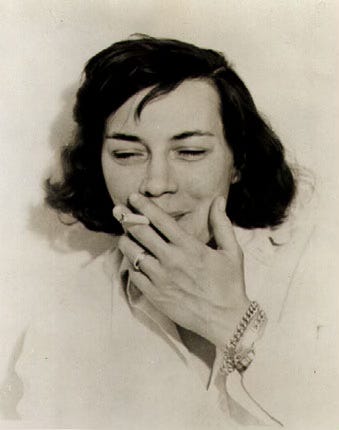
Better to think about people in my lane: writers. The authors Vladimir Nabakov and Thomas Mann were habitual nappers who managed to also write classic novels. Patricia Highsmith napped, but usually at 6 p.m., setting herself up after a day of writing to soldier on into the night.


Patricia Highsmith


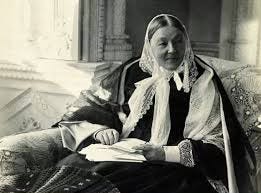
The Internet search calls up many more male writers as self-avowed nappers than it does female. I suppose women writers have often felt that stealing time to be able to write was a great privilege not to be squandered. As the mother of a one-year-old, when my baby napped, I wrote frantically—it was my only chance. I play out this idea to realize that in the 19thand much of the 20th century, women worked hard in the house, caring for children, and if someone got a moment to herself, and was working on a book—there was the focus. I bet that daytime sleeping was a privilege reserved for the elders among them—and was a sign of necessity for their health. Apparently, the legendary nurse Florence Nightingale made the discovery that rest was needed for recovery—though she typically spent less than five hours on sleep herself!


Florence Nightingale


Things are slowly changing. Tricia Hersey is a poet, nonfiction writer and activist famous for her books Rest is Resistance and We Will Rest in which she explains her practice of resting as an act of self-care and protest against the unrelenting, capitalistic grind. I’ve read about scientists proving that a fatigued brain has more trouble finding answers and creative solutions than a rested one. Though it’s not just sleep that does it—walking in nature works, say if you’re in a workplace or at school and don’t have a cozy bed in which to retreat.

Brain power also increases after taking a walk in nature.

My pattern used to be to regularly stroll with my dog after my own lunch. I did it because I know that if I move vigorously after lunch, my blood sugar curve doesn’t look like Mount Olympus. Blood sugar that’s too high is itself a reason for sudden fatigue.

There are plenty of ways to spend one’s time when not writing. I will continue to practice both walking and napping. I may have dreamed up a way to combine both. And this looks like sinking into a chair on my upstairs porch, or on a bench in the park, and letting my eyes ever-so-gently fall closed.

Setting my alarm now for 25 minutes.


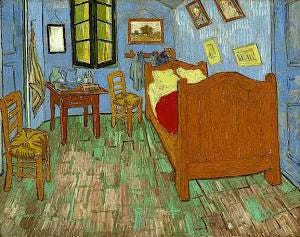
Vincent Van Gogh’s Bedroom in Arles 

Thursday, April 2, 2026

An exclusive excerpt of AN ARTFUL DODGE & thoughts on "historical truth" versus "verisimilitude"

Karen Odden - every other Thursday

I'm thrilled to be able to share the sneak preview, first three chapters of my new book! There's a link at the bottom to read them for free!

But before you do ... I want to say a few words about writing about the Victorian period and the tension between historical truth and verisimilitude. 

One of my favorite anecdotes that illustrates this tension comes from my friend Susan Elia MacNeal, who writes the Maggie Hope series, which begins during WWII, with Maggie serving as a secretary in Churchill's office. For her research, Susan went to the War Rooms, where she read facsimiles of Churchill's letters in his handwriting. In his letters, he uses the abbreviation "OMG." If you think about it, it makes sense -- it's the age of the telegram, when abbreviations saved money.

Now, if Susan were to put that detail in one of her books, she would be sustaining historical truth but destroying verisimilitude -- which we could define as what the reader believes to be true about the period. Imagine the outcry! I can hear the chuckling Goodreads reviews now ... "What's Churchill going to write next? LMAO?" 

None of us writers want to push the reader's "disbelief" button. When it comes to including elements that pull readers out of the story -- well, we have to pick our battles. Sometimes we hit that button inadvertently. 

For example, a few years ago, a reviewer wrote something along the lines of, "I love your books, and they're pretty accurate, except you have Inspector Corravan drinking coffee, when Victorians drank tea."


I've been explicitly warned not to engage on social media platforms over reviews. But had I engaged, I would have replied, "Yes, Victorians drank a lot of tea, and the image of women drinking tea has been widely documented both in words and images (such as this painting, above). But in the 1870s, there were still 7 million tons of coffee being imported annually into England, most of it arriving through the London docks. Elaborate silver coffee services (that you can still see in museums) were still being produced."

That said, even though it's historical truth, I might not have had Corravan drink coffee had I realized it was going to hit the "disbelief" button.

However, there are elements that I'm willing to hit the "disbelief" button to include. The most important is giving my Victorian heroines agency. 

Sometimes, I receive comments along the lines of, "I just don't believe [your heroine Annabel or Nell or whoever] could go running around London the way she does. Weren't Victorian women confined to their homes?"

It's a valid question. TV shows and movies show Victorian women indoors, at balls, drinking tea, languishing in chaises, reading novels, riding in closed carriages. Books by Victorian writers including Anthony Trollope and Wilkie Collins and Mrs. Henry Wood often show women in somewhat stifling surroundings. 

But keep in mind two things. First, these characters are mostly unmarried, upper-class women who are going on the marriage market. They need to be watched and guarded lest their honor be lost and they become unmarriageable. That was a real, historical risk for women of a certain class -- but not for all classes. Second, these characters are fictional! Writers (for TV or of novels) gain a lot of plot advantages by constraining their female characters in particular ways -- in making certain acts impossible. It creates tension, anxiety, stress, frustration -- all good plot drivers and conflict-generators. 

I don't believe in giving women characters undue amounts of agency and justifying it by calling them "spunky." I try hard to be accurate, and that includes showing my heroines behaving plausibly within the strictures and mores of the time.
 

However, one of the ways I work around the conventional constraints in fiction and give my heroines legitimate agency is by having them be members of the lower and middle classes, or orphans with no father or older brother to oversee their actions. In real-life Victorian England, who's watching these women? Virtually no one! Their honor and virtue and morality didn't need to be so desperately protected. Their goal wasn't necessarily to marry. Working women walked all over London alone, without chaperones. They went to shops, they bought breakfast from street vendors, they visited galleries and museums and the Crystal Palace in 1851. They worked in hospitals, in wealthy families' homes, in dressmaking shops, in bakeries, in music halls, in shops, and in brothels. 


And in AN ARTFUL DODGE, they work as thieves. Kit Jimeson is a member of an all-women thieving gang operating out of the Elephant & Castle area of Southwark (above), south of the Thames. My fictional gang is based on the historical (real) gang of women thieves who were working out of E&C beginning in the 1870s. In later years, especially in the 1920s, they'd become known as the Forty Elephants, and they were active into the 1930s. Scotland Yard tried repeatedly to shut them down. To read more about the real Forty Elephants, you might look up Brian McDonald's excellent book Alice Diamond and the Forty Elephants: Britain's First Female Crime Syndicate. 

To read the first three chapters of AN ARTFUL DODGE and to meet Kit and her friends for yourself, click here: https://bit.ly/4uoYSIN