Tuesday, February 23, 2016
Paris is a Gruyere
Monday, April 11, 2011
the big Gruyere - under Paris

With metro tunnels, sewers, old quarries and catacombs crisscrossing under its streets, Paris is a city of layers. And Charles Axel Guillaumot is often credited with saving the city from collapsing into them. Traces of him – and key moments in history such as the French revolution – can still be found underground today.
If you want to know anything about what’s underneath Paris, you could try to find some cataphiles, people who spend time exploring the catacombs with flashlights and waders. But for the history, the man to talk to is Gilles Thomas, my friend.
A wiry, moustached man, Thomas works for the city of Paris, but he is passionate about what’s underneath it, both physically and historically.
The authorities, he says, are only interested in the structural soundness of what’s above ground - he's interested in preserving the history underneath.
The buildings of Paris were built out of the limestone and gypsum – or plaster of Paris – dug out of its belly. The Romans, who founded the city on the Ile de la Cité, found limestone along the riverbanks. “Then the city grew,” explains Thomas. “Around the 12th and 13th century, there was a big demand for stone, because there was a spike in the population of Paris and of religiosity.”
The Notre Dame cathedral was built around this time, along with several other churches, all of them needing stone, which meant digging further underground. Initially, the quarries were far outside the city, beneath fields. But then the city expanded and those fields became city streets.
“Paris, as it grew, was built over the old quarries,” says Thomas. And over the years, people forgot about the quarries and continued to build on top of them - until they started collapsing.That’s where Guillaumot comes in. An architect for King Louis XVI, he was appointed 334 years ago on 4 April 1777 as the city’s first Inspecteur des Carrières, Quarries Inspector.

He was given three tasks, explains Thomas, “to look for all the empty spaces under Paris; to make a map of them; and to reinforce anything under public streets and buildings belonging to the king.”
“Before the year 1777, the temples, palaces, houses and the public streets of several parts of Paris and its surrounding areas, were about to sink into giant pits,” Guillaumot wrote in a 1797 memoir.
He quickly realised that reinforcing the quarries was a long-term project, so he needed to put a system in place. “Neither I nor my collaborators will see the end of it,” he wrote. “Others will have this opportunity, but I have reason to believe that we have paved the road for them, and they will not have any fundamental changes to make on the system that I implemented.”
The system involved building walls - underground – along the perimeters of buildings, which still exist today.
A limestone quarry under the Cochin hospital in the 14th arrondisement still exists today, maintained by an association that has an agreement with the city to renovate and maintain it.
Gilles Thomas works with the association, and insisted on giving a tour, saying that the only way to truly appreciate the history of the quarries is to see it for yourself. The Cochin quarry is not far from the official catacombs, which are open to the public, but it is certainly not as easy to find. Navigating through the hospital’s emergency room entrance, winding through the hospital grounds, Thomas heads into an underground parking area where there is a non-descript door.
Behind the door is a room with old photos and maps of what’s underneath the streets: blue for the empty spaces, brown for the masses left to hold up the quarry ceilings, all laid out in a rough grid.Another door leads to a long concrete stairway that was built in the 1930s when the city turned underground spaces under administrative buildings into bunkers.
And about 20 metres down is the entrance to the quarry.Unlike the public catacombs, which are mainly hallways packed with human bones, this quarry has open spaces with columns. The walls are limestone, the ground is packed dust. Street signs are engraved on columns and walls.
"When you are above ground, you can ask people for directions,” Thomas points out but in the 18th century Guillaumot and his workers had to wander in the dark, holding candles to light their way.
Traces of the first quarry inspector are everywhere, as each reinforcement wall and pillar has a code engraved on it, like 1G1786, which indicates the first column built by Guillaumot in 1786.
Every engraving had a date, but Thomas says you will be hard-pressed to find 1789, the year of the French revolution.
“You’ll see 1777, and years during the revolution, but there are very few from 1789, because it was year when there were other things to think about,” he says.
Guillaumot was imprisoned during the revolution, and removed from his position because he had been appointed by the king.
Later, in 1795, he was given his job back. He reappears on inscriptions with dates referencing the republican calendar, which was introduced between 1792 and 1806. The inscription 22.G.12R indicates the 22nd column built by Guillaumot during the 12th year of the French republic.
Thomas says the work of the Quarries Inspector continued through all of the upheavals of French history.
“Whatever the troubled history in Paris and in France, there was always being work done the quarries - during the revolution, during the terreur,” he says. And traces of this remain: street signs with scratched-out fleur de lys, the royal symbol, because in 1793, anything having to do with royalty was systematically destroyed.
Or not quite everything. Ten signs with fleur de lys remain underground.
“There are so few, that there is an explanation for each one,” he says. The one above the number 270, for example, survived because it was in a pool of water. Another one was on the back of a sign that had been recarved.
In 1794, all references to religion were destroyed. Signs for streets named after saints, like Rue Saint Jacques or Rue Saint Paul were changed, above and below ground.
“The plaques made during the revolution just say Rue Jacques,” says Thomas. “And during the restoration, as there is no room between Rue and Jacques, some just carved a little “St” over it.”Vestiges of this still exist above ground. Look closely at the stone carved street signs on the corner of Rue du Faubourg Saint Jacques and Rue Fossés Saint Jacques, you can see that the Saint was scratched out and put back. The same exists on Rue Saint Paul in the Marais.
Nearing the end of the tour, we come across members of the association setting up an underground lunch, taking a break from their renovation work.And then it was time to walk back through the ages: through the 19th-century tunnels, up the 20th-century stairwell and into the air of the 21st century.
Cara - Tuesday
Tuesday, December 27, 2011
the big Gruyere - under Paris

Happy Holidays Everyone - Here's a post from April that I'm sharing again - Best wishes in the New Year! With metro tunnels, sewers, old quarries and catacombs crisscrossing under its streets, Paris is a city of layers. And Charles Axel Guillaumot is often credited with saving the city from collapsing into them. Traces of him – and key moments in history such as the French revolution – can still be found underground today.
If you want to know anything about what’s underneath Paris, you could try to find some cataphiles, people who spend time exploring the catacombs with flashlights and waders. But for the history, the man to talk to is Gilles Thomas, my friend.
A wiry, moustached man, Thomas works for the city of Paris, but he is passionate about what’s underneath it, both physically and historically.
The authorities, he says, are only interested in the structural soundness of what’s above ground - he's interested in preserving the history underneath.
The buildings of Paris were built out of the limestone and gypsum – or plaster of Paris – dug out of its belly. The Romans, who founded the city on the Ile de la Cité, found limestone along the riverbanks. “Then the city grew,” explains Thomas. “Around the 12th and 13th century, there was a big demand for stone, because there was a spike in the population of Paris and of religiosity.”
The Notre Dame cathedral was built around this time, along with several other churches, all of them needing stone, which meant digging further underground. Initially, the quarries were far outside the city, beneath fields. But then the city expanded and those fields became city streets.
“Paris, as it grew, was built over the old quarries,” says Thomas. And over the years, people forgot about the quarries and continued to build on top of them - until they started collapsing.That’s where Guillaumot comes in. An architect for King Louis XVI, he was appointed 334 years ago on 4 April 1777 as the city’s first Inspecteur des Carrières, Quarries Inspector.

He was given three tasks, explains Thomas, “to look for all the empty spaces under Paris; to make a map of them; and to reinforce anything under public streets and buildings belonging to the king.”
“Before the year 1777, the temples, palaces, houses and the public streets of several parts of Paris and its surrounding areas, were about to sink into giant pits,” Guillaumot wrote in a 1797 memoir.
He quickly realised that reinforcing the quarries was a long-term project, so he needed to put a system in place. “Neither I nor my collaborators will see the end of it,” he wrote. “Others will have this opportunity, but I have reason to believe that we have paved the road for them, and they will not have any fundamental changes to make on the system that I implemented.”
The system involved building walls - underground – along the perimeters of buildings, which still exist today.
A limestone quarry under the Cochin hospital in the 14th arrondisement still exists today, maintained by an association that has an agreement with the city to renovate and maintain it.
Gilles Thomas works with the association, and insisted on giving a tour, saying that the only way to truly appreciate the history of the quarries is to see it for yourself. The Cochin quarry is not far from the official catacombs, which are open to the public, but it is certainly not as easy to find. Navigating through the hospital’s emergency room entrance, winding through the hospital grounds, Thomas heads into an underground parking area where there is a non-descript door.
Behind the door is a room with old photos and maps of what’s underneath the streets: blue for the empty spaces, brown for the masses left to hold up the quarry ceilings, all laid out in a rough grid.Another door leads to a long concrete stairway that was built in the 1930s when the city turned underground spaces under administrative buildings into bunkers.
And about 20 metres down is the entrance to the quarry.Unlike the public catacombs, which are mainly hallways packed with human bones, this quarry has open spaces with columns. The walls are limestone, the ground is packed dust. Street signs are engraved on columns and walls.
"When you are above ground, you can ask people for directions,” Thomas points out but in the 18th century Guillaumot and his workers had to wander in the dark, holding candles to light their way.
Traces of the first quarry inspector are everywhere, as each reinforcement wall and pillar has a code engraved on it, like 1G1786, which indicates the first column built by Guillaumot in 1786.
Every engraving had a date, but Thomas says you will be hard-pressed to find 1789, the year of the French revolution.
“You’ll see 1777, and years during the revolution, but there are very few from 1789, because it was year when there were other things to think about,” he says.
Guillaumot was imprisoned during the revolution, and removed from his position because he had been appointed by the king.
Later, in 1795, he was given his job back. He reappears on inscriptions with dates referencing the republican calendar, which was introduced between 1792 and 1806. The inscription 22.G.12R indicates the 22nd column built by Guillaumot during the 12th year of the French republic.
Thomas says the work of the Quarries Inspector continued through all of the upheavals of French history.
“Whatever the troubled history in Paris and in France, there was always being work done the quarries - during the revolution, during the terreur,” he says. And traces of this remain: street signs with scratched-out fleur de lys, the royal symbol, because in 1793, anything having to do with royalty was systematically destroyed.
Or not quite everything. Ten signs with fleur de lys remain underground.
“There are so few, that there is an explanation for each one,” he says. The one above the number 270, for example, survived because it was in a pool of water. Another one was on the back of a sign that had been recarved.
In 1794, all references to religion were destroyed. Signs for streets named after saints, like Rue Saint Jacques or Rue Saint Paul were changed, above and below ground.
“The plaques made during the revolution just say Rue Jacques,” says Thomas. “And during the restoration, as there is no room between Rue and Jacques, some just carved a little “St” over it.”Vestiges of this still exist above ground. Look closely at the stone carved street signs on the corner of Rue du Faubourg Saint Jacques and Rue Fossés Saint Jacques, you can see that the Saint was scratched out and put back. The same exists on Rue Saint Paul in the Marais.
Nearing the end of the tour, we come across members of the association setting up an underground lunch, taking a break from their renovation work.And then it was time to walk back through the ages: through the 19th-century tunnels, up the 20th-century stairwell and into the air of the 21st century.
Cara - Tuesday
Tuesday, April 22, 2014
The Big Gruyere--Under Paris.

Happy Holidays Everyone - Here's a post from April that I'm sharing again - Best wishes in the New Year! With metro tunnels, sewers, old quarries and catacombs crisscrossing under its streets, Paris is a city of layers. And Charles Axel Guillaumot is often credited with saving the city from collapsing into them. Traces of him – and key moments in history such as the French revolution – can still be found underground today.
If you want to know anything about what’s underneath Paris, you could try to find some cataphiles, people who spend time exploring the catacombs with flashlights and waders. But for the history, the man to talk to is Gilles Thomas, my friend.
A wiry, moustached man, Thomas works for the city of Paris, but he is passionate about what’s underneath it, both physically and historically.
The authorities, he says, are only interested in the structural soundness of what’s above ground - he's interested in preserving the history underneath.
The buildings of Paris were built out of the limestone and gypsum – or plaster of Paris – dug out of its belly. The Romans, who founded the city on the Ile de la Cité, found limestone along the riverbanks. “Then the city grew,” explains Thomas. “Around the 12th and 13th century, there was a big demand for stone, because there was a spike in the population of Paris and of religiosity.”
The Notre Dame cathedral was built around this time, along with several other churches, all of them needing stone, which meant digging further underground. Initially, the quarries were far outside the city, beneath fields. But then the city expanded and those fields became city streets.
“Paris, as it grew, was built over the old quarries,” says Thomas. And over the years, people forgot about the quarries and continued to build on top of them - until they started collapsing.That’s where Guillaumot comes in. An architect for King Louis XVI, he was appointed 334 years ago on 4 April 1777 as the city’s first Inspecteur des Carrières, Quarries Inspector.

He was given three tasks, explains Thomas, “to look for all the empty spaces under Paris; to make a map of them; and to reinforce anything under public streets and buildings belonging to the king.”
“Before the year 1777, the temples, palaces, houses and the public streets of several parts of Paris and its surrounding areas, were about to sink into giant pits,” Guillaumot wrote in a 1797 memoir.
He quickly realised that reinforcing the quarries was a long-term project, so he needed to put a system in place. “Neither I nor my collaborators will see the end of it,” he wrote. “Others will have this opportunity, but I have reason to believe that we have paved the road for them, and they will not have any fundamental changes to make on the system that I implemented.”
The system involved building walls - underground – along the perimeters of buildings, which still exist today.
A limestone quarry under the Cochin hospital in the 14th arrondisement still exists today, maintained by an association that has an agreement with the city to renovate and maintain it.
Gilles Thomas works with the association, and insisted on giving a tour, saying that the only way to truly appreciate the history of the quarries is to see it for yourself. The Cochin quarry is not far from the official catacombs, which are open to the public, but it is certainly not as easy to find. Navigating through the hospital’s emergency room entrance, winding through the hospital grounds, Thomas heads into an underground parking area where there is a non-descript door.
Behind the door is a room with old photos and maps of what’s underneath the streets: blue for the empty spaces, brown for the masses left to hold up the quarry ceilings, all laid out in a rough grid.Another door leads to a long concrete stairway that was built in the 1930s when the city turned underground spaces under administrative buildings into bunkers.
And about 20 metres down is the entrance to the quarry.Unlike the public catacombs, which are mainly hallways packed with human bones, this quarry has open spaces with columns. The walls are limestone, the ground is packed dust. Street signs are engraved on columns and walls.
"When you are above ground, you can ask people for directions,” Thomas points out but in the 18th century Guillaumot and his workers had to wander in the dark, holding candles to light their way.
Traces of the first quarry inspector are everywhere, as each reinforcement wall and pillar has a code engraved on it, like 1G1786, which indicates the first column built by Guillaumot in 1786.
Every engraving had a date, but Thomas says you will be hard-pressed to find 1789, the year of the French revolution.
“You’ll see 1777, and years during the revolution, but there are very few from 1789, because it was year when there were other things to think about,” he says.
Guillaumot was imprisoned during the revolution, and removed from his position because he had been appointed by the king.
Later, in 1795, he was given his job back. He reappears on inscriptions with dates referencing the republican calendar, which was introduced between 1792 and 1806. The inscription 22.G.12R indicates the 22nd column built by Guillaumot during the 12th year of the French republic.
Thomas says the work of the Quarries Inspector continued through all of the upheavals of French history.
“Whatever the troubled history in Paris and in France, there was always being work done the quarries - during the revolution, during the terreur,” he says. And traces of this remain: street signs with scratched-out fleur de lys, the royal symbol, because in 1793, anything having to do with royalty was systematically destroyed.
Or not quite everything. Ten signs with fleur de lys remain underground.
“There are so few, that there is an explanation for each one,” he says. The one above the number 270, for example, survived because it was in a pool of water. Another one was on the back of a sign that had been recarved.
In 1794, all references to religion were destroyed. Signs for streets named after saints, like Rue Saint Jacques or Rue Saint Paul were changed, above and below ground.
“The plaques made during the revolution just say Rue Jacques,” says Thomas. “And during the restoration, as there is no room between Rue and Jacques, some just carved a little “St” over it.”Vestiges of this still exist above ground. Look closely at the stone carved street signs on the corner of Rue du Faubourg Saint Jacques and Rue Fossés Saint Jacques, you can see that the Saint was scratched out and put back. The same exists on Rue Saint Paul in the Marais.
Nearing the end of the tour, we come across members of the association setting up an underground lunch, taking a break from their renovation work.And then it was time to walk back through the ages: through the 19th-century tunnels, up the 20th-century stairwell and into the air of the 21st century.
Cara - Tuesday
Tuesday, May 12, 2020
Underneath the big Gruyérè
If you want to know anything about what’s underneath Paris, you could try to find some cataphiles, people who spend time exploring the catacombs with flashlights and waders. But for the history, the man to talk to is Gilles Thomas, my friend.
A wiry, moustached man, Thomas works for the city of Paris, but he is passionate about what’s underneath it, both physically and historically.
The authorities, he says, are only interested in the structural soundness of what’s above ground - he's interested in preserving the history underneath.
The buildings of Paris were built out of the limestone and gypsum – or plaster of Paris – dug out of its belly. The Romans, who founded the city on the Ile de la Cité, found limestone along the riverbanks. “Then the city grew,” explains Thomas. “Around the 12th and 13th century, there was a big demand for stone, because there was a spike in the population of Paris and of religiosity.”
The Notre Dame cathedral was built around this time, along with several other churches, all of them needing stone, which meant digging further underground. Initially, the quarries were far outside the city, beneath fields. But then the city expanded and those fields became city streets.
“Paris, as it grew, was built over the old quarries,” says Thomas. And over the years, people forgot about the quarries and continued to build on top of them - until they started collapsing.That’s where Guillaumot comes in. An architect for King Louis XVI, he was appointed 334 years ago on 4 April 1777 as the city’s first Inspecteur des Carrières, Quarries Inspector.

He was given three tasks, explains Thomas, “to look for all the empty spaces under Paris; to make a map of them; and to reinforce anything under public streets and buildings belonging to the king.”
“Before the year 1777, the temples, palaces, houses and the public streets of several parts of Paris and its surrounding areas, were about to sink into giant pits,” Guillaumot wrote in a 1797 memoir. Hence the other name for Paris, a Gruyérè for it's similarity to the cheese with holes.
He quickly realised that reinforcing the quarries was a long-term project, so he needed to put a system in place. “Neither I nor my collaborators will see the end of it,” he wrote. “Others will have this opportunity, but I have reason to believe that we have paved the road for them, and they will not have any fundamental changes to make on the system that I implemented.”
The system involved building walls - underground – along the perimeters of buildings, which still exist today.
A limestone quarry under the Cochin hospital in the 14th arrondisement still exists today, maintained by an association that has an agreement with the city to renovate and maintain it.
Gilles Thomas works with the association, and insisted on giving a tour, saying that the only way to truly appreciate the history of the quarries is to see it for yourself. The Cochin quarry is not far from the official catacombs, which are open to the public, but it is certainly not as easy to find. Navigating through the hospital’s emergency room entrance, winding through the hospital grounds, Thomas heads into an underground parking area where there is a non-descript door.
Behind the door is a room with old photos and maps of what’s underneath the streets: blue for the empty spaces, brown for the masses left to hold up the quarry ceilings, all laid out in a rough grid.Another door leads to a long concrete stairway that was built in the 1930s when the city turned underground spaces under administrative buildings into bunkers.
And about 20 metres down is the entrance to the quarry.Unlike the public catacombs, which are mainly hallways packed with human bones, this quarry has open spaces with columns. The walls are limestone, the ground is packed dust. Street signs are engraved on columns and walls.
"When you are above ground, you can ask people for directions,” Thomas points out but in the 18th century Guillaumot and his workers had to wander in the dark, holding candles to light their way.
Traces of the first quarry inspector are everywhere, as each reinforcement wall and pillar has a code engraved on it, like 1G1786, which indicates the first column built by Guillaumot in 1786.
Every engraving had a date, but Thomas says you will be hard-pressed to find 1789, the year of the French revolution.
“You’ll see 1777, and years during the revolution, but there are very few from 1789, because it was year when there were other things to think about,” he says.
Guillaumot was imprisoned during the revolution, and removed from his position because he had been appointed by the king.
Later, in 1795, he was given his job back. He reappears on inscriptions with dates referencing the republican calendar, which was introduced between 1792 and 1806. The inscription 22.G.12R indicates the 22nd column built by Guillaumot during the 12th year of the French republic.
Thomas says the work of the Quarries Inspector continued through all of the upheavals of French history.
“Whatever the troubled history in Paris and in France, there was always being work done the quarries - during the revolution, during the terreur,” he says. And traces of this remain: street signs with scratched-out fleur de lys, the royal symbol, because in 1793, anything having to do with royalty was systematically destroyed.
Or not quite everything. Ten signs with fleur de lys remain underground.
“There are so few, that there is an explanation for each one,” he says. The one above the number 270, for example, survived because it was in a pool of water. Another one was on the back of a sign that had been recarved.
In 1794, all references to religion were destroyed. Signs for streets named after saints, like Rue Saint Jacques or Rue Saint Paul were changed, above and below ground.
“The plaques made during the revolution just say Rue Jacques,” says Thomas. “And during the restoration, as there is no room between Rue and Jacques, some just carved a little “St” over it.”Vestiges of this still exist above ground. Look closely at the stone carved street signs on the corner of Rue du Faubourg Saint Jacques and Rue Fossés Saint Jacques, you can see that the Saint was scratched out and put back. The same exists on Rue Saint Paul in the Marais."
Nearing the end of the tour, we come across members of the association setting up an underground lunch, taking a break from their renovation work.And then it was time to walk back through the ages: through the 19th-century tunnels, up the 20th-century stairwell and into the air of the 21st century.
Cara-Tuesday
Monday, January 18, 2010
Paris what lies beneath...

Dan's post about what lies beneath London got me thinking about underground Paris and the abandoned Metro station I visited.
Underneath these gates to Parc Monceau in the 17th arrondissement where Marcel Proust walked with his governess lies an abandoned Metro station and the graveyard of the Sprague Metro
cars.
Worse for wear now the Sprague Metro cars languish defaced and grafitti'd in long rows but you can see a bit of their former elegance. The wood, the brass fittings, the painted glass panels.


The old poster for the Metro workers to contact inter agency.
A restored tiled advertisement for Maizena. Part of a route map.

The French would say 'Seelance' for this sign. It's part of the underground area under Parc Monceau that was a bomb shelter for Metro executives during the war. Inside are huge seal off gates against poison gas which the French still feared the Germans would use in WWII. Interestingly enough, civilians weren't allowed here and though never used, this shelter would have accomodated only several hundred of the top Metro brass.
Above ground here's the restored Art Nouveau Metro station entrance.

Here's the trailer for Charade, the film with Audrey Hepburn and Cary Grant. Bear with the trailer and towards the end you see Audrey being chased through the Paris Metro circa 1963.
In December during our visit to the Crime Scene Department we met François who, as one of his jobs, needed to recreate a possible crime scene in the Metro station at Bastille. The juge d'instruction, like our DA, wanted to ascertain if foul play or an accident had occured. Evidently a dealer used part of the Metro tunnel, a crevice in the wall, to hide his stash and either the deal went wrong and he was shot or he made a mistake and got hit by the running train. François recreated the scene in the Bastille tunnel after the trains stopped running late at night to assist the juge d'instruction in assembling evidence and possible scenarios. Was the Metro tunnel a crime scene or not?
My eyes lit up...not at the gory details he proceeded to tell us, but at the idea of an underground cache, possible confrontations and the speeding train in the Metro tunnel. Who knows how this could work in a story? After I'd visited the underground quarries in the Latin Quarter, saw the cavern complete with a bar built by underground cinema guerillas who held film festivals and parties there, I ended up using the quarry bar in Murder in the Latin Quarter.

Cara - Tuesday
Friday, January 15, 2010
What Lies Beneath
When the owners of the Metropolitan Railway built Sloane Square station in 1868 they had a problem: the River Westbourne, which flowed into the Serpentine Lake in Hyde Park (and was originally crossed by Knight's Bridge, later Knightsbridge, home of Harrods). What did they do? Relocate the station? No, cocking a snook at nature, they built the station regardless and carried the river above the platform and encased it in a large iron pipe. It was that pipe I could see from my vantage point on the train.
Though travelling on the tube can be occasionally unpleasant, there is much I love about it. Rattling home, late at night, slightly drunk, trying not to doze off and miss your stop; the hot blast of musty air that precedes an oncoming train; people-watching on a long journey; the laconic announcements from long-suffering drivers; tourists staring bewildered at the labyrinthine maps; the underground is an integral part of London life. I'm fascinated by its history. Discovering that my local station, Ladbroke Grove, used to be called Notting Hill, but was later changed when a new station was opened and named Notting Hill Gate provided me with the first big twist of my debut novel.
I'd love to find a plot device where I can incorporate the various 'ghost' stations on the line; disused stations fallen into disrepair, of which you catch a tantalising glimpse in the murk of as your train hurtles past. Stations such as Aldwych, which is used as a film set because it's still in good condition; or Down Street, closed in 1932, used as an air-raid shelter by Winston Churchill and his war cabinet, much of which has been bricked up, though some rooms still survive and the fabulous old facade remains on view at street level in Mayfair.
However, my favourite piece of 'hidden' London Underground arcana is above ground and can be seen by anyone, though, understandably, people often walk past blissfully unaware. When the District, Circle and Hammersmith and City lines were built, architects employed a technique called 'cut and cover.' As they were near the surface, they cut a deep hole to house the track and then covered it with a tunnel. This meant having to knock down houses and cut through roads. In working class areas they went ahead without a care, turfing people out of their homes, often without paying compensation. This being Victorian London, in more affluent areas, the story was different. When the Metropolitan line was built in 1868 and ran through a prestigious terrace named Leinster Gardens, in Bayswater, the residents, in a fit of NIMBYism (Not In My Backyard) complained that a great gaping hole where the tube would run might ruin the look of the street. They were also worried that the steam from the trains venting off might rise above street level and that could also prove unsightly.
After much wrangling a compromise was reached to preserve the street's demeanour (and the value of the residents' property): the railway owners would knock down two houses, numbers 23 and 24, to make way for the line but keep the facade, door, railings and windows. From the street, the houses look like this (note the blacked out windows):
Convincing huh? But from the back, you see this:
A 1930's hoaxer once sold tickets at ten guineas each for an exclusive charity ball at the address, prompting hundreds of guests to turn up in full evening dress and knock on a fake door, and heaven only knows how many pizza delivery drivers, taxi cabs and people spreading the gospel of some God or other have been sent there for a giggle.
cheers
Dan - Friday
Thursday, December 5, 2024
All that glitters
![]() |
Back in the day South Africa was renowned for its goldmining – at one point it was the world’s largest producer of gold. That’s changed over the years. China now leads, and South Africa is only ninth. Mines have a finite lifespan, as do gold deposits. Exhausted mines are supposed to be properly closed down and sealed, and the area rehabilitated. However, as the deposits run down, the big miners who made the early running and lots of money sell the mines on to smaller producers who can still do well by lowering overheads, cutting costs, and often closing themselves down before they have to spend the money on closing the mines down. This leaves retrenched workers with no other source of income, and uncontrolled deserted mining properties. But there’s still gold down there. Just not enough for a commercial company to mine at a profit.
![]() |
Anyone who has ever spent time down an underground mine knows that it’s not pleasant. Without cooling and forced air equipment, it’s hot and stuffy. To its credit the South African government has passed and enforced strict safety regulations, but accidents and mine collapses still occur, particularly in the ultra-deep goldmines of the Witwatersrand. So why would one choose to go down a disused goldmine (or a disused shaft of an operating mine) using ladders and headlamps? Well, how else can a retrenched miner in a shrinking industry make a living? Mining skills are the only ones they have.
A new
industry has developed around these “zama zama” as they are called. They need
food and water supplied to them below ground. Criminals have set up black
market routes to buy the ore the miners produce, extract the gold, and sell it
on. Needless to say, most of the profit ends up in the pockets of these
middlemen. Just enough to live makes its way back to the miners who spend
months underground in dangerous conditions.
This isn’t
just a South African problem. It occurs wherever major gold deposits exist and
poverty abounds. (Kwei wrote about some of these issues in his novel Gold of Our Fathers set in Ghana.) It’s guesstimated
that 20% of new gold reaching the market is a result of this artisanal mining
and that 80% of the employment in the gold industry is in this category. Yes, eighty percent.
Of course,
it’s illegal almost everywhere. We’re not talking about weekend miners panning
for gold nuggets in a river here. We’re talking about a criminal-controlled
industry that compels people to risk their lives underground in awful
conditions for months at a time. It’s a form of economic slavery.
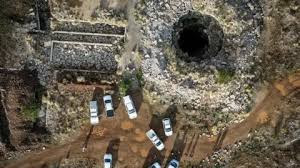
Stilfontein shaft from above
Something
needed to be done. Unfortunately, the South African Police Service decided to go
for the softest target – the miners – rather than addressing the criminal gangs
in control. They chose a well-used mineshaft at Stilfontein.
The police
sealed the mine, stopping the food and water supplies, and demanded that the
miners come to the surface and surrender. They trapped hundreds, if not
thousands, of the zama zama underground. There was a public outcry as conditions
deteriorated, but the government was adamant. The Minister in the Presidency
said that no help would be given to the illegal miners. “We are not sending
help to criminals. We are going to smoke them out,” she said.
![]() |
| Police and rescuers at the shaft with a makeshift pulley system |
Eventually, the government relented and allowed food and water down the mine. After that, they mounted a rescue operation to get the miners up. Several were in bad condition. At least four men died.
What has
been achieved? Very little. Since the zama zama have no choice, it will not be
a deterrent to others. And once the focus shifts and the police leave, no doubt a new group of zama
zama will bring their rickety ladders and well-used picks and shovels and go down the Stilfontein mine again.
There have been calls to develop the industry in a regulated way with the miners allowed to sell their production to the state at a fair price. This would supply legitimate employment and help the country's gold production. The difficulty is that to make it reasonably safe, one needs the proper infrastructure and that requires capital. But those sums have already been done by the companies that shut the mines down in the first place.
So what are the zama zama supposed to
do for a livelihood?
I don’t
have an answer.
Friday, September 16, 2011
Bouchercon Hiatus - What Lies Beneath
When the owners of the Metropolitan Railway built Sloane Square station in 1868 they had a problem: the River Westbourne, which flowed into the Serpentine Lake in Hyde Park (and was originally crossed by Knight's Bridge, later Knightsbridge, home of Harrods). What did they do? Relocate the station? No, cocking a snook at nature, they built the station regardless and carried the river above the platform and encased it in a large iron pipe. It was that pipe I could see from my vantage point on the train.
Though travelling on the tube can be occasionally unpleasant, there is much I love about it. Rattling home, late at night, slightly drunk, trying not to doze off and miss your stop; the hot blast of musty air that precedes an oncoming train; people-watching on a long journey; the laconic announcements from long-suffering drivers; tourists staring bewildered at the labyrinthine maps; the underground is an integral part of London life. I'm fascinated by its history. Discovering that my local station, Ladbroke Grove, used to be called Notting Hill, but was later changed when a new station was opened and named Notting Hill Gate provided me with the first big twist of my debut novel.
I'd love to find a plot device where I can incorporate the various 'ghost' stations on the line; disused stations fallen into disrepair, of which you catch a tantalising glimpse in the murk of as your train hurtles past. Stations such as Aldwych, which is used as a film set because it's still in good condition; or Down Street, closed in 1932, used as an air-raid shelter by Winston Churchill and his war cabinet, much of which has been bricked up, though some rooms still survive and the fabulous old facade remains on view at street level in Mayfair.
However, my favourite piece of 'hidden' London Underground arcana is above ground and can be seen by anyone, though, understandably, people often walk past blissfully unaware. When the District, Circle and Hammersmith and City lines were built, architects employed a technique called 'cut and cover.' As they were near the surface, they cut a deep hole to house the track and then covered it with a tunnel. This meant having to knock down houses and cut through roads. In working class areas they went ahead without a care, turfing people out of their homes, often without paying compensation. This being Victorian London, in more affluent areas, the story was different. When the Metropolitan line was built in 1868 and ran through a prestigious terrace named Leinster Gardens, in Bayswater, the residents, in a fit of NIMBYism (Not In My Backyard) complained that a great gaping hole where the tube would run might ruin the look of the street. They were also worried that the steam from the trains venting off might rise above street level and that could also prove unsightly.
After much wrangling a compromise was reached to preserve the street's demeanour (and the value of the residents' property): the railway owners would knock down two houses, numbers 23 and 24, to make way for the line but keep the facade, door, railings and windows. From the street, the houses look like this (note the blacked out windows):
Convincing huh? But from the back, you see this:
A 1930's hoaxer once sold tickets at ten guineas each for an exclusive charity ball at the address, prompting hundreds of guests to turn up in full evening dress and knock on a fake door, and heaven only knows how many pizza delivery drivers, taxi cabs and people spreading the gospel of some God or other have been sent there for a giggle.
cheers
Dan - Friday
Tuesday, July 2, 2024
More Than a 1% Solution
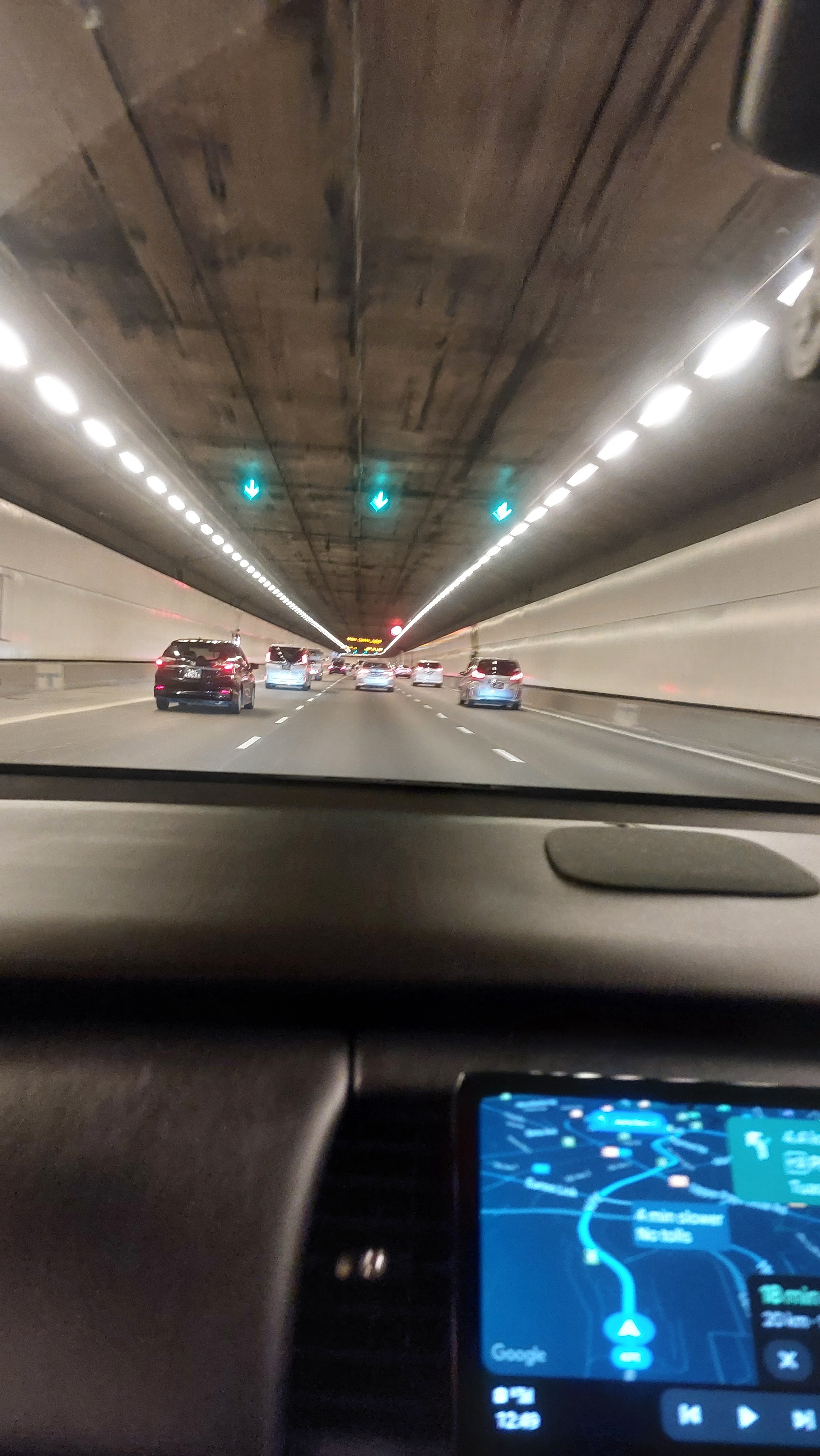
Singapore is a very small island--you can drive across it, coast to coast at its widest point, in under an hour.
But still, when you're underground, especially when you've just entered one of the tunnel expressways, it can feel like it's going to be a long, long road to travel before you'll see the light of day again.
Kind of like following news of the American elections--but I'll leave that to Jeff and Patti.
I took this on the Kallang- Paya Lebar Expressway (KPE). At 12km, with 9km underground, it's the longest underground expressway in Singapore and (I think) the sixth longest underground road project in the world.
The only practical option is to just keep on going forward and not think about what would happen if there's a power disruption or a cave in... the same principle that applies to writing books and living life, I guess!
There are other roads that can feel endless too--I'm thinking of the Tour de France that is on now. But because GCN+ is no longer live streaming the race since the change in ownership, here in Singapore we're reduced to watching highlights and live commentaries.
Anyway, I'm following the Tour de France more from nostalgia than anything else, now I no longer ride and all the riders I hero-worshipped are retiring/ have retired.
It's lucky writers have a longer shelf life than riders, but I still remember how inspiring I found Dave Brailsford's 1% Solution when I was starting out writing and riding.
Brailsford believed in the “Aggregation of marginal gains.”
Simply put: if you improve every area related to riding/ writing by just one percent, those small gains add up to a significant improvement.
Brailsford took on Great Britain's professional cycling team in 2003, a time when British riders were performing so poorly that a top European bike manufacturer refused to sell the British team bikes, fearing it would hurt their sales. After all, in all the 110 years of its history, no British cyclist had ever won the Tour de France, the greatest bike race of all.
Some of Brailsford's 1% improvements were almost laughable (at the time). He got them to redesign bike seats for greater comfort, made riders wear electrically heated overshorts to maintain ideal muscle temperature and travelled with pillows and mattresses to ensure better sleep. He even hired a surgeon to teach each rider the best way to wash their hands to avoid getting sick, and painted the inside of the team truck white, so dirt would be more easily spotted.
Brailsford claimed that if they followed his strategy, Team Sky would be ready to win the Tour de France in five years.
Well, he was wrong.
They won it in three years when Sir Bradley Wiggins became the first British cyclist to win the Tour de France in 2012.
That same year, Brailsford coached the British cycling team for the 2012 Olympic Games, where they won 70 percent of the gold medals.
Chris Froome (my personal hero!) won the Tour de France for Britain again the next year. I've been following his riding career ever since, starting with Team Sky, then INEOS and now Israel Premier Tech.
He won three consecutive grand tours in 2017–2018: Tour 2017, Vuelta 2017 and Giro 2018 before finishing 3rd in Tour 2018. He's the first and (so far) only, rider to wear all the winner's jerseys beginning with the Tour de France, and was the first to do so when the races were in the order 'Giro-Tour-Vuelta'.
Even more, he recovered to ride again after crash injuries that weren't just career threatening, but life threatening, morphing from tour leader to super domestic as younger, faster riders came along.
I find the Tour de France a good focusing tool, because it's a reminder that when you're in the middle of a grand tour or in the middle of a book draft, all the theories in the world don't make a difference.
For riders and writers, you just have to keep your butt in the seat and plow on, regardless of how rotten you might feel. When you're in the middle of a race or a book, that's the only thing that counts; never mind the theories of the past or the ideas of the future, the race or the book you're in the middle of is all that counts.
So--even though Froomey isn't riding this Tour, I'll be using it to try to pace myself to 75k words over the next three weeks...
The big plus of writing over riding is that when you crash or fall off you're less likely to end up with broken bones or road rash.
And I'll be making all the 1% improvements that I can--setting 30 min timers to remind me to stand up and stretch, drinking a glass of water each time and yes, I'll be washing my hands!
The most painful sacrifice is giving up mysore practice for the duration, because even though the atmosphere at The Yoga Shala does me more good than anything anywhere else, I can't afford the two hours it takes to get there and back.
Luckily I've found a neighbourhood place (literally named The New Place) where I can go for classes, and I'll work on staying healthy and working towards the end of this tunnel the best I can!
Wish me luck!
Friday, May 27, 2022
The Roman Baths
The Roman Baths in the city of Bath, Somerset, England. Somewhere we had wanted to visit for a long time. I had been before as a very small person, all I can remember is the dreadful stink.
There has been a spa on these premises since Celtic times, obviously because that happens to be where the water pops up after its long meandering journey underground, getting warmer over the millenia.
For our purposes, the original construction of the spa was around 65 AD. It was a case of 'This is what the Romans did for us!' Non Monty Python fans can ignore that bit.
The thermal waters led to a temple being built, which then led to
the small Roman urban settlement, Aquae
Sulis around the site. The public could use the baths for bathing, and they
were in use right up to the end of the Roman
occupation of ….well most sites state 'Britain', but there were a lot of
bits of Britain that Romans couldn’t be bothered with. The natives
were smelly, the weather was awful or there was just nothing to be gained by invading
the lands to the north of Englandshire.
On and off through the history, the spring waters have
attracted people, including the 1.4 million visitors a year. You can walk
round the museum. It’s a very good experience, the tickets are timed and restricted so that there's not too many people in the small underground chambers at once. There's a lot to see and read. The beautifully constructed displays were marred slightly by
the screaming 2 year old that decided to
accompany our visit. They were timed differently to us but had been late. It’s educationally immersive but not literally so, except
for that wee kid who came close a few times. I felt a novel coming on more than once.
There’s the usual audio narration, plus another narration of various bits by Bill Bryson; he’s
fascinated by the fact that the water emerging from the spring fell as rain in the Mendip Hills about 10 000
years ago. Also, that the Roman soldiers here had a type of funeral fund between
them so they got a decent funeral away from home. There was a trade union amongst them.
On its journey through the hills, geothermal energy raises the water temperature to as high as 96 C (or 204 in real money). On my previous visit, as an extreme youth ( I didn’t scream the place down, or I’d been put in a cupboard ), I could smell the waters – and I can still recall the stink. I knew my dad told somebody that it wasn’t the baths that were stinking, ( rotten eggs was the aroma that came to mind) it was because there was a drought and most of the south of England was smelling oddly.
In 2022, my other half, having little sense of taste, had a sip of the water at the drinking well- he pronounced it
warm and slightly musty, ‘not nice’. The
water contains lots of sodium, calcium, chloride and sulphate.
The whole site is really a place of worship for a Celtic goddess
Sulis who became Minerva when the Ropmans arrived. There’s a story I liked of some ancient King and his herd of pigs being
cured of leprosy after bathing in the water.
The baths at the height of their popularity with the Romans included a caldarium ( where one would be
scalded?), a tepidarium ( lukewarm?), and frigidarium ( freezing ??). These have been long lost to silting up, flooding, leaking and generasl disrepair.