Friday, November 16, 2012

Urban Legend Has It


One from the backlist again, as I'm up against deadline doing rewrites on the book I was finishing a few weeks back. Hope you enjoy...
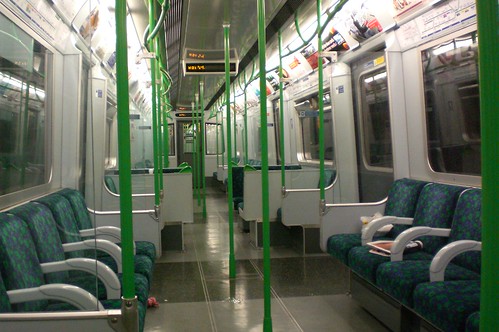


 I'm a sucker for an urban legend. I've even been know to adopt a few for my fiction. I have my favourite ones too, mainly involving the London Underground, whose subterranean mystery generates more than its fair share of myths (underground spaces do generally - alligators in the sewers of New York anyone?): the guy who wakes up on a stopped tube train late at night and thinks it's his station and so gets off, only to reach the surface and find it bricked up - turns out he's in a disused station, lit for the purpose of maintenance, and he's going to be in there overnight bwahahaahaa etc); the stories of secret tunnels that pass Buckingham Palace and/or Downing Street to whisk away the Royal Family and cabinet in times of national emergency; another (which I even tried once) that said if you you encounter an emergency on the tube network, where there is no mobile phone signal, you could still dial 112 and reach emergency services via satellite. It wasn't true.

So I was delighted to be told one the other day by a friend. It goes like this: a young woman gets on the tube late at night. The carriage is empty save for a young man. Three other people embark; two men and a woman, all looking the worse for wear and rather seedy. They sit, the woman between the two men. The young woman, like all good city dwellers, does the right thing when faced with undesirables and avoids any eye contact whatsoever.

While the young woman is reading an advert for throat pastilles or wondering how to pronounce Plaistow, anything to avoid looking at the others, the man in his thirties sits beside her and whispers in her ear: 'Get off at the next stop.' She is obviously taken back by this, not one for trusting orders given by strange men, but something in the man's eyes and the urgency of his voice tells her she should obey, and she doesn't want to be left alone with the other three. So off they get. As the train starts to pull away the man points to the three still on the train, their backs to the window. The woman clearly sees a pair of scissors sticking out of the back of the skull of the woman on the train. As it departs the young man tells her she was dead and he saw them drag her on to the train.

Very creepy. So much so that I had to Google it. It turns out that it is an urban legend par excellence. The story is told relocated to Sydney, Australia, though this time featuring three girls, with the one in the middle staring out at the subject of the story. Later she discovers the girl was dead, strangled by the other two. Then there was another tale where a doctor is involved and recognises the woman opposite is dead.

It doesn't stop there. Variations on the story date back to the 1980s, pre-Internet and the rocket boosters it puts on rumours and conspiraces. One emanates from Manchester, with two girls observing and the later realising the girl with the intense stare is dead. There's a New York version too, dating back before the tube. This time a husband and wife travelling by stagecoach, when three ruffians board, one seeming insensible with drink. The two others get off leaving him there and when the couple try to rouse the last they discover his throat has been cut.

There is even an Italian version, told this time from the point of view those smuggling the corpse on board. The father dies and to save the cost of a coffin to take him home for burial, his two sons take him in the carriage and prop him up either side. So the story has it, they leave the body unattended, but when they return he is gone and a family are sat there instead. Under questioning the terrified family reveal that the train jolted unexpectedly, their heavy suitcase fell on the elderly gentleman below, and when they checked to see if he was ok they found he was dead. Thinking it was their suitcase which killed him, they threw his body from the train. More darkly comic than creepy, but cut from a similar cloth.

It was an instructive exercise, revealing how the stories evolve and are adapted over time. My theory is that like most  of these legends, this story contains a kernel of truth - that an event happened somewhere in which a body was found on a train, or a stagecoach, which other people initially thought to be alive, and because it resonates so much - perhaps due to the impersonality of public transport, where strangers are crammed together in a confined space and rarely speak or even look at each other - it has mutated into myth. There are countless urban legends of bodies riding around and around on the tube for hours on end, dead as doornail, but everyone is too preoccupied to care.

One article even took me to a recent story in which two German women attempted to smuggle the body of a dead relative on to a plane. I learned there is a phrase to describe the phenomenon where real life shares a parallel with urban legend - 'ostension of folklore.' Which then set me to thinking about how much ostension of folklore takes place in crime fiction, and vice versa. I have spoken before how I wrote a scene for my latest book in which someone is poisoned eating a curry, and only a few days later a woman stood trial accused of doing exactly that to her husband. Of course, she had not read my draft, but the reports of her being arrested and charged might have appeared a few months before and seeped into my subconscious.

That or I'm blessed with psychic abilities. Come to think of it, I do remember walking to a sports shop in my home town when I was a kid humming Pinball Wizard by The Who, only to arrive at the shop and hear it playing on the radio. Spooky.

cheers

Dan - Friday

Thursday, November 15, 2012

Notes on notes

Maya
Apologies for getting this up late.  Yesterday after a tough day in the Cape winelands, I spent the night at my nephew's house, with my granddaughter Maya.  Actually she is my late brother's grand daughter, so I picked up the position of Gramps.

Anyway, my nephew does not have internet, so I had to postpone the posting.


This morning I headed home at about 9 AM, expecting to be there in time for lunch.  But here I am at 7 PM just having arrived.  The problem?  Unrest in the old town of Swellendam, where locals were supporting the farm-worker strikes by closing down the N2 highway to my home of Knysna. 


Swellendam

Police at unrest
I decided to take an unpaved backroute via a small village called Malgas about half an hour away.  Malgas is known for a hand-pulled ferry across the Breede River, perhaps the last in South Africa.  Unfortunately, about fifty cars had got there ahead of me. I waited for half an hour or so, then counted the cars ahead of me, divided by the number of cars per hour the ferry was pulling across, and ended up realising I was going to spend at least four hours in line.  So back I went to the N2.  Of course, the road was still closed, but a helpful policeman told me that they would soon let through small cars, ie mine.


Another half hour or so passed until we moved.
Malgas hand-pulled ferry

At this point, I realised I would have to stop in Swellendam for fuel.  My tank was getting low because of the adventure to Malgas.  To my horror, all Swellendam petrol stations had been closed by the police for safety reasons.  I pulled into the last one with my empty light having just come on.  "It is closed until tomorrow," they told me.  The next town, Heidelberg was 55 kms away, more than the reserve on my car.

I begged, I bribed, but no one would succumb to giving me fuel.  I was stuck.

Then some Cape Town University students arrived at the closed garage for some cold drinks.  Being students, they had no problem in agreeing to me siphoning some petrol out of their tank.  In fact, they downed what remained of a 2-litre Coke bottle and a 2-litre Sprite bottle to provide containers for the transfer.  A local who was trying to help said that his father probably had a length of hosepipe we could  use to get the petrol out of the tank and into the bottles.  Off he went.  Eventually he re-appeared with said hose.  We threaded it deep into the tank.  I knelt and sucked and sucked, filling my mouth with petrol, swallowing some of it.  Yuck.  Now several hours later, every time I belch, I almost succomb to the petrol fumes.  I had better not try to blow out any candles tonight.

When I thought the hose was full, I put the end into the Coke bottle and waited eagerly for the petrol to start flowing.  Eight drops, then nothing.  I repeated the process.  Same mouthful, same result.  Eight drops.  Of course, the students thought I was a stupid old man and took over the sucking.  Same result.  Mouths full of petrol. Eight drops.

We decided what was happening was that there was a sieve or filter at the top of the fuel tank, thus preventing the hose from immersing itself in the fuel.  No way around that impediment.

Then the Dad who had supplied the hose came up with an excellent idea.  He grabbed the tyre inflator next to the closest fuel pump.  I stuck the end next to the hose down towards the fuel tank, covered the rest of the opening with my handkerchief, and he pumped air into the tank.  Well, it sort of worked.  This time twenty drops came out per air squirt.  Eventually, I said enough - we had about half a litre in the bottle.  "I'll head off to Heidelberg, anyway," I said.  What was the worst that could happen?  Run out of fuel en route.  And I remembered that my nephew was heading down the road later in the day, so if I was stranded, he could come to his uncle's rescue.  So off I went, taking the car out of gear on the down hills, lifting myself off the seat to reduce the weight on the car, and exhaling backwards to provide a little extra propulsion.

Well I made it.  Fortunately the last two kilometres is down hill and the garage is at the bottom.  I filled the tank.  It took half of a litre over its maximum capacity.

After that it was a quick lunch with Maya and her parents, who had now caught up.  Then the two and a half hour drive still left to Knysna.  And here I am at home, safe and sound!

Hmmm.  I am sitting here wondering why I have just written the drivel above.

Ah, yes.  I was explaining why my blog is late.  Fortunately, the blog was written last night, so I can press ENTER and off we go.
_____________

Thursday's blog:

I have always liked money. Surprise, surprise. But as much as I like money in the bank, I also like it in my hand, in the form of banknotes.

So this last week was particularly exciting in that regard, because South Africa issued a set of new banknotes honoring Nelson Mandela.  I have to admit I was not enthusiastic about the idea for two reasons: I have always been against honoring anyone who is still alive, and I really liked the old notes, which had the Big Five as their pictorial theme.

The Big Five, buffalo, elephant, leopard, lion, and rhinoceros, are so called because long ago hunters thought these were the most dangerous five to hunt.  Today, tourists all want to see the Big Five, although they are certainly not the most difficult to see, and are certainly not the most beautiful.

Here are the old banknotes.  Unlike greenbacks, they are all different colors and different sizes, which helps the sight-impaired. In think they are terrific.


Last week, to my trepidation, the new notes appeared.  I have to admit I like them.  I have persuaded myself to get over the anti-honouring-someone-alive position, but only in this one case because Mandela is my hero.  And my concern about losing the Big Five was unfounded because they are still appear on the notes.  Here they are.


In addition to each note having a different color and different size (all the same width, with different lengths), they also have a raised section to help sight-impaired even more. They have a variety of cunning security features in addition to the usual watermarks, such as numbers appearing when the note is held obliquely to the light. And the animal depicted showing up in miniature at a certain place on the note, but only when viewed with the light behind.

There are eleven official languages in South Africa.  The Reserve Bank was very cunning.  Rather than issuing each banknote in eleven languages, they spread the languages across the five notes.  English is on all,and two other languages appear on each note, giving eleven in all.  Of course, had they printed each denomination in eleven languages, they would have had to print so many more for collectors.  That would have been free money in the till, because they would never go into circulation. 

Banknotes offer a country a wonderful opportunity to sell itself, and I think the new notes will do this for South Africa.  So hats off to the designers - they've done a good job.

Stan - Thursday (late)

Wednesday, November 14, 2012

The hectagon of evil


I did not like history much when I was in school and did not particularly shine at the subject as a result. It seemed like a jumble of guys, none born in a year easy to remember, that constantly fought and bickered about all and nothing. The endless maps of the acient world with arrows showing how this old nation or that flooded over its neighbors. I cringe at the mere thought. The only parts that held any interest to me were the bits where the water wells seemed to have laced with drugs and people were doing things where sanity has no calling. As they say: History is more fun when it is horrid.

My soon to turn sixteen year old daughter attends the same junior college as I did at her age. She is now studying the same history text book as I did at that age. Leafing through it now it seems quite clear that the boring manner in which the development of society and the human race is set forth must have had a lot to do with my lack of fondness. The part about the Romans as an example has a picture of a Roman coin. Who chose that as being depictive of what the Romans stood for? Maybe to save space. One a single page they manage to cram in five emperors, their wives and various other key players. A photo of the Colosseum would have cut this figure down by at least one emperor, one wife and two key players.

My daughter told me her favourite in the history book is the sections on the Roman gods and the Greek gods. I found this odd but when she told me why I understood. Gods do not have a birth year so there is less to remember.

I have decided to keep my mouth shut and not tell her how in three years she will be forced to learn by heart what parties have been in power in Iceland year by year since the establishment of the republic. Then she will look fondly back to the page with the five roman emperors, the five wives and the numerous key players. Not to mention the gods that lived timelessly.

Teenagers are actually in some ways representatives of the old times, before Galileo to be exact. They do not conduct themselves in ways that imply that the earth revolves around the sun. Their view on the universe is that everything within it revolves around them. My daughter as an example expects my husband to read her history book in case she needs him to ask her questions from it in preparation for an exam. This way he will be sure to be on top of things and not have to read through the paragraphs over and over when trying to come up with a question. But it could be worse. So he read the book and knows his Romans. 

Dare I tell my daughter that her father and I will be away on her birthday in two weeks? Not really. Unless I can figure out a way of making it seem as if the trip has something to do with her and her studies. Which will be a cinch since I am going to Rome. I will tell her that her father really wants to get a hands on feel for the Romans so that he can ask really pointed questions come exam time in December.

In all honesty I am going there to promote a book: “Mi ricordo di te” – the one called: “I remember you” in English. Having never been to the eternal city, I can’t wait.

When the first Thóra book came out in Italy it was called “Circle de male” – loosely translated as: the circle of evil. I remember thinking how smart that was and how I had not thought of naming my series something with geometrical shapes. It would have saved me a lot of title worries – The circle of evil. The ellipse of evil. The triangle of evil. The rectangular of evil. The list is endless.

Yrsa - Wednesday

Tuesday, November 13, 2012

I Quit -- A Guest Post From James Thompson


We've been lucky to have Jim Thompson as a regular guest here on MURDER IS EVERYWHERE.

Jim, for those few of you who might not yet know it, is Finland's best and most popular representative in the field of Nordic Noir.

His first book, SNOW ANGELS was selected as one of BOOKLIST'S Best Crime Novel Debuts of the Year. His second, LUCIFER'S TEARS, was chosen as one of the Best Novels of the Year by Kirkus. And you still have time, if you haven't yet done so, to read the excellent HELSINKI WHITE before he launches this one:


HELSINKI BLOOD will be the fourth in the Inspector Kari Vaara series. It goes on sale, in North America, on the 21st of March and is already up for pre-order on Amazon.


Here, and elsewhere, Jim has been doing a series of posts on the subject of Finnish racism.
But no more.
He just quit.
And he tells us why in the post below.

Cara - Tuesday

I Quit

When I started writing a series of articles discussing the feelings of disenfranchised immigrants, I was so naïve that I thought raising public awareness was a good thing, that it would be viewed as I intended, an attempt at fulfilling a social responsibility. I had no idea it would generate such anger. But it did, and so, in an attempt to be fair and objective, I presented the other side of the coin, the views of “critics of immigration.”

A coordinated attack was launched against me on their website, Homma Forum. This despite the fact that I agree with many of their policies concerning Finland’s relationship to the international community. I simply dislike racist rhetoric. The discussion concerning me has been viewed by well over 4000 readers. I had no idea so many people would be interested in me. Hmmm. Should I be flattered?

I was heartened today to see that the latest posts focus on my novels, rather than attacking me personally. A rather lengthy commentary was published that discussed two of my novels. The verdict: I am possibly the worst writer ever born. I’m more than fine with that. The man exercised his right to free speech and is entitled to hate my work as much as he likes. In fact, I was thrilled. It appears that most people on that site who are rambling on about how much my writing sucks have never read any of my novels. At least the man took the trouble to read my work before voicing an opinion about it. I respect that.

I do wish that readers would recognize that I’m a noir writer, and the events and attitudes expressed in my novels are genre appropriate, that writing noir set in Finland doesn’t mean that I view Finland as a violent, corrupt, and dangerous place to live, any more than James Ellroy’s noir writing means that he hates America and in particular, Los Angeles. Folks, it’s fiction. After fifteen years here, Finland is my home, I’m happy here. The culture suits my personality better than anywhere I lived in America ever did. But that’s neither here nor there, and I’m digressing.

My mistake was believing that the public at large is interested in the welfare of all—that an objective examination of the situation from differing viewpoints might be valued. That was idealistic bullshit. I made a mistake and learned a lesson. It isn’t wanted or valued. To not take a side is to be the enemy of all. I offered Perussuomalaiset/Basic Finns a guest blog, and because I’m a man of my word, if they wish, I will honor it, without comment from me.

I view no one as an enemy and don’t want there to be a perception that I do, and so I will write no more about this subject. My views aren’t wanted or needed. There will be no thoughtful discourse. Minds are made up and hate from both sides will reign for another generation. If it makes you happy, go ahead and hate your brains out. You’ll see no more essays about it from me.

I quit. 

Monday, November 12, 2012

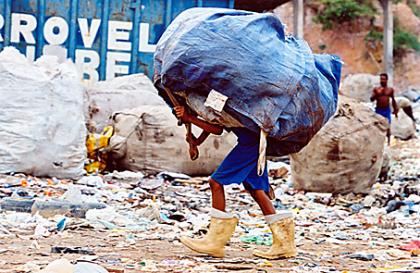
Child Labor In Brazil


Child labor, in North America and Western Europe, is largely a thing of the past.


But it is alive and flourishing in many other places around the world.


Here in Brazil there is legislation against it.


Kids aren't supposed to enter the labor force until they’re eighteen years old.


But, according to the most recent statistics, more than one million of them between the ages of ten and fourteen already have.


In recent years, the federal government has been doing its level best to crack down. But it’s difficult to get the laws to “stick” in the more poverty-stricken regions of Brazil’s north and northeast.


In the semi-arid regions of Bahia, for example, more than 800,000 kids, some under the age of five, are to be found working on small landholdings.


The presence of federal agents, in such regions, is thin on the ground.


Schools are few and far-between.


Transportation is lacking.


But the problem is also a cultural one: child labor is encouraged by parents, and supported by the community.


Complaints to the authorities are rare. And, when they come, the people who made them are often ostracized by their neighbors.


More monitoring is needed, more subsidies to the poor, more education directed toward the caregivers of the exploited children.


Things are changing. But all too slowly.


Thereby condemning at least another generation of kids to a life in which their lack-of-education is bound to result in the perpetuation of grinding poverty.


Visiting some of these regions, seeing some of these kids, is enough to make a grown man cry.

And I have.

Leighton - Monday

Saturday, November 10, 2012

World News Roundup

And now (rim shot) the news of the world, largely true and condensed for 21st-century attention spans.

The U.S. election is still over.  It will remain over for seventy-two hours, at which point the next four-year news cycle will kick in again.

A snake with tentacles has been born at the Washington, DC zoo.  Scientists rank this as the worst evolutionary development since the birth of Pat Robertson.

India has announced that it is accepting applications for the world's least desirable job.  The new employees will be paid a handful of rupees an hour to come up behind people who are defecating in public and hit a pan with a stick to direct attention at what everyone within view is trying not to look at.  The campaign is designed to reduce public defecation, which is apparently not already sufficiently embarrassing.

The family of the former head of the Communist Chinese Party was revealed by the New York Times to have amassed a fortune in the area of 2.7 billion dollars, proving that George Orwell was correct when he wrote, in Animal Farm, “Some animals are more equal than others.”

The Chinese Communist Party announced for the seventh year in a row that rooting out corruption was a prime objective.

The two major American political parties spent, during the election that is still over, approximately the same amount the family of  the former head of the Chinese Communist Party amassed during his years in power.  An international commission has been formed to decide which country got the better deal for the money.


Justin Bieber and Selena Gomez have broken up.  That's it, that's the item in its entirety.

Karl Rove, the political genius behind George W. Bush, proved that denial is not a river in Egypt when he claimed, live on Fox (of course) that the Democrats had not actually won the election.

The Republican party made the strongest case yet for greater stress on basic math in the American school system by losing, by less than a million votes, an election in which they essentially wrote off the largest group of American voters (women), the fastest-growing group of American voters (Latinos) and the (possibly) most committed group of American voters (Blacks) and decided instead to appeal exclusively to old white men.

Puerto Rico turned down a chance to become an independent country and expressed interest yet again in becoming a state.  A popular movement promptly arose with the objective of trading Puerto Rico for Florida, plus two outfielders.

Ugly as well as useless

The Governor of Bangkok, who spent more than 1.3 billion Baht to create a new futsal (sort of indoor soccer) stadium for a world match, failed to get the stadium open in time for the tournament, created a building that did not meet the World Futsal League's safety standards, and then sued the League.  Orwell is alive and well in Thailand, too.

And finally, on a more somber note, scientists at London's Kew Botanical Gardens announced last week that global warming trends could bring about the extinction of the wild Arabica coffee plant as soon as 2080.  The Arabica plant, in hundreds of varieties, is the source of all the world's really good coffee, which is to say almost all the coffee served everywhere but at Denny's. On the bright side, most currently mature coffee drinkers will be dead by then.

More news . . . as it happens.

Tim -- Sunday

With Stormy Apologies to Shakespeare


I quit, I surrender.  First Superstorm Sandy, now Nor’Easter Athena.  And I take no consolation whatsoever in this latest assault on my farm coming from a natural disaster named after a Greek god (That’s the little lady’s satellite photo above). 

The new storm is predicted to bring on a heavy wet snow, perfect for bringing down additional trees and power lines and extending the current power outage in my rural, northwestern corner of New Jersey for another two weeks.  To make matters worse, my trusty chainsaw is broken.  God knows how I’ll end up clearing the road of fallen trees so that the propane truck can make deliveries needed to fuel my generator.

Elmer Fudd at work.
All of which is my way of saying that for the time being my mind is consumed with the non-writing aspects of life.  Even the edits to my new book are taking a back seat to Athena.

But there is a bizarre serendipity to it all:  In thinking about this week’s blog I remembered something I’d written as a lark about a year ago about why to write a blog, never thinking I’d “publish” it.  It’s a parody of Hamlet’s self-questioning To be, or not to be soliloquy that asks his famous “whether” question in its second line.  Ironic, I thought, how my weather had me thinking about his.
Laurence Olivier as Hamlet, with friend


Whether/weather everywhere and not a stop to think. [Sorry, Sammy, but I just couldn’t pass up that line.] 


Yes, folks, cabin fever has set in.  Now suffer along with me if you dare…


JEFFREY: To blog, or not to blog--that is the question:
Whether 'tis nobler in the mind to suffer
In despair at most blogs’ outrageous fortune
Or to take pens against our shared troubles
And by exposing end them. To fly, to leap--
To soar—or do we creep away to end
The headache, and the thousand natural blocks
That publish is heir to. 'Tis a consternation
Devoutly to be wished on others.  Weep--
Perchance even scream: But at the very nub
Of a possible death to the dream of some
Is why we suffer at this mortal toil.
Let us pause. There's the respect
That is the balm to a long writing life.
For who would bear the ups and downs of time,
Th' reviewer's wrong and downright contumely,
The pangs of edited work, the pub delay,
The insolence of the press, and its spurns
Showing patient merit worthy of a saint,
When he or she might quiet exit take
To make a living?  Who would deadlines bear,
To grunt and sweat a solitary life,
But that the dread of giving no more breadth
To all those undiscovered thoughts that churn
Our traveling minds, and puzzle our will,
Would make us far more ill by half
Than denying readers what they know not of?
Dedication makes writers of us all,
And a simpler life of remuneration
Is sacrificed to one of words and thought.
Any enterprise giving pitch and moment
To our words, even if currently awry,
We can’t lose in the name of no action.  
So now fair Colleagues, bring on opinions
That our blog be long remembered.

Jeff—Saturday