Saturday, June 7, 2025

It's Pentecost...and Time for a Reminder: Don't Lose Your Head Over the Holidays


San Juan Bautista, Joan de Joanes (cir.1560)
 
Jeff––Saturday
 
Pentecost falls fifty days after Easter, and in Greece it is always a huge holiday weekend.  It will be celebrated tomorrow and this year’s crowds on Mykonos are expected to pump up the number of tourists on the island, for Pentecost one of the three great feast days, along with Easter and Christmas.  But this isn’t about Pentecost.  Nor is it about Easter.  It’s to retell one of my all time favorite tales as told by Jody Duncan who, together with Nikos Hristodulakis, once owned Mykonos’ Montparnasse Piano Bar.   
 
Jody would like you to THINK his story has something to do with those most holy of days to the Greek Orthodox faithful, but I prefer to consider it simply further evidence of the sorts of minds who once put the olive in your martini or umbrella in your mai-tai from behind the bar at the La Cage aux Folles of the Aegean.  Jody and Niko we miss you...but take it away with your tale.

Jeffrey, this story is entirely appropriate for the season as it begins on Easter and ends around Pentecost.


A few years back we decided to have friends over to our house for Easter dinner rather than following our usual practice of being guests in their homes.  But one friend insisted on contributing the lamb and he would not take no for an answer.   So, a day or two before Easter, Adonis the Greek appeared at our door bearing his gift of an entire lamb, complete with its head wrapped separately in newspaper.


Okay, I get it, if you’re hosting Easter dinner in Greece there must be lamb.  No ifs, no ands, no buts.  But heads?  Please.

I couldn't bring myself to cook that thing, and didn't even know how or where to begin getting a head ready for the oven.  I did the only thing I could think of.  I stuck it in the freezer.  A non frost-free one I might add.

A couple of months later, in June around the time of Pentecost, I thawed the freezer and came across a parcel wrapped in newspaper.  I’d forgotten all about it.  Inside I found what looked to be the frosted, frozen head of John the Baptist.

That was all that remained of that poor unlucky lamb.  And it was my fault it had ended up here rather than in its rightful place on the Easter table.  I had to find some way to redeem myself.  It was still early in the morning for Mykonos—around noon—and the performers crashing at our place from the night before were still asleep.

It was the perfect opportunity for my giving the little lamb a proper send off.  Phyllis Pastore, our headline singer and an institution on the island, was just starting to wake up.   I went to her bedroom and stood in the doorway, balancing the lamb’s head on my left shoulder.  She was ignoring me and so I started softly humming a tune.

I waited until she’d opened her eyes but had not yet grasped the meaning of my visit.  At that instant I stepped forward into her bedroom and in my best Paul Anka impression blared out the lyric I’d been humming, “Put your head on my shoulder…”

I was so proud of myself.

Phyllis had another view of things.  She leaped out of bed with a scream that nearly brought the poor lamb back to life.

I was laughing so hard I was beginning to think the other head on my shoulder was laughing too.

Phyllis drew a deep breath to compose herself, and in a perfectly blasé Ethel Merman sort of way said, “Jody, if I were you, I’d keep the new one.” 

[Ed. note:  I always liked Phyllis’ style.]

Time for a drink, I think.  Here’s what we at the Piano Bar call the Flirtini.  It's a lovely champagne cocktail, light in taste and perfect for warm summer evenings.

In a champagne flute, put one ounce elderflower liqueur (St. Germaine is the most well known brand) and 1/2 ounce lemon juice. Top with champagne and voilà you have a refreshing cocktail—and it’s gentle as a lamb.
 
––Jeff 


Thursday, June 5, 2025

The lost dead


There was a story on social media recently about a lady who had died forty years before she was discovered, and when social services broke her door down, they found her in her front room, sitting in her armchair, watching the TV. She was totally mummified.

And the TV was still on.

It was all rather vague. And probably rather untrue. But I'm sure a good crime writer could devise a way that it could have happened.


There was a real life case in Glasgow where an old lady died, probably of epilepsy, and was found a year later behind her front door. The postman was getting more concerned, her neighbours in the tenement thought she was elsewhere, gone to live with relatives or something.


I believe, in the end it was the smell that alerted  the neighbours to the situation.


The vertical villages of Glasgow are not what they once were. Back in the day families stayed for years, everybody knew the kids, the brothers, the sisters. There was an unofficial social security system up the close. A struggling family would find a loaf of bread on the step for them, a few eggs, something to help feed the family.


Those days are long gone. Tenements are now starter flats; the turnover of residents is quick and constant.


The case of Joyce Vincent is interesting. Her death went unnoticed for over two years; she was discovered in January 2006 when the local authority entered her flat to engage with her over unpaid rent.


In Joyce’s case, the TV was still on; the electricity and TV licence were paid by direct debit. Her bank account was topped up by social security patients. Like the Glasgow case, lack of sightings of her were explained by everybody thinking she was elsewhere.


It was only the residents immediately around her flat who knew Joyce. And then only in passing, as Joyce, more or less had gone into hiding.


A young woman, with a promising career in finance with companies like Ernst & Young.


Then domestic abuse started at home, and she became more and more withdrawn, removing herself from her support network of friends and family.

By the year 2000 she was moving from hostel to hostel, then into a shelter for victims of domestic abuse and then into the anonymous world of bedsit land.

It’s thought that Joyce passed away from an asthma attack.

It was December and her Christmas presents were found, still under the tree, unwrapped.

There’s a docudrama about her Dreams of a Life (2011). It explores her life and her death, the spiralling into loneliness.

There's only one picture of her, easily found if you google her name. She's a very attractive young lady, either black of of mixed race. She was obviously bright, intelligent with a good career path in front of her. 

Was there early indications of mental health issues that were missed? I'd like to think not. I'd like to think that some health care professional somewhere had her under their care. But mistakes do happen.

It's scary to think that if it could happen to her, it could happen to any of us.

Guest Post - Charlie at Crimefest by Paul Durston

Michael - Alternate Thursdays 

Paul Durston served with the Metropolitan Police in London for thirty years, specializing in emergency response and communications. He now lives on a narrowboat and cruises the inland water ways of the UK while writing intriguing crime novels around a very unusual protagonist. I had the pleasure of being on a panel with him at Crimefest last month and learning about him and his books. Then again, maybe it was Charlie on the panel... Over to you, Paul.

In The Met, terms like Plod and Woodentop (demeaning names detectives use for the uniform) are a bit dated. You’d more likely hear something like: 
“We need to run this witness home.” 
“Get a Lid to do that.” 
We Lids would get our own back on the detectives. 
“We need to find consistencies and inconsistencies in these three-hundred pages of statements.” 
“Oh, get a Tecco to do that.”

I’m retired but I kept my lids. Probably shouldn’t have. Probably shouldn’t have posted this either. Probably get a visit from a Tecco – if s/he can find Birmingham. 

“Where’s Birmingham?” 

“Dunno, ask a Lid.”

 After retiring, I sat a creative writing course at City University London. Part of that course was attendance as a reader at the Bristol CrimeFest back in 2016. I decided then that I wanted to sit on a panel. Slight problem – I had to write a crime fiction novel and have it published.

I submitted the novel I wrote for my course (Additional Cargo about asylum seekers approaching the English south coast) to loads of agents and received loads of nice letters in reply – the first sentence of which contained the word but.

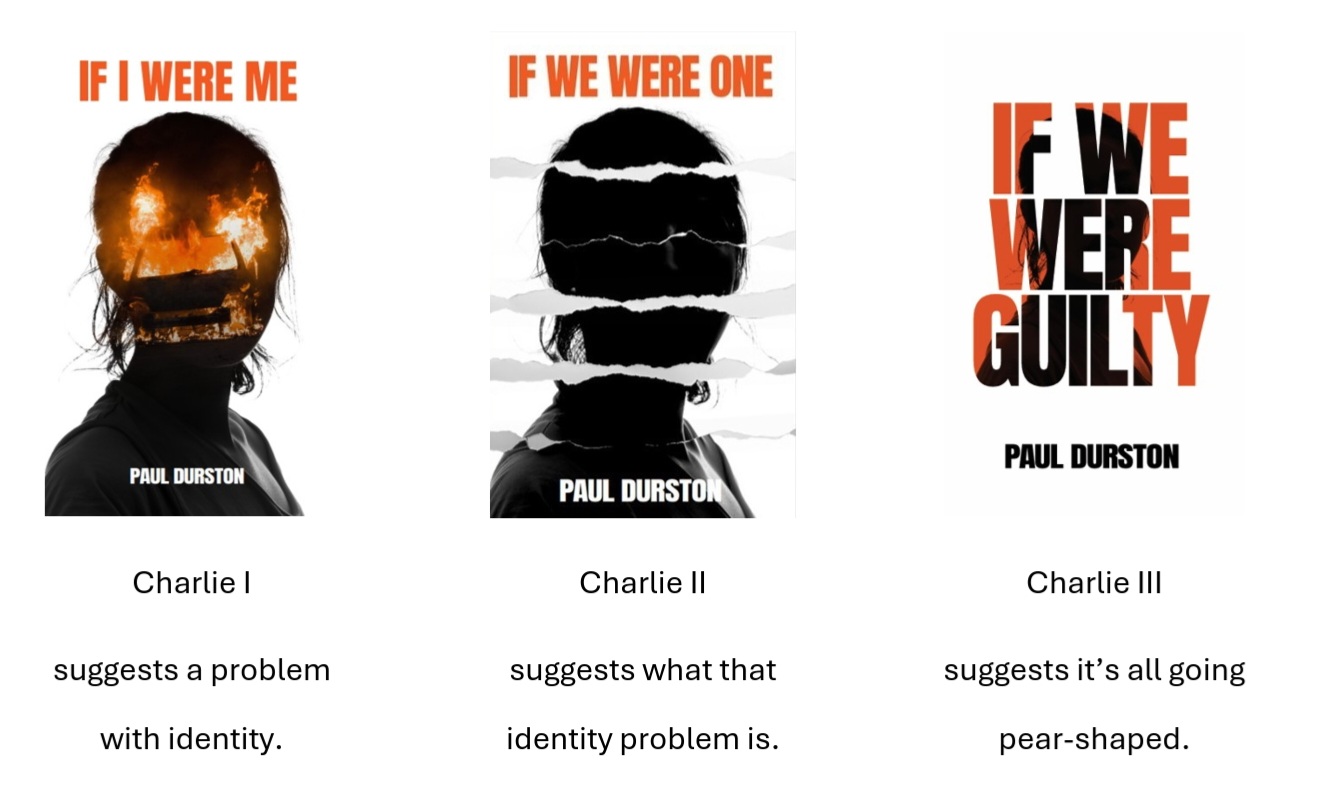
I wrote another book, If I Were Me, about Charlie Quinlan, a London police officer who, when on duty, does police work and, when off duty, kills paedophiles.

I touted this around agents and publishers and came to the conclusion they needed to extend their vocabulary beyond the word but.

A friend of mine suggested Diamond Crime, no agent required. On checking them out, they were clearly different. Instead of the general submission package (first three chapters, synopsis, covering letter) Diamond said not to make a submission unless able to submit a whole book. Was this a publisher who, instead of assessing your submission, assessed your work?

Whatever, Diamond Crime took my book on, published it and, in May 2023, I realised my ambition of sitting on a panel at Bristol CrimeFest. There I was with Lisa Jewell, Lesley Kara, Simon Toyne and Lucy Martin, all best-selling novelists, and little ol’ me, with my little ol’ book.

2024. Second book. I call it Charlie II. It’s actually called If We Were One and I’m up again at Bristol CrimeFest.

2025. Charlie III. If We Were Guilty. Here I am, again, at Bristol CrimeFest. What a difference. This panel’s called One of a Kind – Atypical Characters. Instead of me, I felt as though it was Charlie on the panel. Our moderator was Michael Sears (half of the Michael Stanley partnership) and alongside me were Bridget Walsh, Christina Koning and Tom Mead. 

Michael’s detective, Kubu, does law enforcement in Botswana (I’ve known detectives who look like hippos). Christina’s blind detective in London between-the-wars (never known any blind detectives – blind drunk maybe). Tom’s detective, also in London between-the-wars, who needs the help of a conjuror to solve his investigations (not unlike many of the detectives I know). Last but by no means least, Bridget’s investigator set in the music halls of 1870s London (all investigations are a balancing act and Teccos’ balance improves when they have someone to hold their hand – particularly a tight-rope walker). It was an absolute pleasure not having to read books in a setting in which I’ve served professionally for thirty years and meet and chat with these fantastic authors.

And, of course, Charlie.

She would say, “I kill paedophiles. You got a problem with that?” I don’t think CrimeFest chose her for this panel because of her nefarious off-duty activity. I think it was more to do with why she kills paedophiles.

The three books are dependent on one another. If you do decide to read them, I recommend you read them in order.

On the panel with Michael, I was posed with a weird problem – how to describe the later books without spoiling the earlier ones. Then it dawned on me – the titles.


The identity problem is Dissociative Identity Disorder (used to be called Multiple Personality Disorder). Charlie was raised in a children’s home where one of the wardens facilitated access for a paedophile ring. Charlie was abused regularly and frequently. To cope, she dissociated – Lottie formed. When it got too much for Lottie, Floella formed. Then came Jemima and Gillian. They call themselves The Quins.

The Teccos are getting nowhere and Charlie has to investigate herself – finds her Quins and finds the culprit. What should she do? Arrest her? Report her? Join her? Kill her?

In Merry England, killing people, even paedophiles, is… frowned upon. Charlie’s nicked and ends up gripping the rail.

You as the reader, have the jury at an advantage. You know she’s guilty. But would you find her guilty?

I love moral conundrums. Diamond Crime have set up a forum on their website where you can announce which you would choose and join the discussion

www.diamondbooks.co.uk/discuss

Look forward to hearing from you.

Oh, before I go, towards the beginning, I mentioned my book called Additional Cargo. Well, the book hasn’t seen the light of day but check this out:


That’s me on the back – sorry, stern – emerging from the top lock of the Tardebigge (normal spelling) flight. This flight of locks (10 miles south of Birmingham) is well known in boating circles as it’s the longest flight in the UK – thirty locks – one after the other – can’t stop – no wonder Boaty’s front doors are open – she’s gasping for breath. These boats move so slowly that when we pass one another there’s time for a fairly in depth conversation. Frequently, we’re asked, “What’s the additional cargo?” My partner, Caroline, points at me while I point at myself. Another question we’re often asked is, “What colour’s that?” When I say, “Orange,” I’m looked at like I’m taking the piss. I don’t get it.

Caroline and I love Boaty and spend most of our time on her.

I write silly stories about boating – Detective Inspector Burton of the Canal Police. I’m sure you know it’s a requirement for all protagonists in crime fiction, probably in all fiction, to be in some kind of conflict. Detective Inspector Burton’s conflict is that he’s 6’8”, built like a brick outhouse and lives on a narrowboat. I love playing with names. Detective Inspector Burton’s DS is Evelyn Dense. His DC is Ewan Watt. My favourite, Assistant Commissioner Principal – first name Peter. I’m sure you can guess Detective Inspector Burton’s first name.

The first story sees Detective Inspector Burton investigating a death on the Grand Union Canal – but not Agatha Christie style.

www.pauldurston.com

Enjoy.

Paul

Wednesday, June 4, 2025

A Greek Odyssey, in Three Servings

Sujata Massey 


Our trip to Greece was impulsive.


Let’s go! I said to Tony,my husband and frequent travel mate. Let’s go to the islands again.


I’d made the same suggestion 35 years ago. We were former college classmates whose deep friendship was becoming a fledgling romance. A two-week trip was a celebration of Tony’s medical school graduation—and also a special time for our budding romance. 


I researched the islands that were supposed to be high in beauty and lower on tourist kitsch. I bought reasonable tickets from a travel agent. Tony applied for his first passport and gamely agreed to the islands I’d selected: Sifnos, Naxos and Santorini. 


Greece in the spring of 1990 had just a sprinkling of European tourists, excepting of course, Santorini. Overall, in the three places, we recall the kindness of the people, the grandeur of the mountains and azure sea, the crispness of the salads and the sweetness of the honey. 


What nobody could have expected were the inevitable travel hiccups. Episodes like getting off a ferry to wait on the dark, early hours on Sifnos  beach; arriving in ourswimsuits at water too cool to swim in; Tony’s ankle sprain on the erratic staircases of Naxos, and my full-throttle sickness traveling on a hydrofoil. Tony was the one who held the bag. And the genius of these troubles were how they proved we could work together even through embarrassment and pain. The relationship was sailing ahead! A year later, we married.


Old Venetian Port, Chania


Kucuk Hasan Pasha Mosque


This year, as news about the difficulties of airport exit and entry spread, I felt urgently that I still wanted to travel—to be free innthe world. Having already been in India, I felt the European Union countries calling. And I remembered the birthplace of my lasting love: the Greek islands. 


Once again, I was the primary trip planner, and with over 240 inhabited Greek islands, there was a lot left to see. I landed on Crete, Greece’s largest island, with many places to go and a distinctive cuisine; Syros, the longtime legislative capital of the Cyclades, a marvel of marble sidewalks and grand Venetian style houses; and Mykonos, an international party hub truly chose only because it’s a seasonal home of my dear friends Jeff and Barbara Siger.


Even though we are older and wiser, we still had a big travel snafu. Hiccup One was arriving in the charming and small Chania, Crete airport on a British Airways flight that hadn’t loaded our luggage at Heathrow. We were in Chania two-and-a-half days without suitcases . 


My plane outfit carried me for days

Our historic Airbnb, Casa Regina Luxury House, was in a tiny lane and wasn’t an easy delivery address, so it was only thanks to our kind landlady calling the airport that our clothes were ultimately delivered.  In the meantime, we washed our travel clothing, and I bought a linen dress at a shop in Chania’s Oldtown to feel more culturally appropriate for visiting monasteries. The two monasteries we visited, Moni Ayia Triadha mear Chania, and Moni Arkadhi near Rethymno, were remote, uncrowded sanctuaries. 


Ayia Triadha’s lovely gardens


Ayia Triadha is still inhabited and has lovely gardens and produces its own olive oil and wines. Arkhadi dating to around 1100 AD is preserved clearly as a museum. The monastery was famous in the 17th and 18th centuries for exquisite goldwork embroidery and manuscript copying. It is best known as a holocaust setting in 1866, when 966 Cretan Christians came to stay with the monks to themselves during the period of Ottoman Turkish reign. A fierce battle attack from soldiers led not only to deaths by gunfire, but also of self-immolation in the compound’s powder keg. The treasures and tragedy are both brought forward in the tranquil location. 


We rented a small car—and driving to this monastery, and then bringing the car through a medieval town to park, was very hard. I’d label driving Hiccup Number Two, and Tony was gracious enough to handle all of it!


Scenes from Akhadi


Rethymno port


 Next stop: another of Crete’s medieval Venetian-Ottan towns, Rethymno.


Rethymno was slightly less crowded with tourists than Chania. It has a similar Oldtown to Chania marked by winding lanes and picturesque narrow houses. Here, many local people lived in these homes, and while tourism employs some citizens, the majority are involved in other work. We noticed a strong emphasis on restaurants serving locally sourced food and “Creative Cretan Cuisine.” A very good omen!


We hit gold with our small hotel, Avli, located on a tiny lane in an 18th century palazzo with a courtyard garden restaurant. Our small boutique hotel was quiet at night and gave us the pleasure of feeling like we were in a neighborhood with people of all ages, going about with their everyday lives.


A fortification at Forteza


The big historic site in Rethymno is a Venetian-built fort known as the Forteza. Its walls were too low to serve as much of a stronghold against the Egyptian pirates and later-arriving Turks. Chiefly, Forteza was a location for Venetian administrators to live and work, while native Cretans preferred to build houses lower down in the city. We were impressed by the finely woven textiles, basketwork, ceramics and wood and stonework at the Historical and Folklore Museum in Oldtown. 


Rethymno Historical Folklore Museum


This small and special museum was created by local family donations, just like a wonderful small museum we found in a historic house in Gavalochori, a village in the Apokouronas area near Chania. 


Ayios Nikolaos Greek Orthodox Church


During our time in Crete, I pondered over something with Tony. I know that I especially enjoy  places that are beautiful and retain history. I love planning for these places and will read about them ahead of time. I know just a few words of the Greek language, which makes me dependent on local people speaking a bit of my language when I get there. I hope to visit “friendly” places, with locals not being angry about the disruption of foreigners. Such a welcome is the essence of being a tourist.  Yet at the same time, I carry a secret wish not to want to see that many other outsiders around us in the streets. And what an impossibility it is to hold both things—but it did happen in some places on this  trip.

We had a strong feeling of gratitude to the land and people of Crete when we boarded a Seajets Ferry early on a Wednesday morning, heading for Island Number Two: Syros.


Tuesday, June 3, 2025

Breaking out Books and Bowels amidst Friendship and White Fish

Ovidia--every other Tuesday

First the good news! I'm back in Singapore and my advance copies of The Rose Apple Tree Mystery are here!!!


And even though I'd already seen the cover images, I think these are Gorgeous!

But there's more to be excited about than that... because there's something else on my personal horizon;


Unfortunately, 'bl**dy sh*t' isn't just an expression, so I've been booked in for a procedure on Thursday.

And starting Monday morning, I've been on a Mission of Elimination. No cereals, grains, red meat, dairy... and all these meds to take in before the procedure on Thursday!


As these instructions make clear, it's complicated. But I figure as long as I stay off anybthing with fibre or taste I should be all right.

This was my last watercress soup on Sunday night... now a distant memory...


Since I don't really like white bread and white rice, I find it's actually easier to go on a liquid fast, while being careful to stay hydrated.

Wednesday promises to be extremely productive, unfortunately not in a writing sense.


I've decided that I'm not going to do much writing/ editing, I might as well allow myself a couple of days of deep reading.
And since I'm fasting physically, I've been trying to take a media fast too. Avoiding screens, doom scrolling and rabbit holes and stick to reading books and mkaing notes and see what comes up.

As was explained to me in the pre colonscopy briefing, you can’t see what’s inside your bowels unless the gunk inside there gets cleared out—I figure what applies to my colon applies also to my cerebrum right?

So we'll see what comes out of this!

I was really touched by some old friends though. We were supposed to meet up for a xiao long bao lunch on Monday, before this 'cleansing' appointment was made. Given my dietary restrictions, I warned them I might be dining on congee but I didn't want to cancel or postpone because I really wanted to see them.

And they switched our rendevous to a sushi place--where we'll all eat fish (allowed) and white rice. Now that's friendship!

It's funny how the people you were thrown together all higgledy piggledy poo at the age of six can somehow stay friends over the years. After all we had nothing in common except that our parents signed us up in the same school! So was it just that forced proximity that bonded us? Because we were young, uniformed blobs of hooks and loops that velcro-ed to each other for survival?

Not necessarily I guess. There were forty or forty one girls in a class and I can't even remember most of their names now! They've been flushed out by time and all the other ideas, experiences and encounters that have passed through me since then.

And some things do end well... since I couldn't take dairy, when their desserts ice creams came I was given chocolate mochis!


Which were delicious!

Wish me luck with the results of the procedure on Thursday--and I look forward to seeing what surfaces after I allow myself two days of deep reading!

Monday, June 2, 2025

Asli Hassan Abade

 Annamaria on Monday


Regular MIE readers know that I often come across interesting topics to blog about while I am researching background for a story.  We historical mystery writers have to do a LOT of that kind of study.  From time to time a search will dig up something fascinating but that has little or nothing to do with what I am trying to learn.  Today I bring you such a tidbit.  It provides the kind of story I love - one about a woman who broke barriers to realize her dream.


The more you know about Somalia, especially the position of women in the Somali culture, the more impressed you will be with Asli Hassan Abade's accomplishments.

Born on January 1, 1958, she grew up near the Mogadishu airport, dreaming of becoming a pilot.  Eventually, she left Somalia and went to Italy to learn to fly.  She went on to live in the US for a few years but retuned to her beloved homeland in the 1970's, when there was  period of open-mindedness.  In 1976. she joined the Air Force and became the first and, as far as we know, its only woman pilot.  She served as an Air Force Captain for a decade.

When the political situation broke down, she returned to the US, married an American aircraft engineer, and raised her four children.

She has, from time to time, returned to Somalia to stand up for peace.  Literally: quietly standing during government negotiations - holding the Somali flag, dressed in its colors.


In 2011, she flew into Mogadishu to deliver medical supplies to a local children's hospital.

You can see and hear her tell her own story here:

Interview


Viva Captain Abade.