Monday, April 24, 2023

Kubrick: A Man Who Could Tell Every Kind of Story

 Annamaria on Monday

I have been binge watching the films of Stanley Kubrick, and because I am such a nerd, doing it in date order. I had seen and greatly admired almost all of them before, but packing them densely into the past couple of weeks has tripled my respect for breadth of his talent.

Here is my evidence. And if you are tempted to say that Kubrick had co-writers on most of these films, I give you that. But, in all but one of the his movies, he had complete control over the storytelling. You may also be tempted to say that he based almost all of his screenplays on previously published written works. Please don't go there if you don't want to hear my ever-ready passionate lecture on the greatness of Shakespeare.


Killer's Kiss 1955 Film Noir

This was Kubrick’s second film, but the first one where he was the writer as well as the director.  It is a typical war story that involves a down and out, over the hill, boxer, who when the story begins, encounters a woman who could never be his. She, of course, draws him into a problem she is having with a very bad guy.

Kubrick wrote the screenplay on his own and filled it with unusual turns and twists. It also departs from the typical film noir at the very end. I wondered about that. It was not at all when I was expecting in a genre that never ends happily. While researching this blog, I found that, because his budget was very low, toward the end of making the, Kubrick had to turn to United Artists for support. They agreed but only if he would give the film a happy ending.


The Killing 1956 Caper Movie

Like all its brothers and sisters in this genre, Kubrick's story focuses on a veteran criminal planning one last heist. After this one, he expects to be so rich that he will be able to go straight. The screenplay is brilliant. The main character of course, enlists, all of his former partners in crime, but there is no standard scene where he lays out the whole plot for his friends. Kubrick has him tell some of his cohorts some of the story and others other parts, and he keeps quite a few surprises to himself. It keeps viewers from ever knowing exactly what's going to happen next!


Paths of Glory 1957 War Story

This was the first Kubrick film I ever saw, and I've loved it every time I've seen it, including a week ago this past Saturday! It has battle scenes and deaths as every war story must, but there is triumph at the end. Kubrick is in league with with my anti-war convictions, and though there are heroic deeds, the story is tragic. And beautifully told, as well as brilliantly played by the entire cast, especially Kirk Douglas.
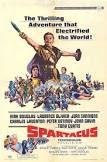
Spartacus 1960 Epic Historical Drama

This story of a slave revolt in antiquity also stars Kirk Douglas, this time heading a brilliant cast the includes Lawrence Olivier, Peter Ustinov, John,Gavin, jean Simmons, Charles Laughton, and a drop-dead gorgeous Tony Curtis! In my research, I discovered some thing quite wonderful about the writing here. Only in this one film did turn over the screenplay to someone else: Dalton Trumbo. Kubrick and Douglas, who were coproducers, boldly announced the name of their writer, even though Trumbo had been blacklisted by the McCarthy committee. As I suspected communist, he was not supposed to have a job.  Ordinarily in those bad old days. work of the blacklisted carried the name of a front.  But Kubrick and Douglas made it a point to be openly defiant.  The screenplay was based on a book by another blacklisted author--Howard Fast, who had been forced to self-publish because no publisher was allowed to do so.  On opening night, Spartacus was picketed by the American Legion. President John F. Kennedy crossed the picket line to support the flick. This film was instrumental in putting an end to blacklisting.


Lolita 1962 Psychological Drama

Kubrick wrote this screenplay jointly with Vladimir Nabokov, author of the notorious novel of the same name.  The Motion Picture Production Code enforcers had everything to say about what aspects of the original story could be kept in and which had to be toned down to such an extent that they lost all their drama and shock value.  Not even brilliant performances by James Mason, Shelley Winters, and Peter Sellers could compensate for the losses.  Kubrick later admitted that, had he known how deep censors' cuts would go, he wouldn't have tried the project in the first place.
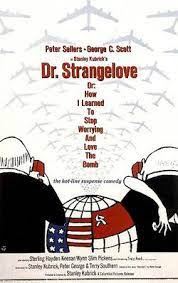

Dr. Strangelove or: How I Learned to Stop Worrying and Love the Bomb 1964 Satiric Thriller 

At the begining, Kubricks intention was to make the movie a serious thriller based on a book by Peter George called Red Alert.  Peter George himself, Terry Southern, and Stanley Kubrick worked on the play, but it became clearer and clearer to Kubrick that the story was not working as a straight thriller, that it needed to be a comedy. A stroke of brilliance that resulted in a masterpiece, one of the funniest movies ever made. I'll give you a little taste of the fun by just giving you the names of the characters: US Air Force Brigadier General Jack D. Ripper (Sterling Hayden), Group Captain Lionel Mandrake,and US president Muffley and Dr. Strangelove (all played by Peter Sellers), General Buck Turgidson, Chairman of the Joint Chiefs of Staff (George C Scott.  To name just a few.  I sincerely suggest that you buy this movie and watch it every few years. You'll never tire of it.


2001: A Space Odyssey 1968 SciFi

Kubrick wrote this screen play with with the brilliant Arthur C. Clark, who--as they were working on it--also wrote a novelisation of the story.  When one sees the film these days, Kuprick and Clark and the film's Art Director and Costume Designer seem to have been prescient!  If you watch it today, you will see clothing styles that look familiar, a laptop-style computer on which a traveler has a FaceTime phone conversation with his daughter back on earth, and, showing that the film is completley current, the main character has many conversations with an AI chatbot called HAL.

Not so impressive you think?  Well, consider this: this flick was released a full year before the then "miraculous" first humans landing on the moon.  Just four years before the film debuted, I worked on the first "real-time" computer project outside the Pentagon.  It required three room-size computers (two IBM 7080s and one 7740).  They sat in a specially air-conditioned glass box erected on a floor raised three feet; the space underneath it was fill with wires and quite a number of cathode-ray tubes.  The miracle that monstrosity could perform was that it could calculate an employee's retirement benefit in less than twenty minutes.  And yet, right around the same time, Kubrick and his team were inventing the setting and technology for their movie 2001, that also asked philosophical questions.  When I saw it for a the first time fifty-five years ago, it felt like a religious experience.
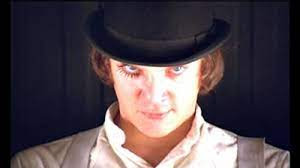

A Clockwork Orange 1971 Dystopian Crime

Kubrick based his screenplay on Anthony Burgess's astonishing 1962 novel.  The flick created a sensation when it was released.  I went to see it in its first week, bought the book the next day, read it immediately, and returned to see the film a second time one week later.  Parts of it very are violent, but the story is so well told that none of it seems like gratuitous sensationalism.  Malcolm McDowell's performance as Alex is perfect.

Barry Lyndon 1975 Period Drama

My professor of writing would have called this film and Thackery's book on which it was based picaresque: a story in which we follow the main character through al long series of life experiences.  Kubrick's direction and John Alcott's cinematography produced a gorgeous work of art.  Every frame of it looks like a beautiful painting. the acting, the music, the costumes, all perfect. 
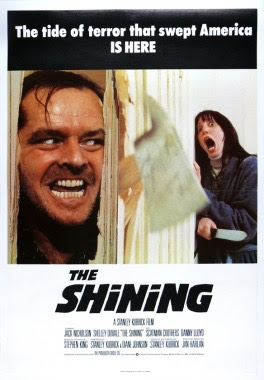

The Shining 1980 Horror

I tried to watch this film again, in fact I repeatedly tried until now there are less than three hours till midnight, when I have to click on "Publish."  I am sorry, I can't take horror in print or on the screen.  Not even if the story comes from the brilliant Stephen King.  Not even if it's a film by Kubrick.  Not even if it stars Jack Nicholson. In fact, especially if King, Kubrick, and Nicholson are involved.  they are all so brilliant at scary.  But no go for me. I run from the room.

I spent so much time trying to watch The Shining, that I haven't gotten to a new viewing of Full Metal Jacket and Eyes Wide Shut.  But I think I have made my case about the breadth of Kubrick's genius.

By the way, the way, the music in each film is worth a discussion in itself.  I used to own recordings of the soundtracks of Strangelove, 2001, Clockwork, and Barry Lyndon.  The have gotten lost in the shuffle of life.  First think tomorrow, I am going to rectify those omissions. 

Saturday, April 22, 2023

Dominion Voting Systems One, FOX NEWS Zip


Jeff–Saturday


Much of the media coverage this past week on a settlement reached on the first day of trial in the Dominion Voting Systems v. Fox News defamation lawsuit, got under my skin. So much so, that I decided to blog about it. But in a parody roughly based upon Mark Antony‘s soliloquy at Caesar’s funeral in Act III, Scene II of Shakespeare’s (who else) “Julius Caesar.”


The gist of what prompted my displeasure was watching the talking heads at some of the more liberal news networks tearing into Dominion and its lawyers for daring to settle this lawsuit.  They would have preferred to see Dominion risk it all for the potential psychic joy many might find in weeks, if not months, of reporting on FOX stars and key executives badgered and roasted in court while fessing up to truths about lies they’d been telling for years.


Yes, that would have made terrific theater, but done nothing toward guaranteeing compensation for the victim.


It’s also unclear the extent to which any of that would affect FOX’s ratings dominance.  After all, FOX is said to simply ignore reporting on anything it doesn’t wish its base to know—such as, for example, the amount or even the fact of its settlement with Dominion!


Bottom line, I see this as an expression of Fox’s critics’ anger at missing out on watching their longtime ratings nemesis relentlessly chastened as it twists in the wind on someone else’s nickel.


But we’re not talking about nickels. To be precise, Dominion would be passing on FOX’s 787.5 million dollar offer of settlement, a/k/a more than three-quarters of a billion dollars, a/k/a $787,500,000.00


WOW, those numbers remind me of some of the digits appearing in my new contract with my new publisher—more on that later.


So, here’s what I see as Mark Antony’s likely take on the masterful job done by Dominion and its lawyers:


FOX, CNN, MSNBC, lend me your ears.
I’ve come to bury Dominion, not to praise it.
The evil that networks do lives on;
The good is oft interrèd with their brands.
So it may be with Dominion. Murdoch
Hath told you Dominion was litigious,
And to strike at FOX was a grievous fault.
But Dominion pursued on undeterred,
Doing battle with Murdoch and his son.
(Murdoch is said an honorable man;
The same as others claim to be at FOX),
So they do not need me to speak for them.
Our besieged champion Dominion does,
‘Cause Murdoch views life as sacrilegious
When not seen as an honorable man.
For he brought many viewers home to FOX,
Along with ratings that filled its coffers,
Launching bitter lies at Dominion’s heart.
While FOX’s competitors whined and bantered,

Dominion showed itself of sterner stuff.
Facing down Murdoch’s minions’s words and threats,
And claims to be an honorable man,
The court did see, behind Carlson et al,
Was Murdoch offering a kingly crown
To one who claimed in lies to have earned it.
Still, Murdoch stood in battle, toe-to-toe,
Until his sharp rebuke before the court.
But I speak not to explore Murdoch’s words,
Rather to reveal what I do now know:
All that we’ve learned we owe to Dominion,
Yet the media is faint in its praise.
Favoring schadenfreude over clear judgment?
Has envy driven their reason away?
Dominion did its job: FOX surrendered.

To beat FOX ratings is another’s job––

Requiring far sterner stuff than banter.


Bravo, Dominion and its legal team, on a job well done.


Now for the promised announcement.


I’m thrilled beyond measure to announce that Chief Inspector Andreas Kaldis has found a new home at Severn House/Canongate Books and his next adventure (Book #13) will be released in February 2024.  It is set on Greece’s grand dame Aegean island of Syros–with New York City’s East Village in a supporting role–and features an
ambitious cast of complex characters caught up in the most challenging societal issue of our time: the dark-side ramifications of Artificial Intelligence.


–Jeff


Friday, April 21, 2023

Walking the Wall; The Roman Baths


Chester is a town in the west of England, slightly to the north and not that far from the Welsh border. it's 209 miles from London and sits on the River Dee. It's a lovely town, with the charm of Stratford Upon Avon and with the history of Bath, yet it's quieter and much less touristy.

The town is surrounded by a wall that is two miles long. Because of its unique position, Chester has been fought over, occupied, unoccupied, put under seige, released from seige and then reoccupied many times, and it bears the scars.

"The siege of Chester occurred over a 16-month period between September 1644 and February 1646 during the First English Civil War. In the engagement, Sir William Brereton and the Parliamentarians were ultimately successful in taking possession of the city and Royalist garrison commanded by Lord Byron."

Fair to say it has played a very important part in the history of Englandshire.


 It's famous for many things,  mostly Roman, and the famous wall still exists. It's a totally charming place, full of old buildings- the coffee shop dates from 1350. The town has 'rows' above street level, so the shops, bars, restaurants are on two layers. Walk around the bottom, one set of shops, around the top and you'll get a completely different experience.

You need to watch your head though, as the medieval types were short people - five feet tall in their stocking feet.

Lots of tall tourists in Chester have a sticking plaster on their forehead.

 For this blog, and for some cake at the end, we walked the full length/circle of the wall and you’ll see the pics in a future blog.

For now......


The old bridge and the River Dee, pic taken from the wall.

What a fabulous address.
These houses are high up, the wall being the height of a third story building in places.
The residents must be used to nosey tourists sauntering past peeking in while they are making a brew.

The wall skirts the racecourse.
This large house sits on the far side.
I think it's going in a book.


We descended the steps of the wall to explore the Roman gardens.


Bathing Roman style.
Quote "The laconicum (i.e. Spartan, sc. balneum, bath) was the dry sweating room of the Roman thermae, contiguous to the caldarium or hot room. The name was given to it as being the only form of warm bath that the Spartans admitted."

A brief history of the plants in the garden.
With a lovely quote about why gardening makes folks happy.


Bits of the mosaic floors have been replicated.


Areas of the Roman garden show the walls of the tombs.

The mosaic at the entrance.


The walk through, you can see the wall on the right.

The remains of the burial sites

The back of the famous Chester Cathedral- see a later blog.

The wall took a bit of a hammering in 1643 to 1646, you can see the damage the cannon balls did, and  the repairs. Chester was under seige at that time.

It's peaceful now and very pretty, a bit like the town itself.

Up on the wall, looking down at the racecourse. Hooves have dug up the grass on the sharp curve so replanting is underway.

Walking the top of the wall, circling round the back of the cathedral.

The luxury central heating of Roman times.
Might be useful nowadays if the cost of fuel doesn't stop going up.


We rewarded ourselves. It was 13000 steps horizontally.
Goodness knows how many up and down!

 Cheers

C

Thursday, April 20, 2023

Forget it, Jake, it's Gentrification

Wendall--every other Thursday

I was particularly heartbroken last week by this Los Angeles news headline: “Chinatown renters rally against 300% spike in rent.”


Can anyone afford a 300% increase in anything?
 

First of all let’s just start with the nightmare, for anyone, of being faced with that kind of increase in monthly expenses. To make matters worse, the building in question has been part of an affordable housing program for the last thirty years, with tenants who’ve lived there for decades. It currently houses 124 families, many who receive Section 8 supplements.


This rent increase is, in effect, according to several tenants interviewed by the LA Times, an eviction. Given the current rental market, few of the residents will be able to stay close by,  and some may even be forced to join the 60,000 people already living on the street in Los Angeles County.


In doing a bit more reading, I found the struggle to fight this increase has been going on for three years. To its credit, the Los Angeles City Council made an effort to buy the building, but the owner refused to sell to them. Last week, renters marched to Mayor Karen Bass’s house and slept outside overnight. She is sympathetic to their plight, but her options are limited because the building is privately owned.


Now that housing in downtown LA has become out of reach for almost any renter, it follows that developers and landlords would set their sights on “up-scaling” nearby Chinatown, just over the 101 Freeway from City Hall and the Los Angeles Cathedral, and nestled between Dodger Stadium and Union Station.


The site of my first job in LA.
 

Before I came west, my only association with this neighborhood was via the film Chinatown, which is, of course, fictional. But my first job in Los Angeles was close by—working as a telemarketer for the Mark Taper Forum Theater. I was absolutely wretched at it, and was filled with dread every time I drove to the Center Theater Group offices on Temple St. where I was forced to interrupt patrons’ dinners to ask for money. Horrors. I only lasted a month. But it was long enough to fall in love.


In 1986, downtown was something of a ghost town and there were only a few restaurants to go to after work. There was the dearly departed Gorky’s, a Russian diner, complete with kielbasa omelets, The Original Pantry, established in 1929, which before the pandemic, had never closed its doors, and the famous Pacific Dining Car, which was well out of my budget then and is now, sadly, gone as well.


A souvenir from the much-missed Gorky's

 
The Original Pantry mug. We have a few in the cupboard...


A photo from the one time I got to visit the Pacific Dining Car

Then, I looked the other direction and spotted the neon lights of ABC Seafood and Yang Chow. It was no contest. For someone raised in North Carolina in the 70s, where Chinese food was hard to find, I was in heaven. Even now, all these years later, Yang Chow is still my go to restaurant for my birthday. 


There are so many great restaurants in these few blocks, but this is my favorite.
 

In the last few years, I’ve seen more and more Chinatown businesses pushed out by rent increases. If any of you are Michael Connelly fans, one of Harry Bosch’s favorite haunts and an LA institution, Chinese Friends, closed last year.


Greed and gentrification have always been with us, but in Los Angeles, they seem to operate on hyper-speed. The city has almost no respect for its own history, and the number of “tear downs” and culturally important landmarks that have been razed just in the thirty-seven years I’ve been here is staggering.


But the takeover of Chinatown is particularly heartbreaking, because in this case, it’s happening for a second time. The original Chinatown, established in the early to mid-nineteenth century, not only suffered the horrendous Massacre of 1871 (another post for another time), but was taken over and destroyed by the city in the late 1930’s to build Union Station.


Chinatown in the 30s


L.A.'s Old Chinatown circa 1930s.

(Los Angeles Public Library Collection)

It turns out that Chinatown was very specifically set in and designed to reflect 1937, just before the buildings were all torn down. Every member of that community was relocated in the service of “progress,” and a “New Chinatown” was opened and dedicated in 1938/39. Again, imagine experiencing this kind of displacement.


The West Gate of the new plaza, circa 1939 (Los Angeles Public Library Collection)
 

Since at that time, only second generation Chinese citizens were allowed to own property, the center of the “new” location approximately a mile north of the original, was initially developed by the American born Peter Soo Hoo, the first Chinese-American engineer for the Department of Water and Power. He and a group of investors bought a local railyard and turned it into a “pedestrian plaza,” in actuality one of the first “shopping malls” in the U.S. That plaza is still there, though several longtime vendors and restaurants have recently gone.


Chinatown Gate in the 80s.
 

If this rebuilt and resilient neighborhood goes the way of much of the city’s new cookie-cutter, overpriced, mixed-use buildings, it’s hard to imagine where the community might re-invent itself within city boundaries.


It’s a familiar story, but always a tragic one, since the strength of Los Angeles has always been the talented and generous people who’ve chosen to live here and establish so many strong international communities and neighborhoods. What is the city, without them?


There is only one building left from the original Chinatown. Since 2003 it has housed the Chinese American Museum (425 N. Los Angeles Street), which is very much worth a visit if you’re in the area.

Today my agenda includes a donation to the Chinese Historical Society of Los Angeles, and a double order of Yang Chow’s slippery shrimp.


--- Wendall


Wednesday, April 19, 2023

A Journey with Anne Perry

 SUJATA MASSEY


I’ve been thinking about the mystery author Anne Perry, who recently died in Los Angeles at age eighty-four from declining health. Anne wrote roughly 102 books and many short stories and essays over her forty-five-year career. The Times of London named her as one of their 100 Masters of Crime of the Twentieth Century. She was the winner of the Edgar award, and multiple Agatha awards including one for lifetime achievement. She was also named the Distinguished Guest of Honor at the 2020 Bouchercon World Mystery Convention. 


After a prolific mystery author dies, eulogies discussing the value of their work typically flood newspapers and social media. Yet there’s been scarcely a ripple about Anne’s death, despite her importance as one of the founding authors of the socially relevant historical mystery genre. Perhaps this is because people still can’t come to terms with Anne Perry the novelist, and Anne Perry the person.


Anne Perry is a pen name. The author was born with the name Juliet Hulme. In 1954, when she was fifteen, she and her best friend Pauline Parker, 16, committed a violent murder in Christ Church, New Zealand. Both admitted to the crime and served five-year sentences in different jails. Only their youth saved them from the death penalty.


The tragic bludgeoning death of Honora Parker has been recounted in great detail by journalists, and in a 1994 book by Joanne Drayton, The Search For Anne Perry: The Hidden Life of a Bestselling Crime Writer. The Hulmes were divorcing and moving away from New Zealand to England and South Africa, which would have broken up the girls. Pauline and Juliet envisioned Honora’s death as providing a path for the girls to stay together. 


After completing her prison sentence, Juliet was released at age 20 under the condition that she never see Pauline again. Juliet legally changed her surname to Perry, that of her new stepfather, and she chose Anne as a new first name. After moving to England, she first worked at various jobs including flight attendant, limousine dispatcher, and insurance underwriter. She longed to write, and lived for some time in California, where she tried to break into screenwriting without success. In 1969 California, she met disciples of the Church of Latter-Day Saints, and she became a Mormon, an action that was to influence the rest of her life, giving her hope for personal redemption and a driving theme for the books she’d eventually write.


In 1994, New Zealand filmmakers Peter Jackson and Fran Walsh cowrote and produced the film Heavenly Creatures, a fictionalization retelling of the relationship between Juliet and Pauline, culminating with Honora’s death. The  high schoolers were portrayed as lovers, something that Anne vehemently denied, although she acknowledged responsibility for her role in the crime and has said that going to prison was the proper outcome. After the film’s release, journalists tracked the whereabouts of the long-lost Juliet Hulme, and a quiet writer, now in her mid-fifties, was exposed.


Talley, Massey, Hirahara and Perry in Los Angeles, 2006


I met Anne Perry in November 2006 in Los Angeles. Along with a number of other Sisters in Crime members, we’d traveled to take part in “Sisters in Crime Goes To The Movies”, a conference that gave writers a chance to learn about transforming books to film. Anne’s first book, The Cater Street Hangman, had been made into a film in 1998 which won an Edgar nomination for screenwriting. She was interested in having more of her work reach a cinema audience. While no more films of her books were made prior to her death, in 2012, she created a short film, Put Your Heart On The Page.


As it turned out, Anne, Marcia Talley, and I were all staying in the Beverly Laurel Hotel. The three of us visited many of the spots on the conference agenda and spoke on a mystery panel, along with Naomi Hirahara, at the Mystery Bookstore in Los Angeles.


Talley, Robin Purcell, Rhys Bowen and Perry in Hollywood


I recall Anne’s friendliness, formality, and gratitude for the companionship and driving help. I liked her and was awed to meet someone who managed to be prolific while writing to high literary standards. During one conversation in the car about everyone’s writing habits, Anne estimated her typical writing schedule as twelve hours a day. This was not a boast; it was an admission of how solitary her life was in an old castle in the remote Scottish fishing village of Portmahomack.


I recently saw what Anne Perry’s private life was like when I streamed Interiors, a 2009 documentary made by Dana Linkiewicz with the cooperation of Anne. The writer speaks frankly to the camera bout her life, and the film includes interview with her best friend, her driver, her secretary, and her younger brother, retired from a medical career and now helping Anne with historical research. Anne went to church on Sundays, but aside from that, her life was devoted to writing.


Perry and Talley, in the 1990s


Marcia Talley, who is grieving Anne’s loss, said their friendship began in 1995 at a St. Hilda’s Crime and Mystery weekend in England. Marcia, who was not yet published and visiting from Maryland, walked into the conference’s opening reception without knowing many people. A tall red-haired woman sipping orange juice caught her eye. Because the woman was also alone, Marcia decided to approach her. 


“Anne was a wonderful conversationalist,” Marcia recounted recently. “She always listened to what I had to say with obvious interest, and later in our friendship—we attended many St. Hilda’s conferences over the subsequent years—as she grew comfortable in my company, she gradually revealed more about herself.”


A few years after that first conference meeting, Anne celebrated the publication of Marcia’s first mystery novel, Sing It To Her Bones.  When Marcia’s first publisher dropped her amateur sleuth series after two books, Anne gave her advice to keep producing work for the reading public. Marcia created two serial novels, Naked Came the Phoenix and I’d Kill For That, with all the chapters written by bestselling novelists; Anne wrote a chapter in each book. In turn, Anne invited Marcia to write stories for four different mystery anthologies that she was editing.  


Anne also gave Marcia advice that runs contrary to the standard advice for a writer facing cancellation. 


“Anne read my Hannah Ives novels—she bought one every year at the conference bookstore, bless her! She was a great fan of the character and was confident that Hannah would live again. ‘Don’t give up on her,’ she said. So, I didn’t, and the next three novels were picked up by Morrow-Avon, and the fourteen after that by Severn House.”


Outside of conferences and speaking engagements, Anne’s life was all about writing. Out of the 102 books, none were about her personal experience with crime. Perhaps this was because Anne’s memories of the crime were blocked, as Marcia said. She also may have considered it immoral to profit by writing about someone she’d killed. Ironically, many prisons have programs where writers volunteer as teachers of creative writing. When former inmates occasionally have their writing published, they are often lauded for it. But we anticipate ex-convicts' writing to be revealing of self. Their writing is supposed to be for healing; it's not supposed to become a well-paying career.  

Anne chose to set her writing in Victorian and Edwardian England. She made plenty of money writing gentle mysteries with exquisite sensory detail and nuanced characters. The recurring themes of kindness and a longing for redemption run through her work.


“I always felt there was a lot of Anne in her character William Monk, who suffered from amnesia,” Marcia says. “Anne told me on more than one occasion that she had no memory of the murder of her friend’s mother, but she knew that she had done it.”


I’ve read and enjoyed a few Anne’s full-length novels about Charlotte and Thomas Pitt, and I have yet to get started on her books about Hester and William Monk, those narrated by their son Daniel, and other series, including one following a family during World War I, and another that takes a heroine, Elena Standish, into pre-World War II intrigue. 


I especially enjoy Anne Perry’s Christmas novellas. These tales usually start with a scenario wherein a central character is pulled away from the anticipation of holiday merriment at home with an unwelcome order to help someone far away. Strong winter weather—perhaps a blizzard, or a very rough storm—inevitably arises. The mystery unfolds, and inevitably, the wrongdoer’s reason for the crime is explained with compassion. The final scene is always about family, and the redemption of Christmas. 


I find the audiobook versions, especially those read by Terrence Hardiman, exceptionally calming. If there’s a night that I feel too restless to sleep, I will play the audio version of Anne Perry’s A Christmas Journey or something similarly named. As long as it's got 'Christmas' in the title and Perry on the spine, I will be off to sleep within twenty minutes.


Rest in peace, Anne.
