Tuesday, January 7, 2020

Facets of Death - Diamonds are forever ... or are they?

Michael and Stanley - Publication Day!

The new Detective Kubu mystery out today
"...easily one of the best heist novels I’ve read since Gerald Browne’s classic 11 Harrowhouse"
Bookpage starred review
Gaborone in the early days
When Botswana became independent in 1966, it was a sparsely populated, poor country the size of France, mostly covered by the Kalahari Desert. Before that, Britain had governed it as the Bechuanaland Protectorate, not even bothering to set up a capital inside the country. It was administered from Mafikeng in South Africa. Gaborone was an insignificant town, and the country was basically a subsistence farming economy.

Kalahari landscape
What changed all that was the discovery of diamonds. There are stories that De Beers knew about the huge resource in Botswana before independence and kept it quiet, but that may be apocryphal. What is true is that the development fifteen years later of Jwaneng, the world’s richest diamond mine,  completely changed Botswana’s economy and its future.

Jwaneng is a huge open pit mine about an hour's drive west of Gaborone. It produces more than 10 million carats of raw diamonds a year. If all those diamonds ended up as jewellery, they would retail for about $150 billion! As a 50% partner in the Debswana joint venture, Botswana earns huge revenue.

The open pit mine at Jwaneng
But much could have gone wrong. Political instability would have turned off investors. Nationalisation might have led to the industry’s collapse (as it did with the copper mines in Zambia). Or security issues might have destroyed the country’s credibility. And that brings us to the new Detective Kubu novel, Facets of Death, out in North America today.

Huge rock moving vehicles
There are big differences between Facets of Death and the previous Kubu novels. It’s a prequel set about twenty years ago (ten years before A Carrion Death), and it starts with Kubu’s first day at the Botswana Criminal Investigation Department—trying to learn the job and build a role for himself. He’s given the job of discovering why suitcases are disappearing from Gaborone Airport—something minor to cut his teeth on. But almost immediately, there’s a huge heist of 100,000 carats of raw diamonds being transported from the Jwaneng diamond mine to Gaborone. Even as raw gems that's at least $10 million worth.

Rough diamonds
Not only are the diamonds stolen, but the driver and a guard on the security vehicle are cold-bloodedly executed. The police are initially confident of catching the perpetrators before they leave the country, but that gives way to despondency as time passes. It’s exactly the sort of security breach that could lead to a collapse of confidence in the vibrant new Botswana economy. So the stakes couldn't be higher, and the powers that be want the case solved and the culprits brought to justice very quickly, or heads are going to roll. The commissioner of police, government ministers, and even the chairman of Debswana are looking over the CID’s shoulder.

Cash in transit vehicle after a heist in South Africa
Kubu is thrown into this maelstrom before he’s even settled into his office, let alone settled into his job. His new boss, Assistant Superintendent Jacob Mabaku (later the director of the CID) identifies him as having special talents and pulls him onto the case. But even as Mabaku and his team make progress, the robbers seem to be one step ahead. Everyone who knew the mine's security plan is a possible suspect, including the director of the CID and the owners of the mine. And Mabaku and Kubu can't even trust the South African police. 

We had great fun writing the prequel and playing with this “what if” scenario. As far as we know, Debswana has never had a serious heist of this nature, but then again they are very secretive. Maybe it happened, but they kept it dead quiet…


Monday, January 6, 2020

Brooklyn the Exotic

Annamaria on Monday

Hey everybody, meet my dear friend and MWA-NY tribal sister, Triss Stein!  Triss writes Brooklyn.


For at least a decade now, Brooklyn has been the happening place in the most happening city on the planet. Triss's fascinating, beautifully written mysteries will take you there with compelling stories about the present and the past of NYC's most storied borough.  Regular readers of MIE know well my deep devotion and familiarity with my beloved city.  I learn more about Brooklyn from Triss's books than I do from my regular visits to that place just over the most beautiful bridge imaginable.  If Brooklyn were a city separate from NYC, it would be the fourth most populous city in the USA - just a squinch smaller than Chicago.  Here's your chance to read an engrossing mystery AND feel as if you've been there.  I cannot wait to read this next one.

First let me tell you about Triss:


Triss Stein is a small–town girl from New York farm country who has spent most of her adult life in Brooklyn. She writes mysteries about different Brooklyn neighborhoods, their unique histories, and unique modern issues, in her ever-fascinating, ever-changing, ever-challenging adopted home. In her new  book, Brooklyn Legacies, murder gets in the way of historian heroine Erica Donato’s efforts to understand historic Brooklyn Heights’ clashing cultures and seismic current changes. How do historical preservationists, large real estate developers, a powerful religious organization, old Brooklyn society and aging hippies, live side by side? The answer is, with great difficulty.  And It all begins with a classic McGuffin, a lost portrait of Brooklyn’s own genius, Walt Whitman. 
Thank you to Annamaria for inviting me to join the Murder Is Everywhere blog today. Since your tag line is Ten Renowned Crime Writers From Different Corners of the World”, anyone might ask, what am I doing here? For readers in the United States, my mystery series is set in Brooklyn, New York. For readers in the US, this hardly fits in with France, Ghana, India or Greece. Foreign? No, not at all. 

However, for me, when I started working there, a lifetime ago, it did seem exotic, or at least foreign, and I’m not just talking about the neighborhoods created by immigrants. 

I’m not a native New Yorker, which tends to surprise people who have read my books. I grew up in a small (very small) city in mostly rural upstate New York. That gave me two pluses when I got to know Brooklyn: I took nothing for granted, and I had no baggage.


My first job as a children’s librarian took me to in nine different neighborhoods, and I approached every one like a wide-eyed tourist. I was fascinated to see how different they were from each other and from anything I had ever known. And there was something to see everywhere I looked: two world famous bridges slicing into the sky; quaint old streets and intimidating  housing projects (Brits read council housing);  storefront churches and Victorian Gothics; parks that were masterpieces of design. And one of those  beautiful parks is a cemetery. I could take the subway to the beach… and the beach could be Coney Island.


I’ve seen Brooklyn’s image change from “Why in the world would you live there?” to “I’d love to live there if I could afford it” to learning that even in Paris, Brooklyn in now “tres chic.” (That is hilarious)


 And I found there were three things that were similar in every varied neighborhood I worked. 

One: though I thought I was in New York, Brooklyn  natives did not say that, or often, even Brooklyn. They were from Mill Basin, Van Dyke Houses, Cypress Hills, The Courts. Many of them only ventured into Manhattan, “the city,” once a year. In other words, it was a lot more like a small town than most of them had any idea.

Two, there were always some people who insisted  the neighborhood  was  better in “the old days” before “they” moved in.  “They” could be the obvious – people of a different race or religion, with their hair in dreads or covered by a hijab – or they could also be the same faith or color, but from another country. Or perhaps just be Americans who drink fancy coffee, have tattoos, and live together unmarried. 

Three, everything changes.  In one decade, the building of public projects is a great improvement over the tenements. And in another, they are called “vertical slums.” Sometimes the people who live there are the ones who say that.  And long-abandoned factories become artist’s studios. 


And so, I’ve written five mysteries about Brooklyn, each in a different location, with a sleuth who is an urban historian. Yes, many people love to reminisce about the old days, but sometimes they don’t welcome questions or have secrets they want to keep buried no matter what it takes. In lovely Park Slope, a shabby brownstone hides a secret that goes back to a darker time not so long ago.  Green-Wood cemetery holds architectural treasures and history that was lost, and also workers whose lives are part of today’s Brooklyn.  Brownsville was always a challenging and even murderous place to grow up. The population changed, but not the struggles. The Navy Yard goes all the way back to John Adams’ day, and there was glory and pride and crime, desolation and rebirth. And lethal bitterness? Of course.


 In my new book, Brooklyn Legacies, we look at Brooklyn Heights, the oldest part of the borough, a neighborhood of quaint and charming streets, family names out of history, and spectacular views of the harbor and the world-famous bridge. And also, a powerful religious organization, some lost souls, avid real estate developers and historical preservationists. They make for uneasy neighbors.


 I invite you to come visit Brooklyn.  These days we see tourist buses here – quite a surprise – but you can travel by book from the comfort of your own home. 

Sunday, January 5, 2020

Horsing Around on the Kaida Plateau

--Susan, every other Sunday

One of the highlights of last November's 130-km hike along the Nakasendo was an overnight detour along the Hida Kaido, an even older route once used to transport salt and horses over the Jizō pass to and from the Kaida Plateau.

Kisouma no Sato, on the Kaida Plateau, home of the Kiso Horse

The Kaida Plateau was once the primary breeding ground for the short, stocky Kiso horses (kisouma) that were favored both as samurai mounts and as beasts of burden on the travel roads. Kiso horses average 133cm at the withers, and are generally dun or brown in color.

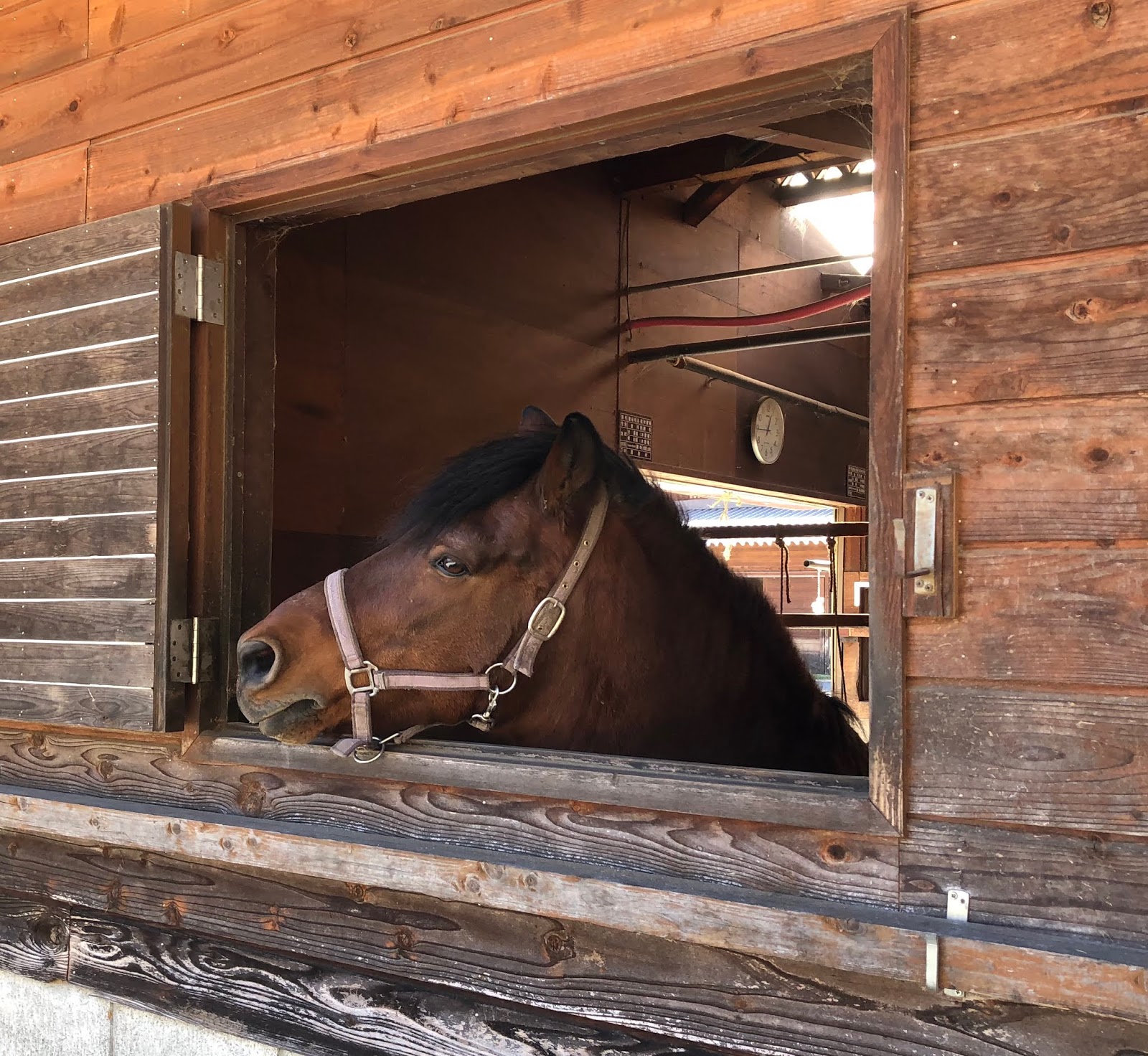
A friendly Kiso horse


They are native to Japan, and were long considered a food source, as well as working animals, in the Kaida area. In fact, basashi, horsemeat sashimi, is still a regional specialty of Kaida.

Welcome to Kiso. Make new friends . . . and eat them.

(And despite the cognitive dissonance it creates in my horse-loving heart, I think it's delicious.)

My hike to and through the Kaida Plateau included a stop at Kisouma no Sato, the "Kiso Horse Village" where these now-endangered horses are preserved, celebrated, and bred.

A resident of Kiso Horse Village

(For riding and interacting with, not for eating.)

The horses live in stables and large, open paddocks, with plenty of room to graze and exercise.

Horses grazing on the Kaida Plateau

Smaller paddocks near the walking paths offer visitors the opportunity to touch and interact with the horses one-on-one, while larger grazing areas give an idea of the way the horses were formerly allowed to roam the open areas of the Kaida plateau.

One on one time with the Kiso horses

Kisouma no Sato also has a visitor center with information and educational films about the history of the Kiso horse, and its importance to the region and to Japan.

Sadly, I didn't have time to take advantage of the opportunity to ride (visitors can either saddle up or ride in a horse-drawn cart) but I have plans to return.

So long, but not goodbye.

I'm sure my little fuzzy buddy will be waiting.


Saturday, January 4, 2020

There Is a Wedding Gift We'd Much Appreciate


Jeff—Saturday

Last week I announced Barbara’s and my wedding in a post titled, “No Gifts Please.”  Now that we’re married, things have changed.

But not for the reasons you might think. Rather it all arises out of something I first learned on New Years Eve. 

My ninth book in the Chief Inspector Andreas Kaldis series, AN AEGEAN APRIL—centered on the Eastern Mediterranean refugee crisis, and picked by Library Journal as a Best Book of 2018—has been selected as a KINDLE MONTHLY DEAL for January!


What this opportunity means to a book buyer is An Aegean April is now available for purchase through January 31st across every e-book platform for $0.99 by simply clicking on the link https://books2read.com/u/38E86w


What that means to this author is a potential source for cutting into wedding debt, but at royalties based on 99 cents a book you can understand why I’m so blatantly huckstering for sales—my first and last such effort on MIE in 2020.Thank you for indulging me this commercial moment, and please feel free to share my plea. :)  

Now, on to what I’d actually planned on posting before my very pleasant New Years Eve surprise.  It’s a piece that really should be written by a Scot since it’s derived from a poem by perhaps the most famous Scot of all, Robert Burns (1759-1796),

Burns wrote the poem (here’s the original version) in 1787, set to the tune of a traditional folk tune (Roud #6294).  Its seminal phrase, “Auld Lang Syne,” is traditionally translated as “long, long ago” though “old long ago” is more literally correct (based upon my deep understanding of the Lowland Scots language) and is a song about love and friendship in times past. For those of us who believe in time travel, astral planes, and questionable sobriety, I should point out that the phrase “auld lang syne” has been used by other poets in their work, including one Allan Ramsay (1686-1757), which I guess gives our Caro and her Alan a claim to have beaten me to the punch (bowl).

Happy New Year, everyone—and please forgive me, Scotland.


Should odd acquaintance be forgot,
And never brought to mind?
Should odd acquaintance be for not,
And made to toe the line?

For all fond thine, I cheer,
For all fond mine,
We'll share a cup o' kindness yet,
For we’re all fine.

And surely you’ll pick yours to hug!
And surely I'll pick mine!
And we'll show a lot o' kindness yet,
For we’re all fine.

For all fond thine, I cheer,
For all fond mine,
We'll share a cup o' kindness yet,
For we’re all fine.

We all have run about the hills
In search of flower wine;
And wandered many a weary foot,
But we’re all fine.

For all fond thine, I cheer,
For all fond mine,
We'll share a cup o' kindness yet,
For we’re all fine.

We too have paddled up the stream,
In mourning, fun, and grind;
And seas between us broad have roar'd,
But we’re all fine.

For all fond thine, I cheer,
For all fond mine,
We'll share a cup o' kindness yet,
For we’re all fine.

And here's a hand, my trusty friend!
And give a hand o' thine!
And we'll drink to kindness and good will,
For we’re all fine.

For all fond thine, I cheer,
For all fond mine,
We'll share a cup o' kindness yet,
For we’re all fine.

A Happy, Healthy, and Prosperous New Year to ALL!

—Jeff

Jeff's 2020 Speaking Engagements and Signings (in formation):

Thursday, March 12-Sunday, March 15, 2020 
San Diego, CA
LEFT COAST CRIME—San Diego Marriott Mission Valley
Panels yet to be announced

Monday, March 16, 2020, 11AM-2PM
Saddlebrooke, Arizona 85739
FRIENDS OF SADDLEBROOKE LIBRARIES 
30th Anniversary Authors Luncheon
SaddleBrooke Clubhouse
40010 S. Ridgeview Blvd.
Author Speaking and Signing

Thursday, June 4--Sunday, June 7, 2020
BRISTOL, UK
CRIMEFEST—Mercure Bristol Grand Hotel

Panels yet to be announced 

Friday, January 3, 2020

The Irreplaceable Mrs B.


 The old year ended slightly darker than it has started, the world of crime fiction lost one of its cleverest, most witty and devilishly mischievous writers.


I was strolling through Facebook Hogmanay, in my bed, too tired to stay up for the bells and I saw the news that MC Beaton had passed away after a short illness age 83. I was actually shocked when I read it, somehow I thought she would be around for ever as we tend to think these larger than life characters should be. She was small, wide swathed in purple velvet and attitude, her eyes glinted with an intellectual sharpness that was a beacon for her total inability to put up with inappropriate political correctness.


She was of course the creator of Hamish Macbeth and the fabulous Agatha Raisin, the former had been televised here 20 (30?) years ago starring a very young Robert Carlyle and a Westie Dog who broke wind constantly during the shoot, keeping its most potent out puffing for the sections of the story filmed in the airtight set of the police car interior.


My first encounter with MC Beaton was on a panel at Crimefest many years ago. I think I am right in thinking that our moderator was a much acclaimed crime writer called Cara Black. She is of course, American – I know we know that but I am pointing it out for a reason.  She introduced me and said something like ‘Caro was born in a ghetto in Glasgow, a place called Govan….. ‘And so it went on.

Then she introduced Marion, who spoke in public with quite a pucker English accent…’ Interestingly, I too was born  in Glasgow, in a ghetto called Newton Mearns…’’  They audience then had to witness me trying not to laugh, I was left snorting and snivelling. Newton Mearns is the Jewish really posh area of Glasgow, nobody was any the wiser but me.
                                               

And that moment always stayed with us. Whenever we met there was always that bond, I like to call it a no bullshit bond.

At one awards ceremony, I was already seated, I saw her come in. I popped over to say hello, she had her attendants all around her but she leaned over and whispered 'can you not come and sit at this table; I could do with a laugh.’ Our relative minders kept us apart and we sat through those endless, endless speeches, eye rolling each other, occasionally mouthing Glaswegian phrases that were less than complimentary to the speakers.


She was a great talent, a real wit and ferociously intellectual. She grew up as a reporter at a time when she was expected to climb in the windows of Glasgow tenements at the wake, to get the story on the deceased. I have many more stories, but right now I can’t recall a single one. She wrote over 160 books in her lifetime, starting as a buyer for a Glasgow bookshop before becoming a newspaper reporter and eventually, an editor. Latterly, she divided her time between houses in Paris and the Cotswolds.


I last saw her at Bloody Scotland; she was in the company of Ashley Jensen who plays Agatha Raisin. They had just finished filming a new series of the show. Marion looked a little frail, but we had a few words in the green room, she was still her sparky self.


She died on Hogmanay after a short illness.


More sadly, I had read one of her more recent books in November. It was as if it had been written by somebody else. Agatha’s character had gone from being an independent women who could take or leave men – mostly she wanted to leave them- keeping herself for her off on love interest for the historical writer who lived next door to her own cottage in the Cotswolds to a rather nasty man-eater, the plot didn’t quite gel, and it read as if it had not been edited properly.  It irked me so I looked up a few reviews, and yes, there was a general agreement that something was ‘off’ about the book.  

I do wonder why that was, and why it happened? A publisher under pressure to get something out there. Marion was such a professional, it really annoyed me that, maybe, she had become a victim if her own success.


It saddened me, so I am going to forget that book and watch Ashley Jensen strutting herself as the wonderful Agatha Raisin. The Quiche Of Death is my personal favourite so as a tribute to Marion, I am going to sit and watch it again tonight while drinking Irn Bru and eating chips (salt and vinegar not salt and sauce - no need to be getting above ourselves!).


Somethings are too good to change.


 Caro Ramsay

03 01 2020


Thursday, January 2, 2020

I found a gem!

Stanley - Thursday

When you live in a big city, it often takes visitors to make you explore places you've never visited. This happened to us a few days ago, except this time the visitors were only from St Paul - a mere stone's throw away from Minneapolis. (That is, if you can throw a stone across the mighty Mississippi.)

We were invited to meet our friends at The Museum of Russian Art (TMORA) in South Minneapolis - a location that I had passed countless times in my car and barely noticed. And what a surprise it was.
The Museum of Russian Art 
Probably one reason for not knowing that the building was a museum of Russian art is that it doesn't look like a museum of Russian art. In fact, it looks like a Mexican church. This is what the TMORA website has to say about the building.
The building style is Spanish Colonial-Revival, with architectural elements based on the Texas Mission in San Antonio. The façade silhouette resembles Mission San Antonio de Valero, also known as the Alamo. The Rose window and stone carvings are adapted from Mission San Jose y San Miguel de Aguayo, also in San Antonio. The pierced belfry, multiple arches, Romanesque windows, stucco walls, large wooden beams, and terra cotta tile roofs are all common to the Mission style. 
The (Mayflower) church’s first resident pastor, the Rev. Silas Meckel, traveled south to the Mission Valley and according to his daughter, Bette Meckel Babcock, fell in love with the architecture of the Mission Trail. Upon returning to Minnesota Rev. Meckel requested that the new church building reflect those Texas Missions. According to church member Marguerite Farnham Drake, “That Spanish Mission style was not a Congregational style and it really wasn’t a style appropriate for Minnesota, but it was a style that the Meckels were fond of and the congregation was extremely fond of the Meckels”
The building before its conversion to a museum

The church
So, how did it become a museum? Of Russian art?

Again, excerpted from the TMORA website:
In 1991, Raymond E. Johnson, an art dealer and collector, sponsored the first known retail exhibition of Russian Impressionist paintings in North America. The positive response by American collectors to this exhibition encouraged Johnson to launch a large-scale program to identify the finest examples of Russian Realist paintings from throughout the former Soviet Union. Since then, Ray Johnson and his wife Susan have acquired what is believed to be the largest privately owned collection of Russian Realist paintings outside the borders of the former Soviet Union. 
The Johnsons recognized the importance of their collection and, desiring to create a legacy honoring Russian art, they initiated the idea of a museum dedicated specifically to exhibiting the art of Russia. They founded The Museum of Russian Art (TMORA) at a Bloomington, Minnesota location in 2002, and the Museum’s inaugural public exhibition took place that year. In 2005, (after the Mayflower Church had moved across the street) the Museum moved from its original Bloomington site to its current location in Minneapolis.  
The building was then converted into a gorgeous exhibit space, retaining many of the original features of the church.
The main exhibition hall

The view from the gallery
 Exhibits change frequently, and the ones currently are


Here are some of the posters. Pretty much what I expected.


It is wonderful to keep learning. I've known many of Chagall's paintings for a long time. What I didn't know or a long time ago forgot was that he was born in Belarus. Here is the one that I liked the best.

David and Bathsheba (1956)
I also very much liked this piece, called Let him kiss me (1954) by Ben-Zion, who was born in the Ukraine.


Some pieces from Christmas with the Tsars.


And, finally, TMORA boasts an amazing gift shop with everything Russian that you can imagine, including a variety of matryoshka dolls.

Matryoshka dolls with faces of prominent people
However, the item that really caught my eye was not for sale. It was this painting on the wall. As my friend said: 'You can just tell that the milk maid on the right had just told a very funny joke.'


TMORA is a small but delightful museum, well worth a visit when in the Twin Cities.

I wish you all a healthy and happy New Year. Normally, I also usually wish people a peaceful one, but hoping for that may be suspending disbelief too far.