Annamaria on Monday
In March of 1986 I had already made up my mind about the death penalty. I was against it. Completely. Intellectually. Politically. Emotionally. Public opinion was raging on the subject at that time. The Supreme Court had declared it unconstitutional because of the Constitutional ban on cruel and unusual punishment and because of the enormous racial inequity in the way it was being applied.
But crime rates were high, and many people, maybe a majority, wanted it back. Mostly, they thought the threat of execution would stop people from killing. The hardest liners said - as the Attorney General of the United States has reiterated in the past few weeks, that "justice" required it.
It is that action by AG Barr that prompts me to write today. I have no individual permission to publish what I am posting here, but the words below were broadcast on the radio, so I think they are fair game. First let me tell you how I knew about them and how I acquired them in print.
In March 1989, while driving to the country house, I tuned into to my local public radio station and heard the voice of our then New York State Governor Mario Cuomo, speaking against the death penalty. When I arrived at my destination, I stayed in the car in my driveway to hear the Gov till the end. I never forgot that speech.
Fast forward to December 2017. On an Author's Guild trip to Cuba, one evening our group learned that another smaller tour group would be joining us on our bus. We were going off for a night of Cuban Jazz at the Buena Vista Social Club. I was traveling solo, and when I boarded the bus, I saw a man i knew had to have been from that other group, sitting next to an empty seat. As a gesture of inter-group friendship, I sat down next to him and introduced myself.
His group of ten were the board members of a anti-death penalty organization in the United States. Our conversation soon led to my telling about my wish that I could find that speech of Mario Cuomo's that I had heard nearly thirty years before and remembered so vividly. "I have a copy of that speech," he said. He sent it to me. Here it is in its entirety, transcribed from what looks like a copy of the pages from which Mario might have read it out. I hope it convinces you.
REMARKS BY GOVERNOR MARIO M. CUOMO
COLLEGE OF ST. ROSE. ST. JOSEPH’S HALL
ALBANY, NEW YORK
MONDAY, MARCH 20, 1989
 |
Governor Mario Cuomo
Photo: Judi Benvenuti |
It is difficult to imagine a more important subject for consideration than the one that brings us here together this morning.
Together the legislature and the governor every year make thousands of judgments that are important.
But occasionally we are confronted with a question that has transcendent significance: One that describes in fundamental ways what we are as a people; One that projects to ourselves, And to the whole world, Our most fundamental values…One, even, that helps configure our souls.
This is the right setting for such a discussion. Here at The College of St. Rose, Surrounded by excellent leader like Bishop Hubbard and Bishop Ball and Rabbi Silverman and so many Clergy.
Right… Not because it is a Christian or a Jewish Setting … or even a religious setting.
Right… Because this is a place, and these are people who believe in reason, enlightenment, and the uplifting of the human condition.
The question that confronts us is whether this state should choose to kill human beings by electrocution, as punishment for commission of the crime of murder.
I have spoken my own opposition to the death penalty for more than thirty years.
For all that time I have studied it, I have watched it, I have debated it, hundreds of times.
I have heard all the arguments, analyzed all the evidence I could find, measured public opinion when it was opposed, when it was indifferent. When it was passionately in favor.
And always before, I have concluded the death penalty is wrong. That it lowers us all, That it is a surrender to the worst that is in us; That it uses a power—The official power to kill by execution—which has never elevated a society, never brought back a life, never inspired anything but hate.
In recent years I have had the privilege of casting my vote on bills passed by the Legislature to bring back the Death Penalty. And I have voted against it each time. On each occasion that I did, The Legislature might have passed the bill despite my disapproval by obtaining a two-thirds vote. So far they have chosen not to.
Now the Death Penalty bill is before me again and there can be another chance for the legislature of this state to speak on this subject in the name of the people they represent.
Because of the awesome significance of the matter, and the immensity of the decision, I sought a chance to speak directly to the public so that I could add my voice to and underscore the cogency of the arguments made by the Bishop, the Assembly people and so many of you. And made already so cogently, so forcefully, so eloquently.
I thank Dr. Vacarro, The College of St. Rose, and The coalition for providing me this opportunity.
Clearly there is a new public willingness to return to the official brutality of the past, by restoring the death penalty. And it is just as clear what has provoked this new willingness.
Life in parts of the state, and nation, has become more ugly and violent that at anytime I can recall.
Many, like myself, who have spent more than fifty years in this state, are appalled at the new madness created by drugs. And frustrated by what appears to be the ineffectuality of the federal, state and local governments to deal with this new problem.
Savage murders of young, bright, and committed law enforcement people, and the other citizens, enrage us all.
Our passions are inflamed by each new terrible headline; each new report of atrocity.
We know the people have the right to demand a civilized level of law and peace. They have a right to expect it.
And when it appears to them that crime is rampant, and the criminal seems immune from apprehension and adequate punishment, and that nothing else is working—then, no one should be surprised if the people demand the ultimate penalty.
It has happened before. It will probably happen again.
To a great extent it is a cry, a terrible cry of anger, anguish born of frustration and fear in the people.
I know that.
I understand it.
I have been with the victims, too.
I have felt the anger myself, more than once.
Like too many other citizens of this state I know what it is to be violated—and even to have one’s closest family violated, in the most despicable ways.
I tremble at the thought of how I might react to someone who took the life of my son.
Anger, surely… Terrible anger. I would not be good enough to suppress it.
Would I demand revenge? Perhaps even that.
I know that despite all my beliefs, I might be driven by my impulses.
So how could I not understand a society of people like me, at times like this, wanting to let out a great cry for Retribution, for Vindication ... even for revenge, like the cry we hear from them now.
I understand it
But I know something else.
I know this society should strive for something better than what we are in our worst moments.
When police officers are killed, violence escalates and lawlessness seems to flourish with impunity, it isn’t easy for people to hold back their anger; to stop and think; to allow reason to operate.
But that, it seems like to me, is the only rational course for a people constantly seeking to achieve greater measures of humanity and dignity for our Civilization.
And so, for a few moments, let’s try, just try, to reason our way to a solution.
We need to respond more effectively to the new violence we know that.
But, There is absolutely no good reason to believe that returning to death will be any better an answer now, than it was at all the times in the past when we had it, used it, regretted it and discarded it.
There are dozens of studies that demonstrate there is simply no persuasive evidence that official state killing can do anything to make any police officer, or other citizen safer.
There is in fact, considerable evidence to the contrary.
Consider just this: For the decade before 1977, we had the death penalty in New York State. In that period 80 police officers were slain. For the decade after, without the death penalty… 54 were killed.
The argument for deterrence is further weakened by realization of how rarely and unpredictably it is applied.
For hundreds of years we have known that the effectiveness of the law is determined not by its harshness, but by its sureness.
And the death penalty has always been terribly unsure.
The experts of the New York State Bar Association’s Criminal Justice section, and The Association of the Bar of the City of New York, have come out strongly against the death penalty after hundreds of years of cumulative lawyers’ experience and study.
One of the points the state section made is that the death penalty must be regarded as ineffective as a deterrent, if for no other reason than because its use is so uncertain. Execution has occurred in only about five-hundredths of one percent of all the homicides committed in America over the past decade.
And then, despite Ted Bundy, It seems to threaten white drug dealers, white rapist, white killers, white barbarians a lot less than others.
Think of this: of the last 18 people executed in this state, 13 were Black and one Hispanic. And that seems an extraordinary improbability for a system that was operating with any kind of objective sureness.
And there’s more.
Some of the most notorious recent killings, like the gunning down of the D.E.A. Agent, Everett Hatcher, and the killing by Lemuel Smith, occurred in the face of existing death penalty statutes.
And psychiatrists will tell you that there is reason to believe that some madmen, just like Ted Bundy, may even be tempted to murder because of a perverse desire to challenge the electric chair.
For years and years, the arguments have raged over whether the death penalty is a deterent. That used to be frankly, the only argument when I first began debating it.
But the truth is now that because the proponents have never been able to make the case for deterrence convincingly, they have moved to a different argument.
It is phrased in many ways, but in the end it all comes down to the same impulse.
It was heard in the debates in recent weeks on the floor of the senate and assembly, which I listened to and read with great care. Things like this: “Whatever the studies show, the people of my area believe that taking of life justifies the forfeiting of life”. Or “ Our people have the right to insist on a penalty that matches the horror of the crime.”
Or even this: “An eye for an eye, a tooth for a tooth.”
An eye for an eye, a tooth for a tooth. Where would it end? “You kill my son, I kill yours.” “You rape my daughter, I rape yours.” “You mutilate my body, I mutilate yours.”
You treat someone brutally, and I – the established government of one of the most advanced states, in the most advanced nation on earth—will respond by officially, and deliberately, treating you brutally, by strapping you to a chair, and burning away your flesh, for all to see, so the barbarians will know that we are capable of official barbarism.
And we will pursue this course, despite the lack of reason to believe it will protect us—even if it is clear, almost with certainty, that occasionally the victim of our official barbarism will be innocent.
Think of it: At least 23 people are believed to have been wrongfully executed in the United States since the turn of this century. Twenty-Three innocent people officially killed. But it is not called murder.
And tragically, New York State — our great state, the Empire state – holds the record for the greatest number of innocents put to death over the years. We lead all the states in the nation with eight wrongful executions since 1905.
Here are the names of the victims of the state of New York’s killings: Charles Becker, Frank Cirofici, Thomas Bambrick, Stephen Grzechowiak, Max Rybarczyk, Everett Appelgate, George Chew Wing, Charles Sberna.
These are real names. These are real people. Like Mario Cuomo or Ralph Marino. Like Mel Miller or Fred Ohremstein. Like Clarence Rappelyea or Joe Serrano or Al Vann.
Or your son, or your father, or your mother. Real people who were killed, innocently.
The proponents of the death penalty in this state assume that the criminal justice system will not make a mistake.
They seem to be unconcerned about the overly ambitious prosecutor, the sloppy detective, the incompetent defense counsel, the witness with an ax to grind, or the judge who keeps courthouse conviction box scores. But that, ladies and gentlemen, is the human factor, and it’s the deepest, most profound flaw in their argument.
In this country, a defendant is convicted on proof beyond a reasonable doubt – not proof to an absolute certainty.
There’s no such this as absolute certainty in our law.
The proponents of the death penalty – despite this – say we should pretend it cannot happen.
They do not discuss the infamous case of Isadore Zimmerman, who got so far as to have his head shaved and his trouser leg slit on the day of his scheduled execution in 1939, before governor Herbert Lehman commuted his sentence to life imprisonment.
And the Twenty- Four years later, Zimmerman was released from prison, after it was determined that the prosecutor knew all the time that he was innocent and had suppressed evidence. Zimmerman died a free man just a few years ago.
They do not discuss William “Red” Gergel, age 62, released in Queens just this year after spending 535 days in jail for a triple murder he did not commit. It was a case of mistaken identity.
They do not discuss a young man named Bobby McLaughlin of Marine Park, Brooklyn.
Bobby McLaughlin was convicted of the robbery and murder of another young man in 1980. This was a one–witness identification case – the most frightening kind.
In July of 1986, Bobby McLaughlin was released after serving six years for a murder he did not commit. Wrongly convicted by intention or mistake – take your pick of the facts – right here in the great state of New York.
It all started when a detective picked up one wrong photograph.
One wrong photograph, one mistake, one date with the electric chair. It could have been one more tragically lost life.
It didn’t happen. But it took an almost superhuman effort by his foster father and some aggressive members of the media. To keep the case from falling between the cracks of the justice system.
Bobby McLaughlin had this to say after he was released: “If there was death penalty in this state, I would now be ashes in a urn on my mother’s mantle.”
Yes, It can happen. And it will again, if we allow it to.
And what would we tell the wife, what would the governor tell the wife then, or the husband or the children of the parents, of the innocent victim that we had burned to death in our official rage? What would you say to them?
“We had to do it?”
Then we would be asked, but why did you have to do it, if you were not sure it would deter anyone else, why did you have to do it? And what would we answer? “Because we were angry. Because the people demanded an eye for an eye… even if it were to prove an innocent eye?”
What would we tell them. Should we tell them that we had to kill, because we had as a society come to believe that the only way to reach the most despicable among us was to lie down in the muck and mire that spawned them?
I hear all around me that the situation had so deteriorated that we need to send a message, To the criminals and to the people alike, that we was a government know how bad things are and will do something about it.
I agree.
Of course we must make clear that we intend to fight the terrible epidemic of drugs and violence.
But the death penalty is no more effective a way to fight them, than the angry cries that inspire it.
We need to continue to do the things that will control crime by making the apprehension and punishment of criminals more likely.
We’ve made a good beginning. Since 1983 we have increased funding for local law enforcement alone by 65 percent.
We’ve added 500 more states troopers to the force. We’ve opened 13,000 new prison beds, and we will be adding room for another 4,000 by 1990. We’ve tripled the number of drug felons sentenced to state prison, and increased dramatically our rehabilitation efforts.
We should be doing more.
The legislature should be giving me the forfeiture bills I’ve asked for. I hope they will. Those bills will allow us to take the wealth away from the drug dealers and put it to use fighting them and rehabilitating people who are addicted to drugs.
They should give me the judges I’ve asked for, the troopers, the money for courts and prisons, and rehabilitation programs.
And one other thing.
The legislature should finally vote for a real, tough, effective punishment for deliberate murder.
And there is one. Better, much better than the death penalty. One that juries will not be reluctant to give.
One that is so menacing to a potential killer, it would actually deter.
One that does not require us to be infallible in order to avoid taking innocent life.
One that does not require us to stoop to the level of the killers.
One that is even – for those who insist on measuring this question in dollars – millions of dollars less expensive than the death penalty, millions … true life imprisonment, with no possibility of parole … none, under any circumstances.
If you committed a murder at 20, and you live to be 81, you’ll live 61 years behind bars. You’ll go in alive, and come out only when you die. Now that’s a tough penalty.
Ask the people who know, how tough this penalty would be. The people who know Attica, or Auburn. Ask the people who know how hard such places are.
They will tell you to most inmates, the thought of living a whole lifetime behind bars – only to die in your cell … is worse than the quick, final termination of the electric chair.
Anecdotal evidence is, of course, limited in its usefulness. But it can give you insight.
Just recently, in an article in The New York Times Magazine, a young man on death row named Heath Wilkins was asked whether people underestimated the deterrent power of life without parole.
“Absolutely”, Wilkins responded, “Death isn’t a scary thing to someone who’s hurting inside so bad that they’re hurting other people. People like that are looking for death as a way out.
For the six years I have offered it to the legislature, I have heard no substantial arguments in opposition to the proposal for life imprisonment without parole. I’ve heard none.
If they fail once again this year to achieve their preferred choice – The electric chair – I hope the legislature will put aside any temptation simply to preserve a political issue and, instead, finally give the people of this state what I believe is a smarter, saner, more effective answer … By adopting real life imprisonment, without parole.
Finally, while we are fighting the criminals in the street with the relentless enforcement of firm laws and with swift, sure punishment, we must at the same time continue to do all the things we know dull the instinct for a crime.
Education, housing, health care, good jobs and the opportunity to achieve them.
All the old fashioned effort to deal with root causes that has never lost its relevance, even when it lost its popularity.
That, in the end, I think personally, may be the best antidote of all against the kind of terrible crime we are now experiencing. Certainly it offers us more hope than does the politics of death.
Now ladies and gentlemen, brothers and sisters, there will be few questions more difficult for us than the one we now face.
And few opportunities as good as this to prove our commitment as a people to resisting the triumph of darkness. And to moving our society constantly toward the light.
For a politician, like the people from the assembly who have joined us today and myself rejecting what appears to be a politically popular view can be troublesome.
But I – as they do – make the same decision I have before, in my case, I make the same decision now that I have for more than 30 years. This time I believe on the basis of even more evidence and with a firmer conviction than before.
And I do it with a profound respect for the people who have raised their voices … and occasionally even their fist… asking for the death penalty.
I have not as governor ignored those voices. I have listened intently to them.
But after the sincerest effort, I have not been able to bring myself to agree with them.
I continue to believe with all my mind and heart, that the death penalty would not help us… it would debase us; that it would not protect us … it would make us weaker.
I continue to believe more passionately now than ever, that this society desperately needs this great states leadership.
We, the people of New York, ought now, in this hour of fright, to show the way. We should refuse to allow this time to be marked forever in the pages of our history, as the time that we were driven back to one of the vestiges of our primitive condition, because we are not strong enough, because we were not intelligent enough, because we were not civilized enough to find a better answer to violence … than violence.
Today I will veto the death penalty bill sent to me by the legislature and return it with my proposal for life imprisonment without parole with the hope and the prayer that the legislature will once again choose the light over the darkness.
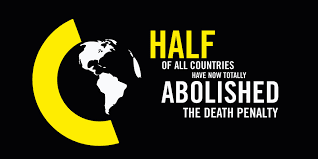 |
| I pray that my country will go back to being among the enlightened of the world. |