Monday, July 3, 2017

What to Keep


Annamaria on Monday

I don’t have an attic anymore. 

I grew up in a two-family house where we shared the attic with my grandparents.  When I was kid, it had stuff in it like a Japanese sword captured on Okinawa and my mother’s bridal gown.

When the family moved for the first time in a few decades, the stuff in the attic got moved, too.  All if it.  Then, more accumulated.  When my dad sold the family home about twenty-five years later, three generations worth of stuff got moved to David’s and my attic in the country house, soon to be joined by two more generations' worth.

I had to triage all that drastically in 2012, when the last of my attics left the family.  I have been spending this Independence Day weekend trying to free myself from the dregs of what is left of about a century's worth of largely mindless accretion.  I have discovered some prizes and spent quite a lot of my time reminiscing and kvelling over the fact that I still have the following:

Three generations of wedding dresses: my mothers, mine from my second marriage, and my daughter’s.  Here they are with photos of the brides who wore them.


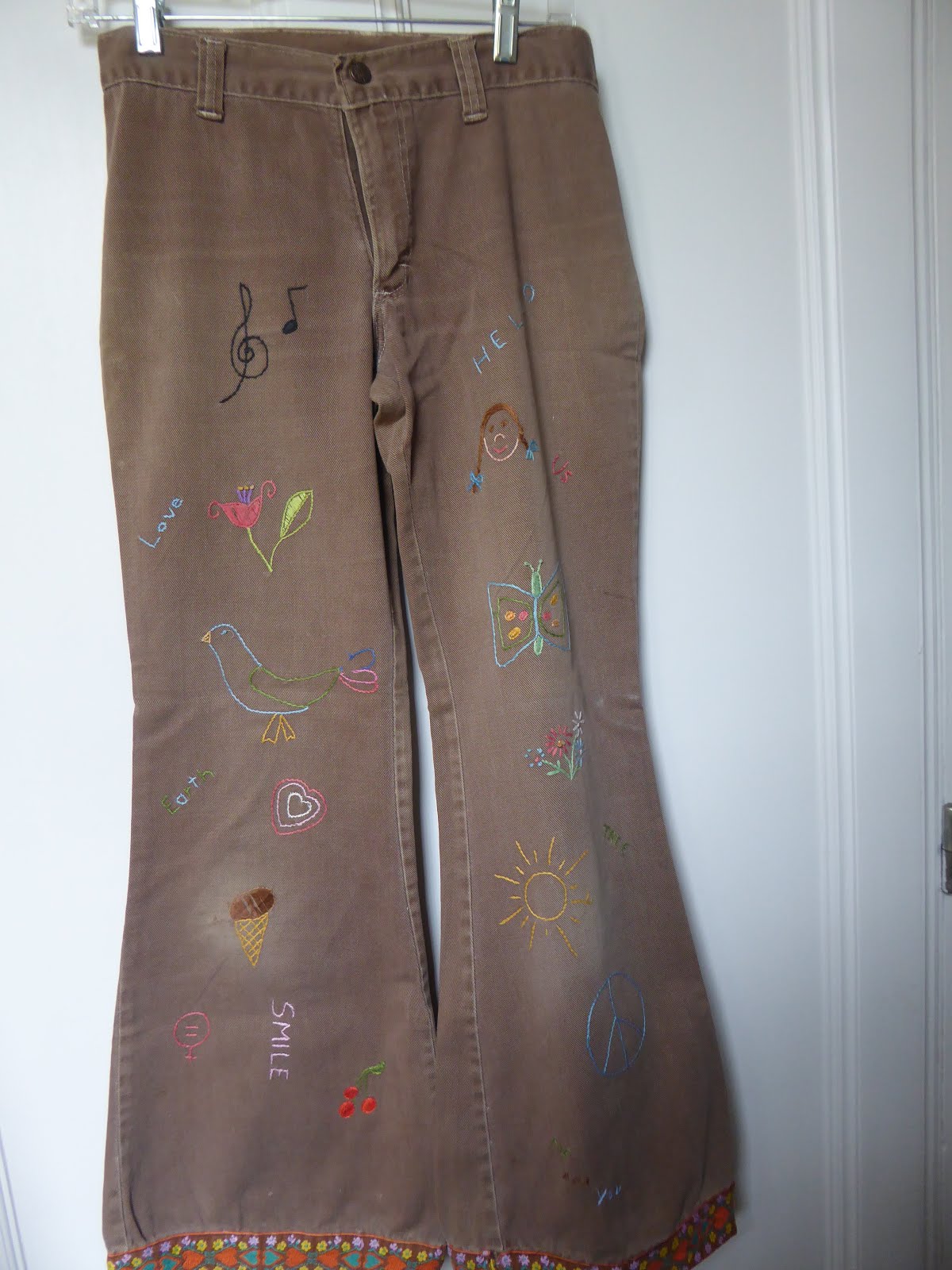
Hippy clothing:

David owned these shoes when we met.  One day I'll find the photo
of him wearing them on our first first trip together, driving the California Coast


The children in the commune told me what to draw on
these jeans and picked out the colors of the
embroidery thread.  

Best of all, theater memories:
  

These, some of my first Broadway shows, turned out to be legendary.  They are still vivid in my memory, and am I glad I hung on to the souvenirs!


April 1963: Emlyn Williams as Sir Thomas More

June 1958: Robert Preston in The Music Man, with
Barbara Cook as Marian the Librarian!

May 1961: Mary Martin as Maria
BEST OF ALL:

May 1964: Richard Burton's Hamlet.  I can still describe
the staging and tell you what Hume Cronyn wore when
he played Polonius.

So what do you keep?  What do you wish you had kept?

Sunday, July 2, 2017

Mistakes What I Have Tried: the words that confuse us the most


Artefact / Artifact
Having recently finished writing a book where archaeological items play a role, the word artefact cropped up occasionally in the text. My US copyeditor corrected this to artifact, which I initially understood to be simply yet another example of the difference between English-English, and American-English. And, indeed, some dictionaries have the same definitions for both words, with only that difference between them. However, others list an artifact as being a physical object possibly of historical significance, while an artefact is for more abstract, intangible use, such as an error in a compressed digital file.

Enquiry / Inquiry
Likewise, when my US copyeditor corrected all my enquiries to inquiries, I thought the same US/UK spelling rules applied. But it appears that enquiry is used more in the nature of a question, instead of ask, where inquiry denotes a more formal investigation.

Reign / Rein
Another one I keep seeing a lot of, particularly in the sense of giving someone a free hand to do something. Although I can see the logic in using reign for this purpose—after all, it does suggest a monarch who can do as they please with their subjects—it’s not correct. It’s a horse-riding term, as in not holding the horse back by having the hand keep a tight hold on the rein.


Callous / Callus
For some reason I’ve been coming across this one quite a bit lately, and usually wrongly used. Callous means cruel or insensitive, whereas a callus is a thickened patch of skin, as on the hands of a manual labourer, or the bony tissue that forms over the site of a fracture.

Imply / Infer
I can imply something from what I say, and you can infer from it, but not the other way around. Imply is to suggest. Infer is to deduce.

Round / Around
The distinction between round and around is one that frequently has me confused, I must admit. Generally, the former is used far more frequently in the UK, and the latter in the US. Round tends to be less formal, too, and is used more in English speech. There are occasions when around would be incorrect, depending on the definition. You wouldn’t play around of golf, for instance, although if you didn’t take it seriously there’s no reason why you couldn’t play around while playing a round of golf.


I’ve also assumed round had a closer proximity than the more general around, although I don’t really have evidence for this. I would normally write that someone wore a scarf round their neck, but that there were candles placed around the room. To my mind, if you look round, you just turn your head. If you look around, you go nosing into all the nooks and crannies.

Pursue / Persue
This is one of my favourite accidental discoveries. Most people know that pursue means to go after; to chase. My Chambers dictionary says it is ‘to follow in order to overtake, capture or kill’ something. In Scots’ law it means to prosecute or sue. But persue comes from Spenser, who seemed to take delight in making up new words. It means a track of blood, from the French percée, to pierce.

Hanged / Hung
This one is wrongly used all the time—especially in period dramas—and it bugs me. Basically, meat or pictures are hung, but people are hanged. Except, of course, if one is not talking about putting a rope round—or indeed around—their neck, but referring to a different part of the body altogether …

OK, I’ll leave that one there, shall I?


Destroyed / Decimated
If you destroy something, you pull it down, demolish it, overturn, kill, ruin, put an end to, or ruin it. If you decimate it, however, you take or destroy only one tenth of it. If defeated in battle, the Roman commanders would punish their troops by killing every tenth man. It has now come to mean to significantly reduce rather than utterly demolish.

Androgenous / Androgynous
Both these words have their roots in the Greek andro- denoting male. One of the male sex hormones is androgen, and the same name is applied to synthetic compounds with similar effect. So, androgenous means to have only male offspring. But when you combine andro- with the Greek gyne, woman, from which comes gynaecology, we get both male and female in one word, or one individual.

Discreet / Discrete
If someone is good at keeping secrets, they are discreet; careful in their actions, prudent, modest. Discrete, on the other hand, means something that has distinct separate parts. It is often used in an abstract context, where it means the opposite of concrete.


Flammable / Inflammable
There isn’t actually a difference between flammable and inflammable; they both mean capable of burning. The original word was inflammable derived from inflame or enflame. The word flammable was coined in the 1920s, apparently by the National Fire Protection Association (why does fire need protecting, I wonder?) because they were concerned that people might confuse the word inflammable with non flammable, meaning it was not capable of burning.

Less / Fewer
Simple rule for this one. If you can count something, use fewer. If you can’t, use less.


Blatant / Flagrant
The easy way to differentiate between these two is to remember that blatant is something that is ‘offensively conspicuous’ while flagrant is something that is ‘conspicuously offensive.’ If that doesn’t help, my trusty Chambers dictionary suggests that blatant is something that is noisy, obtrusive and glaringly obvious, while flagrant is something that is notorious or outrageous. It also means burning or raging. From this we get the phrase to be ‘caught in flagrante delicto’—to be caught in the act. Literally, ‘while the crime is blazing’.


Presumably, therefore, to be ‘caught in blatante delicto’ means they can hear you from all the way down the corridor …


What about you, folks? Any favourites you'd like to share?

And although I didn't know it when I wrote this blog, tomorrow is actually English Grammar Day!

Saturday, July 1, 2017

Athens and Mykonos: For Better or Worse?


Jeff—Saturday

Two classic literary lines come to mind as I hunker down this Friday afternoon inside a friend’s naturally cool guestroom, squirreled away from the 105 degree F (41C) Athens heat, contemplating how to survive an even warmer Saturday attending the outdoor college graduation of my close Mykonian friends’ sons.  But I shall persevere and overcome.  Which brings me back to those two lines, and what’s on my nearly fried brain…make that poached.


“I come to bury Caesar, not to praise him,” is the first (thank you, Bill), and the second is, “It was the best of times, it was the worst of times” (kudos to you, Chuck).

They come to mind because I’m honestly not sure if what I have to say is intended to bury, exhume, or praise two places I truly treasure, or whether it’s their best or worst of times.

First, Athens. 


There is no need to go into detail describing all that’s rocked Athens as a result of the worldwide financial crisis. Unemployment is still at Great Depression era levels, it faces insurmountable bailout obligations, and though reports of its death may be greatly exaggerated (a bit of a borrowing from Mark Twain), likely just as exaggerated are reports of its imminent recovery … certainly economically. BUT, there is a distinct new upbeat vibe taking hold in the city, one that I’d missed until now.

Yes, the Athens garbage collectors are on strike, and protestors in the Exarchia part of town are tossing petrol bombs at police, but that’s pre-crisis business as usual activities. 


What’s different is a noticeable lift in the spirits of the Athenians.  As if they’ve come to accept that times aren’t going to get better anytime soon, so they’re going to do what they must to make the best of it.  The art and culture scene is in robust revival, hotels are packed—with new ones coming on line or being refurbished—and the young are looking for innovative new ways to make things better for themselves and their country. 


That’s the sort of diehard entrepreneurial Greek spirit which stands the best chance of propelling Athens and the nation out of these dark times—and with just a little help from their friends (tip of the hat to the Beatles) in government, they just might pull it off.

So, is this the best of times or the worst of times for Athens?  That’s not for me to say, no more than can I for the second place on my mind, Mykonos.

Twenty years ago 


As many know, I call Mykonos home, and have felt that way for thirty-five years.  But just as Guest Blogger Lisa Alber observed here earlier this week, and others agreed, hometowns inevitably change. Mykonos is no exception.  If you go back to World War II, it was a place of starvation and struggle, but for purposes of this comparison, my baseline is just a couple of decades ago, after the island had already established itself as a tourist paradise. 

Today, it’s catapulted itself into a completely different orbit, one where Mykonos stands as an international symbol of tourist hedonism and 24/7 glitz.  I think it’s safe to say (despite Santorini’s anticipated objections) that there is no more profitable a place in Greece to do tourist related business than Mykonos. Inevitably that has attracted a myriad of investors looking to outdo one another in projects aimed at attracting and maximizing as big a share of that high-end market for themselves as they can. 

Does all that development better or worsen Mykonos?  Again, I have no answer, but one thing is for certain: As with so many other "hometowns," the old Mykonos of my contemporaries' recollections is long gone.

For example:

Paraga Beach 50 years ago (courtesy Dimitris Koutsoukas)

Paraga Beach 45 years ago (courtesy Dimitris Koutsoukas)

Paraga Beach today

Perhaps Shakespeare or Dickens can answer those questions, but at the moment what really matters to me is only one thing:

Congratulations, Nikos Fiorentinos and Spiros Apostolou on your graduations from college.  May you continue to make your communities and the world a better place!


—Jeff