Saturday, June 21, 2014

Greece As A Muse.


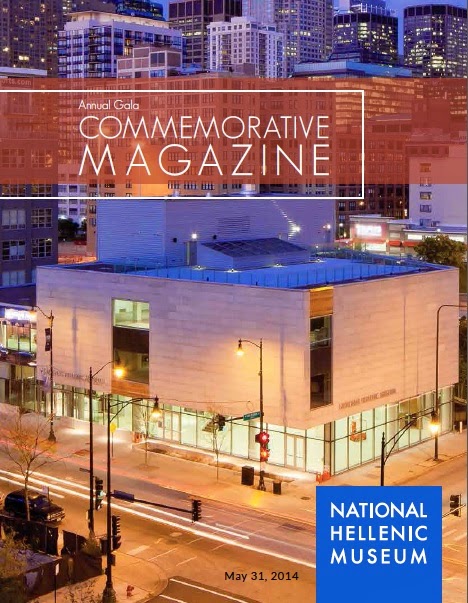
This post comes to you courtesy of the Chicago-based National Hellenic Museum, for it is the essay I prepared for NHM’s Annual Gala Commemorative Magazine, “Journey to the Greek Islands”—a glitzy first-rate affair, and that’s just the magazine!  The Gala took place May 31st as the central fundraising event for America’s only national institution dedicated to preserving, commemorating, and celebrating the enduring contributions of generations of Greek-Americans to the very fabric of national life.  Thank you, NHM, for this distinct honor and, thank you, Renee Pappas, for both the opportunity of contributing to your first rate publication and giving me something to post this week so that I might play uninterrupted with my visiting grandchildren (their parents in tow) during their own journey to the Greek islands.

The Muse is always with them; they live in a place of complete happiness in perpetual sunshine.  Those words are derived from the works of two legendary Greek poets separated by 2500 years: Pindaros, the lyric master of Greece’s Classic Golden Age, and George Seferis, a 20th Century, Nobel Prize winning giant.
George Seferis (1900-1971)
 
Pindar (522-443 BCE)


Each was speaking of Hyperborea, a mythical land somewhere beyond the north wind.  Sort of like Peter Pan’s Never Never Land, but different.


It’s not surprising that they wrote of such a place, for creative types are always searching for their Muse, and—except among the clinically depressed—for happiness and sunshine.  The artistic process is largely a solitary quest, lived out among the thoughts, anxieties, and instincts of the mind, so anything that helps bring about a visit from the Muse is as welcome as a pardon to the imprisoned.  

For writers, artists, and musicians in search of inspiration who don’t like cooling their heels waiting for some fickle muse to show up, or simply prefer finding one on their own, the trick is in knowing where to look.  To me the obvious suggestion is the same today as it was in Pindaros’ time back in 500 B.C.E., “Seek a place of sunshine and happiness and ye shall find your Muse.” 

Translation:  Go to Greece—even if it’s not as sunny and happy a place as it was a couple of millennia ago.


That’s not novel thinking on my part. It’s been that way practically forever.  Foreigners have always come to Greece to find their destiny.  Even Herodotus, “The Father of History,” who wrote Western literature’s seminal work on much of what our world knows of Ancient Greece and its times, was not born in Greece, but in the rival Persian Empire. He did not migrate to Greece until his late thirties where he composed most of The Histories. In what some might say was a nod of appreciation to what inspired Herodotus to create his opus, The Histories are divided into nine volumes, one named after each Muse.

For many, the first person that comes to mind when asked to name one among all the foreign cultural icons drawn to Greece to find their Muse is Lord Byron, the notorious romantic poet who gave his life to Greece’s War of Independence.  
 
Lord Byron
Less flamboyant, but no less inspired by Greece was Byron’s friend and fellow Romanticist, Percy Bysshe Shelley, who wrote, “We are all Greeks,” “Our laws, our literature, our religion, our arts have their roots in Greece.”

Percy Bysshe Shelley
Those roots transplanted well. There is not a place on earth unaffected by the Muse that is Greece.  W.H. Auden, another legendary English-born poet perhaps put it best, “Had Greek Civilization never existed…we would never have become fully conscious.”

W.H. Auden
But for most mortals it is not the study of Greek history that brings fire to the creative experience; for that sort of magic to happen you must experience Greece first-hand.

I love sitting on a beach in the early morning taking in the smell of wild rosemary and thyme scented sea breezes, watching sunlight dance upon the water casting the sea in hues of silver, rose, and gold, popping distant islands into sight, and bouncing shades of blue across the sky to fire up a splash of green along a light-brown hillside, a shot of pink amid oleander green, a beige lizard against a gray wall, or a cresting wave of white against a deep blue sea.

But my favorite time of day is late afternoon, as light ranges across fields of ochre, gray, and black––framed in the stones and shadows of ancient walls lumbering up onto hillsides or sliding down toward the sea.  Those moments never fail to make me wonder how akin my own thoughts might be to those of ancients who looked out upon those same hills, seas, and sunsets so many thousands of years before.

How can one not find inspiration in such moments? And many have. 


Among the world’s literary masters, John Fowles wrote and set The Magus on Spetses; Lawrence Durrell’s life on Corfu, Rhodes, and Cyprus profoundly influenced all of his writing; Henry Miller, during a visit to his friend Durrell on Corfu, wrote “The light of Greece opened my eyes, penetrated my pores, expanded my whole being,” and penned what he considered his finest book, The Colossus of Maroussi; Louis De Bernieres’ Captain Corelli’s Mandolin brought Cephalonia to life for much of the world; Mark Twain, in The Innocents Abroad, the best selling travel book of all time, described 1867 Greece in far less than complimentary terms, but with observations of undoubted interest to students of Greece today (Chapters 32 and 33); and Patrick Leigh Fermor’s work showed his deep love and appreciation for all things Greek from before his days of service as a war hero on Crete through his final ones in Kardamyli close by his beloved Mani.  

Musicians of every genre have found their Muse in Greece.  Greek gods, heroes, and legends inspired operatic classics by the likes of Mozart, Offenbach, Handel, Gluck, Verdi, Rossini, and Gounod.  Others found musical inspiration though experiencing the Greek life:  Classic violinist and conductor Yehudi Menuhin had his love affair with Mykonos (one which I share), Joni Mitchell wrote and sang songs of her time spent on Crete, Leonard Cohen found his home on Hydra influencing his work, as did Rhodes and Pylion home owners Rick Wright and Roger Waters of Pink Floyd.


And when it comes to artists influenced by Greece, the list is endless.  One from centuries back who immediately comes to mind, even though he never travelled to Greece, is Eugene Delecroix for the sheer power of his depiction in The Massacre at Chios of the horror wrought upon that island during the War of Independence. In the 1950s and 1960s, photographer Henri Cartier Bresson captured the essence of Greece in black and white photos that give him claim to rival Apollo for the title god of light. But of all the modern lovers of Greece, no artist has charmed his Greek Muse more than American artist Thomas McKnight.  His instantly recognizable work introduced generations of non-Greeks to the land he’s called his spiritual home for more than forty years.  Today, more artists (including actors) are calling Greece home for at least part of each year, notably American artist Brice Marden on Hydra, and Tom Hanks and Rita Wilson of Antiparos.

Thomas McKnight

For those of you who don’t think “sunshine and happiness” are a sufficient explanation for why so many seek their Muse in Greece, I can offer you this observation by the distinguished psychologist James Hillman, “We return to Greece in order to rediscover the archetypes of our mind and of our culture.”  But instinctively I think the answer lay closer to the thinking of baseball philosopher Yogi Berra, “If you come to a fork in the road, take it.”

After all, that’s just about how author Truman Capote ended up spending the summer of 1958 on the island of Paros. He was soul searching.  He’d finished writing Breakfast at Tiffany’s earlier that year and was a year away from beginning work on In Cold Blood, and as his time on Paros drew to a close he wrote this line in a letter to his New York publisher, Bennett Cerf, “I’m leaving here in four days—sad, it has been a wonderful working-place.”

Truman Capote

Yes, the answer could be as simple as that.  Greece is just a wonderful place to create. 

Personally, I’d like to think there’s something deeper of a draw to this birthplace of the gods where the Iliad and the Odyssey still serve as travel guides for some. It’s not anything I can put my finger on, but I sense it’s out there, waiting for the right moment and the right person. Just look to the Book of Revelation. Whether you believe it’s a vision from on high or the inspiration of a man, there’s no denying its impact on the world for nearly two thousand years.

And it all began with one man sitting in a tiny cave on the island of Patmos, under a bright blue sky, on a hillside staring out across green fields and olive trees toward a sapphire sea laced with muted brown-green islands.

View from the Cave of Revelation, Patmos

I guess what I’m getting at is that what draws so many creative types to Greece is likely a question only God can answer definitively. All I know is that Greece works just fine as my Muse, and for that I’m eternally grateful.

Yiasas.

Jeff—Saturday


Friday, June 20, 2014

The Eyewitness


In crime fiction we tend to tie things up neat and tidy – in the end but only after a plot with more twists and turns than the river near Tomintoul. The final thing we do, is put the perpetrator in a little box, the case fixed by a nice wee dollop of DNA.


The use of faulty eyewitness ID in ...(whatever novel it is I am on now....writing 6, researching 7, gearing up for publication of 5 and getting very confused.) Tears Of Angels caused me to have a re-think. Do such mistakes really happen? Can people have such certainty and confidence about their own testimony?
Then a cheerful happenstance  I was offered a place on a course on Forensic Psychology And Eyewitness Identification.
                                         

The importance of  'evaluation' of eyewitness evidence should never be overemphasised  because many facts make such evidence largely unreliable. 70% of the cases of the cases of wrongful conviction now being overturned by  DNA evidence were convicted in the first place because of incorrect identification by eye witnesses.
                                             
Although forensic evidence has its place – many more convictions are based on the evidence of the victim or eyes witnesses – a jury full of people tends to believe  people. My lawyer friend says that;  A jury will go with a  “ nice lady victim”  versus "evil man in the dock.' The fact that it has got to court so there is no exculpatory evidence.  So he is convicted…
And the firm confident eyewitness evidence of the nice lady victim will always  play a huge part.
But being confident doesn't mean being right.
The jury don't want to hear about the dull light, the trauma, her state of terror at the time, the fleeting glimpse.....and on it goes.
                                              
The forensic psychiatrist evaluates the accuracy and usefulness of any eyewitness ID.  Research has shown that children make much better witnesses than was previously suspected, but any evidence from them must be viewed from their world perspective. For adults they have established guidelines on distance (15m), light, familiarity and the duration of the event ( more than 15 seconds). They have posed doubt on co-witness accounts; don't let witnesses talk to each other. Forensic psychologists have changed the way police question victims or eyewitnesses. It's Do you see the man in the line up... not.... which of these guys was it? Even the most subtle nuance  can alter the memory.
                                               
It’s all about meta cognition and meta memory.  And all memory is like a story – it changes every time its told and shared.

Memories are also subject to influence by social media and general media – public outcry about a crime – about the way it is reported can affect the memory and the confidence of the eyewitness reports of that crime. A recent murder in Glasgow produced a warning from Police Scotland. Do Not Discuss this on Facebook.

For part of this course I was asked to put the following eight factors into the correct order with those that have contributed  most to wrongful conviction at  the top. They are from the USA and 'wrongful conviction' refers to a case later overturned by DNA evidence
So the 8  are
           informants 
          DNA inclusion
          defective forensic science
          forensic blood analysis
          eyewitness ID
          police misconduct
          false confession
          false witness testimony

Answers at the end...
                                              
Some figures from Project Innocence. Of the 275 exonerations by DNA, 75% had eyewitness ID as main contributory factor in their conviction. Weirdly for our CSI generation, 23% of wrongful convictions were due to ‘bad’ forensic science.  My pathologist pal always states that pathologists should know nothing about the victim and the likely perpetrator. It should all be double blind. The findings are subjective and experts are only human.
A partial fingerprint found on a bomb? Does it really help if fingermark XYZ is known to be that of somebody with previous convictions of terrorism, or belonged to a certain racial, ethnic or religious group.  If the media are baying for blood after an outrage, how far will the eye search for the merest of matches in swirls and loops in a fragmented print. Will the search continue until they feel a match is made.  Much better then to have no knowledge of the surrounding circumstances at all.
Bad finger print ID accounts for much of the faulty forensic science.
                                     
Other stories include the 16 year old hunt for the Phantom of  Heilbron where the  same female  DNA was found at over 40 crime scenes. In the end it was proved to be that of a perfectly innocent woman who worked at the factory in Germany that manufactured the swabs. The swabs were sterile for medical use but not DNA sterile for forensic use.
                                                    
And my pathologist pal tells of a case where a smattering of black powder started to appear on the bodies of all kind of victims. All victims were attended by the same forensic pathologist (not my friend) – it was from the frayed binding of his little black notebook.

A much more serious case involved a  murder of a woman and her daughter in a field . With little or no evidence to go on the police had ordered forensic tests on all the clothing present. Sure enough, one perfect spray pattern of DNA loaded mucous appeared.
Joy was short lived when it was proved to be the lab technician who had tested it – caused by an inadvertent sneeze!

The answers - 1)  Eyewitness ID
                       2)  Forensic blood analysis
                       3) Police misconduct
                       4)  defective forensic science
                       5)  false confession
                       6)  false witness testimony
                       7)  informants
                       8)  DNA inclusion


Well I think that was what was on the screen, but my eyes might have deceived me.

Caro 20 06 2014
   

Thursday, June 19, 2014

Getting a Life


This blog was going to be about my visit to the South African Book Fair last week.  The weather was variable - as it is in Cape Town in winter – but at least we had a few gorgeous days before an awful weekend when we could take refuge at the Convention Center.  One of the great pleasures of being a writer is meeting other writers, readers, and people in the book business.    These people have wide interests, read a lot (smiley face), and can talk about a variety of topics.  Even if they don’t know a lot about them, they see things from different and interesting perspectives.  (Just consider the other authors on this blog.  My case rests.)  So my plan was to write about a couple of the interesting writers I met and whose books I now have by my bedside or on my Kindle.  They are not mystery writers, but they have stories to tell.  However, life got in the way.  Or rather 150 Freshman exam papers to mark by Friday – That’s tomorrow?  You’re kidding! -  got in the way.  So I’m going to postpone those stories to a future blog.

In contrast, as a mathematician in my previous life, I was lucky to meet anyone who didn’t talk in equations.  I intended to start this blog with a single example along those lines to make the point, but I ended up intrigued.  (Okay, so I’m still a mathematician.)  Here is my suggested scoring table.  (The hippo doesn't count.) For each one you get, score one point.  If in addition you found it funny, score a second point.  If you get more than 16 points, you probably should go out more and try to make friends.  Or at least one friend.  If you get more than 20 points, it’s probably hopeless, but you might try the internet social sites.  They are the ones that…never mind. If you get more than 25 points, score two more points!


(Why is this the only one with "she"? That is not cool.)


Michael (with apologies) - Thursday

Wednesday, June 18, 2014

A visit to "Chinawood"


Whenever I come to China, I try to go somewhere I’ve never been. On this trip, I decided to visit Hengdian World Studios. I worked on a film studio lot in Los Angeles for many years; how could I resist a visit to the largest filming facility in China, which, as I understood it, is also a tourist attraction a la Universal Studios.


This trip happened kind of quickly and I didn’t have much time to research it or even really think much about where I was going and what I would do. I’d read an article about Hengdian that purported to explain how to get there and what to do, and for whatever reason, I just took it on faith that the information was correct.


So, I took a high-speed train from Shanghai to a place called Yiwu that I knew nothing about. From Yiwu I was supposed to look for Bus K850 and for 1.5 yuan take that to someplace called Jiangdong, where supposedly there were shuttles to Hengdian for 10 kuai. I didn’t know what time the buses ran or stopped running. I was mildly anxious about this, but not enough to do anything about it. I just got off the train in Yiwu and wandered over to the right, where the bus station was.


(this was on the way back, but you get the idea)


The bus: a typical Chinese public bus. I asked the attendant if it went to Jiangdong and if from Jiangdong I could get to Hengdian. She nodded and said “yes,” rather curtly, so I got on the bus. I was naturally the only laowai on the thing.


Which was standing room only. The bus jerked and moved and stopped and went, all of us who were unfortunate enough to be standing hanging on to the plastic strap handles and swaying with every turn and halt. I do not necessarily recommend traveling this way.

Yiwu, as it turns out, is a pretty big city. We passed a row of luxury car dealerships as we headed into town. Lexus and Infiniti. I’d never even heard of Yiwu, but at least a few people there must be making enough money to buy them.

The drive took a long time. We seemed to go out of the city, and then into another one, but when I asked the woman next to me where we were, it was still Yiwu.

Finally we came to Jiangdong, which was the end of the line with a lot of other city buses, still in Yiwu. A smaller white bus was parked there. I figured it was probably the shuttle to Hengdian, and as I stood there, considering, a guy asked me if I was going to Hengdian and said that this was indeed the right bus.

I sat by an open window, thinking, it would be nice to sit for this leg of the journey.

Unfortunately, just as I got comfortable, someone came on the bus and made an announcement in dialect that I couldn’t understand, but the upshot of which was, everybody had to get off this bus and get onto another one.

That bus, naturally, was already full. I grabbed the absolute last seat on it, climbing over someone’s suitcase to claim it, next to a young woman who was sitting sideways in the seat because her luggage was piled around her. More people boarded, filling the aisle. It was a 12 yuan ride, as it turned out. I asked the ticket collector how long it was to Hengdian. “Yige xiaoshi,” she told me. An hour. And “Nide Hanyu ting bucuo.” Your Chinese is not bad. This is a compliment. “Not really,” I told her. “I have a long way to go.” I would demonstrate how far later in the evening.

“Are you going to Hengdian?” my seatmate asked me. I said that I was. “I heard it’s fun,” she said.

What is not fun: sitting with your seatmates’ kneecap pushed into your thigh, a water bottle in the front seat pocket poking into your knee, your backpack and bag perched on your lap, being jammed into your kidneys by the collapsing seat of the person in front of you.

According to the article I read, “Hengdian is so small that you can easily find hotels of all kinds and many restaurants.” Also, supposedly, there are Hengdian Studios electric cars and rickshaws to take you where you need to go. Well, not so much. It’s more like a medium-sized town, and when the bus stopped in its center and we all got out, I realized that I had no idea where my hotel was and no idea how to get there. I didn’t see any of these magical electric cars and/or rickshaws.

What I did see was a “modi,” one of those motorized trike vehicles with a tin covering, where you can ride on a wood bench inside. They are of course extremely underpowered and pretty dangerous. Oh well. The driver looked at the address of my hotel and told me it was “very far” and would therefore cost me 30K to get there. I wasn’t sure that I believed her. “Very far” in small Hengdian? But after a halfhearted attempt to find other options, I gave up. Odds were I probably wasn’t going to die in a crash taking one of these things just this once.


Not only are you riding inside of a giant tin can, you are riding on one that is being hammered on, where every bump in the road is a major jolt, and who knew, she was telling the truth when she told me it was “very far,” or “very far” in terms of Hengdian. We bounced along, down rough roads that appeared to be taking us out of town. This can’t be right, I thought. This is supposed to be a four-start hotel with “excellent” ratings on CTrip, and we are heading out into the countryside. Then, down a road lined with…furniture factories. Yeah. Long, warehouse-like buildings advertising mahogany and rosewood furniture.

Then, suddenly: my hotel. An apparition in marble and gilt in the middle of a row of furniture factories.

The name of it was the Hengdian Honton Boutique Hotel. “Honton” is not a word in my Chinese dictionary, but looking at the actual characters, the name has something to do with “rosewood.”  As close as I can figure out this hotel caters to businessmen coming to make deals on furniture. It does not cater much to foreign tourists, and I quickly reached the limits of my Chinese understanding when trying to communicate with the desk clerk, who spoke very quickly and with a heavy local accent. But eventually I made my way to my very nice room, and then, to dinner.

The restaurant was a series of private banquet rooms, and I sat alone in one at the end of the dinner service and drank a Cheerday Beer. I really needed a Cheerday Beer by that point.


After the adventure of getting to Hengdian, the actual studio visit was almost an anticlimax. Not that it wasn’t interesting. I visited the Qing/Ming Dynasty filming base, the one with the giant full-sized replica of the Forbidden City that Zhang Yimou used in his films HERO and CURSE OF THE GOLDEN FLOWER. 


After that I wandered around the streets of old Hong Kong.

Filming was mostly done without sound, so tourists clustered around the production sets in close proximity to the filming. 


Other tourist activities included dressing up in costumes for photos and performances in your own movie skits, a blue screen demonstration, horse and archery shows, comedy performances.


When it was time for me to head back to Yiwu, the Hengdian tourist taxis again eluded me, and I ended up in yet another modi back to the part of town where the shuttle buses waited. Hopped on that.
“Oh, you’re back!” It was the same ticket taker as yesterday. “Did you have fun?”
“Yes. A lot of fun.” And I really did. Because sometimes half the fun really is just managing to get there.


Lisa…every other Wednesday...

Tuesday, June 17, 2014

What the Dickens? The Five Miss Havishams Invade London Underground

As any regular commuter will know, you see all sorts of people on the London Underground.

But rush hour passengers, a few weeks ago, were stunned to see a group of five Miss Havishams take the Tube.

The group - who were promoting a screening of Great Expectations on TV - travelled among surprised commuters on the Underground and buses before congregating in front of Big Ben at 8.40am, the time Miss Havisham is jilted by her fiancƩ Compeyson in the novel and stopped all of the clocks around her.

The Miss Havishams also visited Westminster Abbey, the final resting place of author Charles Dickens.
 Here's Miss Havisham's wedding cake - cobwebbed and decaying - from
the wedding feast that never happened.

I'm waiting to see Madame Defarge from A Tale of Two Cities on the Paris Metro knitting.

Cara - Tuesday

Sunday, June 15, 2014

Maasai vs. Kikuyu

No, this is not about a FIFA football match.  It’s about a rivalry that goes back nearly a millennium.  The sort of rivalry so pervasive in human experience that Rogers and Hammerstein wrote a song preaching against it:

“The farmer and the cowman should be friends,
Oh, the farmer and the cowman should be friends.
One man likes to push a plough, the other likes to chase a
cow,
But that's no reason why they cain't be friends.”

Sadly the two dominant tribes in East Africa had great difficulty finding a way to heed this advice.

Here is a very quick overview:


Maasai


The Maasai, one of the most famous African tribes, are also one of the most enduring culturally.  They are semi-nomadic pastoralists, whose society is ruled more by tradition and their customs than by law.  “Dignified” is the word most often used to describe them.  Their chic clothing is much what it was 150 years ago.  Their life style is strongly ingrained and assiduously defended, sometimes violently in the past, against any intruder who tries to get them to move over or to force them to change their ways.

Their oral tradition says they moved into what is now Kenya and Tanzania from the Nile valley.  These days their strongly patriarchal society is the target of much criticism because of their stance against the education and self-determination of women.  On the other hand, there are things about their culture that are much admired.  The governments of the adjoining countries where they live have been trying to get them to abandon their age-old ways and live more like modern citizens, but no less an organization than Oxfam has taken their part, saying that in the face of climate change, the Maasai ability to feed themselves out of desert and scrubland is a way of life to be preserved.

Kikuyu


The Kikuyu are the farmers in our story.  They were, and still are the largest ethnic group in Kenya.  They are a Bantu people, whose origins are uncertain.  Their reputation has long been as an attractive, cheerful people, who welcome any reason to laugh or dance.  Before the arrival of the British, they fought off Arab slavers and were in a constant state of enlarging their settlements in the area around Mount Kenya.

They had been the traditional enemies of the Maasai.  The bone of contention was, as ever, territory.   The Maasai took umbrage when Kikuyu settlements popped up in their pastureland and exacted revenge by stealing the Kikuyu’s cattle and goats.  The two tribes battled back and forth for eons until Her Majesty’s subjects showed up to impose the Pax Brittanica.  The bad feelings, of course, persisted.

One of the main characters in my upcoming book is Kwai Libazo, a half-Maasai, half-Kikuyu tribal policeman.  I gave him that identity to keep in a no-man’s land in terms of his allegiance.  In solving the mystery of Strange Gods, his background gives him an advantage.  The victim is murdered with a tribesman’s weapon.   Kwai readily identifies it as a Maasai spear.  But the immediate suspect is a Kikuyu medicine man, who may have killed to protect his honor.  Kwai knows that such a person would never use a Maasai spear to commit such an act.

I carefully described the difference in design in the text, but here I can show you examples.

 
A Maasai warrior with his spear.
The blade curves abruptly into the shaft.


A Kikuyu medicine man with his spear.
The blade tapers into the shaft.

And here is the cover of the book.  Kudos to the designer who got the difference right.  The man you see in the jacket photo is a Maasai herdsman.  And the spear he carries is exactly the right shape for the man pictured.


I will have LOTS to say about my story next Monday—the day before the book launches.


Annamaria – Monday.