Saturday, December 15, 2012

Greece Goes Up In a Puff of Smoke


My blog last Saturday was about Greece and corruption, a topic that led one of my Mykonian friends to leave a note on Facebook:  “Jeffrey—Enough with the corruption, let’s go fishing.”

Sound advice.  I think everyone in Greece would rather go fishing.  So, I decided to do a pictorial piece on fishing.  But then Leighton frightened me away from the water with his piece on piranha.  So, I looked elsewhere and that’s when an article caught my eye in Ekathimerini, the online version of Greece’s newspaper of record.  

It’s not about fishing, but it does extend to perhaps the most popular activity in Greece. No, I’m not back on corruption, nor does it require involving two (or more) consenting adults.  I’m talking about smoking.

Greece alone in a deep blue as intense as its smoking habit
Greece has one of the highest smoking rates in the world.  Indeed, the article says that taxes on smoking account for 4% of Greece’s national revenue.  I don’t know where that number comes from, but I did find that ten years ago tobacco taxes accounted for 7.72% of Greece’s revenues and six years ago for 8.69%, only slightly behind China for the #2 spot in those years.

Anyway you look at it smoking is big in Greece.  And that means big business.  So, this is the headline that caught my eye.  “Philip Morris shows its faith in Greece.”

Wow, support from an international corporate giant in Greece’s moment of direst need.  The very thought warms the cockles of my heart…or rather cockles the heart and warms the lungs. 

So what act of faith by this global tobacco giant garnered such a headline?

Philip Morris International is moving a production line to Greece!  Yay, more cigarettes available for financially strapped Greeks to buy. 

Cigarette production line.
From the article it all fits together nicely with the Greek tobacco industry’s decision to “restructure its distribution network in [the most populated parts of Greece]…in order to secure the optimum presence of its products at the points of sale and the sustainability of the traditional retail trade, which has been suffering in the last few years.”

In other words, smoking has been declining in Greece and big tobacco sees this as an opportunity to get Greeks back to puffing away even more, and in these days of financial crisis be applauded for the effort.   I’m sure the nation’s impoverished and overrun health care system is just jumping for joy at the possibilities.

And what is this act of faith costing Philip Morris?  It is making an investment of—coronets please—three million euros (3.9 million dollars).  Yes, that’s million, not tens of millions, not hundreds of millions, and certainly not the billion moniker linked to practically every other mention of euros and Greece in the same breath these days.

I know, to be fair, one should take into account the desperately needed jobs this will bring to a population staggering under (smoking) unemployment.  So, how many new jobs is this creating?  The answer given by Greece’s deputy development minister at the inauguration of the facility was “in coming years new jobs will come.”  Put differently, no new jobs just new smokers.

Still, three million euros is three million euros, and Philip Morris is taking a risk at putting its money into Greece.  Well, sort of, but then there is another comment from that same deputy minister: “authorities had confiscated 1.5 million packs of smuggled cigarettes last week.” 

The only reason I can think of for why the deputy minister made such a comment at that event was to impress upon big tobacco that the Greek government was committed to keeping illegal cigarettes from competing with legitimate sales.  To the extent increased enforcement may have played a part in Philip Morris’ investment decision is something I do not know, but it certainly makes sense for big tobacco and Greece.  Or rather, it makes euros for them both—mega millions of euros.

The cost of a pack of cigarettes in Greece currently averages about three euros, cheap compared to the rest of Europe. Still, if in just one week 1.5 million packs of illegal cigarettes are taken off the market, Philip Morris has a shot at 4.5 million euros in additional sales.  On an annualized basis that’s a more than 230 million euros!

Hmm, that one-time three million euro investment (without additional labor costs) for a shot at sharing in a potential 230 million euro additional annual market seems more like a brilliant (or no brainer) business decision than an act of faith. 

But what do I know.  I should be fishing, and not looking a gift horse in the mouth. After all, it might bite my head off.  Or, in this case, asphyxiate me.

Jeff—Saturday

A Personal Postscript:  I don't think there is a soul on earth who hasn't heard of the tragic, horrendous, inexplicable slaughter of twenty so very young elementary school children and six adults in rural Newton, Connecticut by a lone, now dead twenty year-old gunman.  I've been listening to the coverage all day and am numb.  I don't know what to say, except for what the world is saying: Pray for Newtown.

Friday, December 14, 2012

How to be a Detective and Keep Kids Quiet


Kids eh? God bless the little ankle-biters. They enrich your life at the same they empty your pockets. And don't they say the funniest things? Like, 'Dad, will you dance Gangman Style with us?' To which there's only one answer you can give, as they look at you imploringly, eyes alight with respect and love. Yes, that's right: '**** off and play on your Playstation.'

I jest of course (I just said 'Not just now' and carried on listening to the cricket on the radio, thereby giving the impression I might dance later, when of course I didn't. This is both good parenting by me and good preparation for them for the realities and disappointments of life.) My kids are great fun. And now I've finally put them to good, profitable use.

You see, the problem with writing gory detective novels with graphic scenes of torture is that when your children, all under 10 and prone to suffering from nightmares, say, 'Dad, can we read your book?' you have to refuse. This leads to a situation where your nine-year-old tells his pals that his dad writes sick books about people getting tortured, and all of a sudden you're given a wide berth in the playground whern you collect them from school. It also means endless questions about when you will write a book that they are allowed read, and if there's one thing I hate it's endless questions.

So, to keep them quiet, I wrote, with the help of the wonderful people at Walker Books and a very talented illustrator called Jim Smith, a book called How to be  Detective. It's a fun, interactive guide to detective work, complete with fingerprint kit and microscope and all manner of other things to do and make. There's even a mystery to solve at the end of the book, as well some jokes and this picture of me...


A friend bought it for her son. She says he loved it, and has become quite the snoop since. Only the other day when the last of the biscuits went missing, he had his younger sister under interrogation and was hilariously Googling the term waterboarding to help his investigation further. I'm still being given a wide berth in the playground, but the kids are far more forthbcoming about the misdemeanour of their parents. Oh and the Boston Globe liked it too.

So - and sorry for this bit of self-pimping but we all have to make a living  - if you have any curious sons and daughters, nieces or nephews, or even better: you're a grandparent and you think it'd be hilarious to turn your grandkids into nosey sleuths who would make their parents' lives a misery, then you have your Christmas present sorted. Available from all good bookshops and the ones online too.

Next up: How to be a Parent.

cheers

Dan - Friday


Thursday, December 13, 2012

My last cricket blog!


In my last blog, I tried to describe the excitement and tension surrounding a cricket Test Match that ended having no result.

That match – the second Test Match between South Africa and Australia – was (somewhat surprisingly) followed by the third Test Match.  This turned out to be another thriller, particularly for South Africa.  The match saw South Africa give Australia a drubbing, winning by over 300 runs.  This kept South Africa as the top team in cricket.

Judging by the flood of emails I received enquiring about the rules of cricket, I will devote this blog to a brief synopsis of them.  I’m sure this will clarify things for you.

Here they are:

You have two sides, one out in the field and one in.

Each man that’s in the side that’s in goes out, and when he’s out he comes in, and the next man goes in until he’s out.

When they are all out, the side that’s out comes in, and the side that’s been in goes out and tries to get those coming in, out.

Sometimes you get men still in and not out.

When a man goes out to go in, the men who are out try to get him out, and when he is out he goes in and the next man in goes out and goes in.

There are two men called umpires, who stay out all the time and they decide when the men who are in are out.

When both sides have been in and all the men have out, and both sides have been out twice after all the men have been in, including those who are not out, that is the end of the game!

Got it?

Actually these rules were dreamed up in the 1970’s by an enterprising English marketing genius as something to sell, printed on tea towels or parchment paper, to the type of American tourist who, when visiting London, buys plastic bobby helmets as a memento of their visit.  The same tourist who believes that 98% of England speaks Cockney and the rest are relatives of the queen.


Everyone who enjoys cricket has been given these rules as a Christmas present at one time or another, usually by some well-meaning soul, usually an aunt.  The appropriate response, of course, is to immediately burn said present and scatter the ashes in the garden.

‘Nuff said.

Wishing you all a very fine festive season and a happy, healthy, and prosperous 2013.

Cheers – hic!


Stan - Thursday

Wednesday, December 12, 2012

A dozen


Today is the 12th day of the 12th month of the 12th year of this century. Not bad. Although I can‘t say what it is supposed to do for us earthlings. Just one of those things that is interesting without merit. A curio.

I have never really gotten or understood the popularity of dozens. Who came up with the idea to use 12 as a benchmark when you have 10 so very close by? I guess the same guys that organized the clock face. Cousins of the people that made the week 7 days.  

I also think that the term “dozen” is on its way out. In twenty years it will be a word like “burlap”, conjuring up images of olden times when mentioned in passing. The reason has little to do with the clunkiness of the number and that it is illfitting to the decimal system. It has more to do with corporate greed/genius. Egg producers as an example have now managed to reduce a dozen eggs to ten. Florists will probably end up being the last outpost for this term, if you sell roses by the piece you have no inclination to get people to buy ten rather than twelve.

MacDonalds left Iceland soon after the banking collapse/fiasco. They packed up all of their happy meals and took the next plane out. This was just around the time people began to realize the economy imploding was not a bad dream and there would be no shrugging the situation off to continue spending like crazy. This was one of the few times that our most precious saying, laden with wisdom, did not apply. This saying is: ƞetta reddast” meaning: “It’ll be ok.” We say this no matter what and usually it works. But it is not a slogan that will carry you far in the banking business.   

Dominos pizza did not leave however. They stuck with us having been here a lot longer and probably become accustomed to the “þetta reddast” mentality. "What the hell, they’ll recover. The pizza business will be fine. It’ll be ok”.

Every now and again Dominos throws what is know here as a mega-week. It involves lowering of prices, not really enough to warrant the connection to “mega” but still. When mega-week hit town they dust off a cardboard cut-out superhero named Megaman and put him outside to advertise. I am unsure if this is a global thing or if Megaman is an Icelandic invention. I would venture a guess as to him being an immigrant.

Now if you have been wondering what happened to al Qaeda, wonder no more. They are here now. In Akureyri. And they have kidnapped Megaman. Until their demands are met they have threatened to chop off one of his limbs – one a day. Being loosely modeled from the human blueprint Megaman’s limbs will not take a week to chop off.

This astonishing and shocking development has been in the news here – first an announcement that Megaman had been stolen in a drive-by kidnapping. Then the below video from the kidnappers was made public and it became clear who was behind it all. Al Qaeda of course. Who else would stoop so low? Poor Megaman, trying to look chipper despite the annoying tape sealing his trap shut.


The kidnappers want free pizza. For a year. Not sure where they want it delivered. Maybe to a cave on the outskirts of Akureyri.

I think Dominos should pay up. ƞetta reddast. It will be ok. After all, it is 12.12.12 now. Only nine days left to 21.12.12. Can’t deliver pizza after the world ends.

Yrsa - Wednesday

Tuesday, December 11, 2012

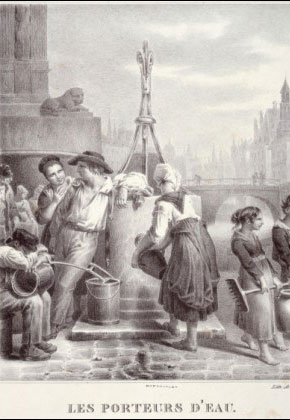
Paris Fountains


Let's talk l'eau pronounced 'loow' water.

 On Paris streets you'll find many types of fountains: les Wallace, les Bornes, les MillĆ©naire, fontaines de l'Albien and fontaines eau pĆ©tillante. That's not counting the fountains in the squares or in the 14 Paris cemetaries which hold 81 fountains.

But Les fontaines Wallace were named after the British philanthropist and art collector  Sir Richard Wallace, who financed the installation of 50 fountains throughout Paris after the Franco-Prussian war left the city with almost no clean drinking water. Designed by a French man, these iconic fountains of the Paris streetscape. They are uniformly painted a deep emerald green.

The largest model, nicknamed the 'Brasserie des quatre femmes'  (brewery of the four women), sports four caryatides each symbolizing kindness, simplicity, charity and sobriety.
Cara - Tuesday

Monday, December 10, 2012

Piranha


In Brazil,  the word can mean a prostitute...


…or a fish.

This post is about the latter.


Their name in Tupi-Guarani simply means “toothed fish”.

They are found in many of the rivers of Brazil and can grow to a length exceeding forty centimeters.  
Most, however, are a good deal smaller, the average being about half that.


I have written earlier in this space about President Theodore Roosevelt’s 1913 expedition up the River of Doubt:


When he returned to the United States, he published a book about his experiences.


Here’s what he had to say about Piranha:

“They are the most ferocious fish in the world. Even the most formidable fish, the sharks or the barracudas, usually attack things smaller than themselves. But the piranhas habitually attack things much larger than themselves. They will snap a finger off a hand incautiously trailed in the water; they mutilate swimmers—in every river town in Paraguay there are men who have been thus mutilated; they will rend and devour alive any wounded man or beast; for blood in the water excites them to madness.”

He wasn't wrong. Attacks on humans are recurring in the Amazon basin. The photograph below was taken in that area. The sign reads, Attention bathers. Area subject to piranha attack. Careful!


In the city of Palmas, Tocantins, 190 piranha attacks were reported in the first half of 2007. In 2011, a drunk eighteen-year-old man was attacked and killed in Rosario del Yata, Bolivia. In 2012, a five-year-old Brazilian girl met the same fate in PiauĆ­.

But while shoals of piranha can consist of as many as 1,000 fish, the stories about them being capable of reducing a human being to a skeleton in a matter of minutes are vast exaggerations.

That voracious, they are not.

If, however, you’re into gruesome images, try Googling the words mordidas de piranhas.
And click on images.
Most, I warn you, are pretty horrible – the reason I didn't want to reproduce them here.

And then there’s the boi de piranha.

The literal meaning is “piranha ox”.
It’s a technique invented by people like this fellow.


Brazilian cowboys.

If they had to drive a herd of cattle across a river they knew to be infested with piranha they’d commonly sacrifice a weak or diseased animal by opening its veins and putting it in the water.

The piranhas, sensing the blood, would gather to attack.
And while the greedy little creatures were busy devouring one unfortunate beast, the others could cross safely upstream.


The expression has entered the vernacular.
And come to mean sacrificing any person or thing for another person or thing, generally of higher value for the person doing the sacrificing.

Scapegoat would be a good translation for some of the usages, but not for all. It’s a very useful phrase if you speak Portuguese, virtually incomprehensible, in a literal translation, for people who don’t.

But now that you know what it means, you’ll be able to appreciate this cartoon:


Substitute the names on the cattle for some of your own least-favorite politicians.

Leighton - Monday

Saturday, December 8, 2012

In Living Black-and-White


Consider the glories of classic Hollywood in black-and-white.

I'm going out on a limb to say the the greatest lighting and photography in the history of motion pictures was put on film before the advent of color.  Look at the picture of Alan Ladd above.  Not only is it brilliantly lighted, composed, and shot, but it also tells you every single thing you'd need to know if you're trying to  decide whether to see that movie.

To find color motion pictures that compete in terms of image quality, you really have to ransack the catalogue.  David Lean's movies, especially "Lawrence of Arabia" (but that's no better pictorially than his "Great Expectations" in black-and-white), Rueben Mamoulian's musicals, and (obviously) a bunch of others.

Gloria "We had faces then" Swanson in "Queen Kelly"

But--and here's part of the point--films where the color photography really stands out tend to be "big" pictures.  In the days of black and white, they created miracle images on a daily basis for B pictures.  In some cases (film noir, for example) some of the most creative lighting was designed to hide the fact that there was barely enough budget to dress the set.


The same held for portraits.  What mattered was the picture, not the importance of the subject.  Anna May Wong, the first major Asian-American film actress, was never really a star.  But the most creative still photographers of the 1920s could not stop pointing their cameras at her, and I think you could argue that she was one of the best-photographed of them all.


Look at the composition, look at the light.  I mean, come on.

Why was black and white so great?  I think it's mostly because they didn't have color.

Max Reinhhardt's "A Midsummer Night's Dream"

I don't mean that in a flip way.  What they had to draw the eye, identify the star, set the mood, and hold the audience were light, shadow, and movement.  In color you have a million variables, whole color themes, hues with emotional value, color contrasts that make it impossible to look at anything other than what the colors say.

In black and white, they had light, shadow, and movement.  At the beginning, they didn't even have dialogue.  From the '20s into the mid-'40s, every film had directors, lighting directors and camera operators who had worked in silents.  They knew how many things a single shot had to do to be worth shooting; it had to please the audience, tell them where to look, show them who was important, convey the mood, clarify relationships, further the story.

Is there anything important you don't know about the couple in this shot from "Citizen Kane"?


Orson Welles famously said that black and white was an historical accident--that if color had been invented first, we never would have bothered with black and white; it would have been too abstract.  We only grew to like it because we were forced to get used to it--it was all we had.

But he went back to B&W over and over again.  And I think there's something for artists of all kinds, writers included, to be drawn from the best of black and white.  Every element in your picture/paragraph/poem has to pull its weight -- draw the eye, set the mood, show the reader where to focus, further the story.  Every element.

As long as this piece is, I could do four more that are all pictures.  I love these images.

Tim -- Sundays