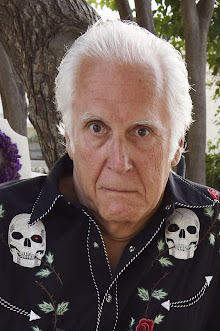
From Weekendletter.com
It did not want to get written. In fact, during the last eight months, nothing I've worked on has wanted to be written. Here I am, someone whose creative motto is, "A writer is someone who finishes," and I abandoned my initial attempt at Poke #5 after writing more than 40,000 words. That really hurt.
So when THE FEAR ARTIST threatened to congeal and die on me, it was high drama.
It's no wonder there are so few movies about writers. I spent three of the worst months of my life pushing this book uphill, writing anything at all, no matter how ragged, improbable, or boring, to try to get the characters from Point A to Point B, to try to bring to life the world they were attempting to traverse. Every day, seven days a week (even during Bouchercon), failing, failing, failing. Becoming increasingly certain that this time failure was permanent and that I had written my last novel.
And what would the film camera, dollying in for the dramatic high-point closeup, have seen? A guy staring at a screen. Who once in a while bit his fingernails. Occasionally, in the privacy of my home, I would vent a bit, in a moderate, suburban Anglo-Saxon manner. My wife, normally the most understanding of women, called me a drama queen.

From sarahsfate.wordpress.com20110513writers-block
I define myself as a writer. It's not something I do for fun (although it is fun at times) or for money. It's -- burst of music -- what I am. I'm someone who regards real life as interesting in direct proportion to how useful it is for fiction. Real life, to me, is potential material. I'm a fiction filter. A story sifter. Even if nobody ever reads me, my job is to try to make some kind of sense out of my world and express it as story.
It means a lot to me that I create something where nothing was before, even if what I create isn't all I would like it to be.
All of that part of my life really did -- without any intended hyperbole -- seem to be over. Every day I hauled myself to the chair, turned on the computer, and, as William Gibson says, "hoped the part of me that writes fiction showed up." And it didn't.
Except that it did. What I had six weeks ago was long and fifth-rate, but it was about 75% of a not-very-compelling story. And then the magic happened, and the Bangkok floods started to weave their way into the book. The story's setting turned out to be a world threatened by rising water, unstoppable, deadly, and completely unmalicious. The book isn't about the flooding; but the threat of flooding, so mindlessly unselective in what it destroys, turned out to be the metaphor I needed, a natural-world complement to the story of someone who's been caught up on the outer margins of the war on terror.
Suddenly, everything I'd written made a kind of sense. It required total revision, but now the story had a sort of sound track, the music of fast-flowing water, the music of rain, and that helped me find the language and the rhythms I needed. And lo and behold, I had moved the characters and the world from Point A to Point B, and the journey turned out to be interesting after all.
Interesting to me, at any rate. I'm currently entering my agent's suggested revisions and reading the manuscript aloud to my wife as a way of laying bare things that don't work and need improvement, and spending about ten hours a day in fine-tuning, but I think there's a book here.
If there's a moral to all this, it's two things I already knew. First, write even when you don't like what you're writing, because you don't actually know while you're laying the words down whether it's good or not. Second, be open to the material the universe sends your way. Sometimes, when we're weaving our story, we'll suddenly be presented with the strand we need most, but we'll walk right past it if we're not open to it.
On Tuesday, I'll send it to my editor, and we'll see what she says about it. Thanks for listening.