Friday, March 5, 2010

Winging it.

Reading Stan and Cara's fascinating posts about the use of experts, my face reddened slightly. Fact is, I'm slightly researchaphobic (see, I couldn't even be bothered to go online and find out what the fear of research is called, if indeed it's called anything...actually, now I'm quite interested to see if it is a condition.) This is part-laziness and partly because nothing turns me off a book more than the sinking realisation that the author has done a tonne of research and nothing, absolutely nothing will stop him or her wasting two or three pages telling us how the Victorians lit a fire or whatever...

One of the most heartening things I read, when I first decided to write a crime novel, and then suddenly felt myself slightly overwhelmed by the task I had set myself, was an interview with Colin Dexter, doyenne of British crime fiction writers and creator of Inspector Morse. He was asked about how he approached research. He said whenever he felt the need to do some research, he made it up instead, then checked when he finished the book. Occasionally, he added, he would go for a cup of tea with Oxfordshire police, but he always felt a bit uncomfortable. For the purposes of his fiction, he claims to have learned more about crime detection from reading other mystery novels.

Colin is brilliant though and I ain't so clever. I'm lucky that one of my themes, London's past and its secrets, has long been an interest too, so I have a store of accumulated knowledge.

The best writers, and I include my colleagues on this blog among them, wear their research very lightly. And in the world of mystery writing veracity is extremely important. Readers are immensely clued up and well read, able to scent a false fact or erroneous twist from a mile away. An otherwise meticulously researched book, beautifully written, with rounded characters and a strong sense of place can be destroyed by an unbelievable fact or improbable conclusion.

Which is why I'm proud, and a little relieved, that not one person has written to me say the detective work in The Blood Detective, my first book, is a load of cobblers. While I bled a genealogist dry for every ounce of information I could about family history (and ended up inserting a facsimile of him into my novel) and pounded the streets of my location delved into its murky past, and metaphorically lived and breathed Victorian London, and enjoyed it all, I pulled what I will now call a 'Dexter' and completely made up the police procedural. Granted, I have a few years of working as a reporter and seeing how the cops operate up close to call on, but all else was the product of my imagination.

Realising that you can dodge a bullet once, but to expect to do so twice is a bit optimistic, for my next book I got access to high-ranking murder detective in the UK. Nev was invaluable, and discussions with him created a whole new set of ideas and plot directions I could follow. On the down side I felt it necessary to run every detail of my police investigation by him, which slowed down the whole process , and I wondered if I might not have been better off doing a Dexter and sending him the finished manuscript and recasting where necessary.

And guess what? Since its release I have had two emails telling me in no uncertain terms that the detective work in Blood Atonement is a load of cobblers. And having Nick Barratt, one of the pre-eminent genealogists in the UK, as my expert in hasn't stopped me getting several emails pointing out faults in my genealogical storylines too. Go figure.

Next week, how I'm plot-outline-a-phobic (I read recently James Ellroy wrote a 397 page treatment for his latest. 397 pages? I'm sorry, but I'd want a D&A payment for finishing that alone...)

cheers

Dan - Friday

Thursday, March 4, 2010

Those who have helped


Cara’s post Experts or is it all done with smoke and mirrors reminded me of our first experience with an expert.  Like Cara, Michael and I had no connections to the worlds of police or forensics or, I’m glad to say, criminals.  We had a sliver of an idea for a mystery set in Botswana, but we knew nothing of the police system there, how it was structured, etc.  We guessed that it would be similar to that of South Africa, since both countries had been heavily influenced in their bureaucracies by England.
Early in the process of writing A Carrion Death, we decided to rectify the situation by visiting the capital of Botswana, Gaborone, and speaking to the detectives of the Criminal Investigation Department.  Our protagonist, David “Kubu” Bengu, was, after all, an Assistant Superintendent in the CID.
For several months before going, I emailed the CID to set up an appointment, but never received a reply.  For a couple of weeks before we set out, I started phoning.  I certainly got through, but was still never successful in setting up an appointment.  I was told to just show up at the CID Headquarters at Millennium Park.
Michael and I eventually arrived in Gaborone and went to the CID, where we met the Deputy Director, who was very suspicious of two white men purporting to be writers asking to speak to the Director.  He was evasive, and we did not get to meet the Director.  But I did manage to get his cell phone number.  So I called and called and called.  The phone was never answered, so I kept leaving messages.
On Saturday morning, I decided to continue my telephonic assault and left another message.  Suddenly my phone rang – it was Director Mulale himself.  “You’re very persistent.  You’ve worn me out!  What do you want?”
I told him who we were and what we were up to.  “Meet me at noon at the registration desk of your hotel,” he said.  Needless to say, we were excited, but a little nervous because ours was a seedy hotel situated in a seedy part of town.
We went to the desk at noon, and there was this tall man in jeans, cowboy boots, and a Stetson chatting to the receptionist.  Not what we had anticipated.  But what a delightful man.  He didn’t sit down with us for 30 minutes and leave – he spent the rest of the day driving us around Gaborone and environs showing us all the various police buildings, including jail, the old CID buildings, and the Botswana Police College in Otse, 20 or 30 kilometers south of the capital.  One could see how proud he was of the College – we suspect he was instrumental in getting it established.
He was very open in answering our questions and told us about a number of the major cases he had been involved in over the years.  It certainly gave us wonderful insights into how the CID and police operated. 
While we were driving around, Director Mulale kept getting phone calls from his Deputy, informing him that they had arrested a gang of thieves, or worse, in Lobatse, who were armed with AK-47s.  He wanted the Director to get involved and sort out the situation.  Director Mulale kept fobbing him off.  “I’m busy!  Sort it out yourself,” he kept telling the Deputy Director.  That made us feel very important! 
It was late afternoon when he eventually dropped us off.  We invited him in for a drink, but he declined.  “I have to leave tomorrow for an Interpol meeting in Mexico.” Unfortunately we were so nervous about upsetting him that we did not take a photograph of him.  And we worried that it may be against the law.
Since then, he has retired.  But we have continued to meet and question members of the Botswana Police, all of whom have given us the time we need – from Commissioner Thebe Tsimako, to forensic pathologist Salvator Mapunda, to a variety of station commanders at the police stations in the towns where our stories take us.
We could not have had a better set of experts.

Stan - Thursday

Wednesday, March 3, 2010

Hotel identity crisis

The world is a funny place. I am going to New York tomorrow with my family and in our search for a hotel we came across many different gimmicks meant to entice people to book a room. Some hotels had installed fireplaces in every room; one was completely designed as some sort of library, not to mention the numerous other less inspired themes available. My favourites however involved animals, for one a hotel that offered their guests a goldfish bowl, with a goldfish, that they could have sent to the room to assume as their pet during the stay. The other one allowed you to bring your own pet from home and supplied the honoured guest with a bathrobe (i.e. the pets ) and also had an in-house pet physic whose services you could engage via the concierge. Although we cannot bring our pets to New York unless we are willing to have them placed in quarantine for weeks on end upon return, we nonetheless decided to opt for the pet psychic hotel. We are thinking of bringing some fur off their backs (2 dogs, one cat and one stray cat that we feed) and see if the other side has some messages for them but this is not the selling point – that was the pillow menu with 30 odd selections. It was impossible not to book a room there seeing that they have really gone out of their way trying.

Did you buy the pillow menu excuse? Ah. The real reason that we booked rooms there is the third great thing about this hotel (aside from the forth which is the relatively reasonable price) namely that we will have a balcony. This we do not intend to use to look into the sky, gazing for pet angels or pet aliens in spaceships – no, we are going to smoke on the balcony.

I remember having mentioned that I would at some point tell you about the unluckiest logo in the history of the world and guess this is a good a time as ever to do so. The logo in question is the trademark chosen for the first shipping company established in Iceland – hið íslenska Eimskipafélag – now named Eimskip. Founded in 1914 it meant a great deal to the country as we depend greatly upon shipping and it was soon nicknamed “the country’s dream child” and referred to as such till this very day. For decades it was the only Icelandic company backed up with shares and was long considered a very good and solid investment, the closest thing to “blue chip” that we have ever had. Now it is of course bankrupt or almost bankrupt, one can’t keep track anymore. But I digress, it was the logo I set out to tell you about, the logo that was carefully chosen in 1914 and meant to relate to our heritage, be recognisable and awake feelings of an honourable establishment you would want to sail with or send your container between countries with. Little did Eimskip’s founders know, nor could they have seen what was coming since they had no psychics (pet or otherwise) in their service when they chose the symbol for Thor’s Hammer as the company’s logo.


Being stubborn, this logo was used until sometime in the 90’s when tourism became an actual industry here and our foreign guests started pointing and taking photos of Eimskip’s headquarters. To us it was just Eimskip’s logo, often mistaken for something else, but not justly so since it was not tilted and blue, not black. We have an old saying “glöggt er gests augað”, meaning something akin to “a guest’s eye sees better” and in this case it certainly applied.

Before going to bed in a few minutes, in preparation for my trip tomorrow, I am going to pull some hairs from a couple of pelts.

Yrsa - Wednesday

Tuesday, March 2, 2010

Experts or is it all done with smoke and mirrors?


Murder in the Palais Royal, my tenth book in the Aimée Leduc Investigation series came out yesterday. When I began writing I never thought I’d finish a book much less set it in Paris or write a series.

    I wasn’t a doctor, a policewoman, a sketch artist or with the FBI. I was a mom, a preschool teacher and had old friends in Paris. The total sum of my qualifications apart from reading and loving mysteries. It was a bit like the photo above of Harry Houdini - you can just see the white speck of his pants - jumping manacled from the morgue walls into the Seine.
 
   But friends have friends, and their introductions in Paris opened doors. In my case doors to private detectives, police, and local cafe owners. Over the years I’ve built up these connections, nourished them with bottles of wine over dinner and running possible scenarios by these experts, some of whom have become friends.
   
"I want you to get it right," a retired Commissaire once told me. "If you’re writing a book set in Paris, a real city, you need to get the police system and all the details correct."
I appreciate that and the time he takes meeting with me and talking.

    Ok so many of us kill people on the page - some for a living - but in my case it pays for my habit. Going to Paris and doing research. There’s so much I don’t know, I tell my husband, so I have to visit the archives, libraries, interview computer hackers etc. he just nods. “I know.”
In Paris on the cobblestones, in the metro I get a spark of a story, a detail, overhear a conversation I’d never hear otherwise. 
   
Yet when I come home to San Francisco my research isn’t done. Experts abound here and it’s about forming relationships and making contacts to ‘get it right.’ Years ago, maybe book three, I met Dr. Terri Haddix through the SF Medical Examiners office when I had autopsy questions. She volunteered to talk to me - little did she know - and I haven’t let go of her since. She’s been an amazing resource, patient beyond belief, with a great sense of humor. Not only that she has two Corgis who send my family a Christmas card every year.
     
I’ve run ideas by Terri, asked her questions, proposed plausible and implausible medical scenarios and generally badgered her over the writing of many books. Terri holds two jobs and wears two hats. She is a forensic pathologist in a independent crime lab in the East Bay and at Stanford University works as a neuropathologist. 
    A busy woman. The best time for Terri to talk happens during her more than one hour commute each way from home to each of her jobs.
When I told her I’d like to blog about what she does and the common misconceptions of her job from shows like CSI, she laughed. In her work at the crime lab, she is most often asked to offer an opinion based on an autopsy performed by someone else. In her words, her ability to render an opinion is only as good as the documentation she receives. People don’t often know that, she said. And the cause of death is not the manner of death but quite different. For example Terri gave the example of a body found in water. Arriving at the conclusion that the person drowned is not necessarily difficult, but how that drowning came to occur is another thing – that is the manner. Did the person voluntarily enter the water? Was that for the purpose of recreation or self destruction? Was the person in the water against their will – were they forced into the water or not permitted to leave? While she would look for evidence of a struggle or some other investigative information to help clarify this – sometimes an opinion to a reasonable degree of certainty cannot be reach and the manner remains undetermined.
There is often confusion in the lay press between cause of death and manner of death. A manner of death of undetermined does not mean that the cause of death is unknown, just the means by which the death occurred cannot be determined. 
Terri’s worked on many cases, given testimony and depositions in her vast experience. But I asked her about her most intriguing autopsy - was there one in which at first it looked one way and ended up totally different from her first impressions.
Oh yes, she said and as she told the story, I heard pride in her voice. The true story was tragic, a relatively young man goes for outpatient surgery. He does well and returns home that day, the next morning he’s unresponsive and dies later that day. Terri was asked to give an opinion on the cause of death. The documentation given to her arrived in dribs and drabs – some indication that there was a brain hemorrhage. Her autopsy didn’t indicate that though. Through sheer persistence she kept requesting the complete medical records as the picture wasn’t clear.
Finally, one of the medical records offered some insight – the young man had been discharged after the surgery with a pump for administration of pain medication. Nearly simultaneously the toxicology report returned indicating a high level of a pain medication in his blood. Eventually with multiple inquiries, the pump was found, interrogated and a sample of the contained medication analyzed. The pump worked perfectly, but the original settings of the pump had been wrong resulting in an excessive administration of the medication.
Terri had put together the evidence step by step and independently arrived at the premature cause of death of this young man. But she found the investigative aspects rewarding - going beyond the surface, asking and asking questions, following up and re-examining evidence which paid off. Like a real detective.
   
So I posed a real life scenario to Terri and asked her opinion. On my last research trip to Paris, I visited the Police Prefecture (Inspector Maigret’s old haunt) and was lucky enough to spend several hours with the Crime Scene Unit. One intriguing story came from Francois, the crime scene sketch artist/photographer. The juge d’instruction, like our DA, had asked Francois to recreate a crime scene and photograph the reconstruction. In this instance, the Metro (subway)station at Bastille and train tracks into the Metro tunnel. Francois showed me the digital photos of his reconstruction (taken at night after the Metro had closed) and related the events. A drug dealer, known to the police, had kept his stash in a crevice of the Metro tunnel just past the Bastille station platform. When what was left of the drug dealer’s body (no need for details but you can imagine) appeared in parts on the train in the next station the police began an investigation. The investigation went before the juge d’instruction and her job was to find out whether a homicide or an accident had occurred. 
   
So I asked Terri the options she would consider in this case - what would lead her to determine this man’s death an accident or homicide?  
  
First, she’d look for the point of impact in the tunnel.
 If that could be determined from trace evidence she’d try to determine from the recovered body if the person was lying down on the tracks which could indicate suicide or he’d been killed and left there. From the injuries she could discover if the body had turned away, the train sideswiping him indicating an accident. Most important would be to talk to the train driver and learn what he’d witnessed and when he’d stopped the train. Then do tissue toxicology on the remains to test for drugs.
But even if this man was under the influence of drugs, it could be framed in many ways, foul play, a deal gone wrong or an accident. Terri again went back to the fact that an investigator can’t truly arrive at an informed conclusion without an integrated approach incorporating the crime scene reconstruction, physical evidence and medical findings.
   
By the time I heard Terri’s garage door open I knew we’d talked her whole commute! What about you? Do you have people in the field you consult and talk to?
Cara - Tuesday

Saturday, February 27, 2010

Phnom Penh Life

"So," you may ask (and if you don't, you should) "what's it like to live in Bangkok these days?"

The short answer is that these days I live mainly in Phnom Penh, which is as much like Bangkok as Lodi is like Los Angeles. It's an interesting town, even if many of the ways it's interesting take some getting used to.

Let's start with my apartment.

This is the alley one walks down to get to my apartment.

What you don't see any of is lights. It took me some time to learn to enter it around 11 PM without my pulse rate tripling. Now, however, I know every family in the place, and it's no longer an ordeal that produces interesting adrenaline spikes. After you feel your way all the way down the alley in the dark, you reach:

My door.

Note the curb appeal. Yes, it's solid steel and yes, it triple-locks. The door has a message, directed to anyone who might decide to try to get through it to relieve me of any of my possessions, and the message can be summarized in five words: Don't even think about it. Inside the door, a flight of stairs leads to my apartment itself, which has a door just like this one except that there's steel mesh behind the bars and glass behind the steel mesh and a hideous, vaguely African, fabric behind the glass. The door leads directly into:

My kitchen.

I think "functional" is the best word, although you might modify it by preceding it with "more or less." The little refrigerator comes up to my elbows and holds less than the average body pore, and freezes most of that solid. The most important thing in the kitchen is the coffee maker on top of the refrigerator. It's almost the only thing I use. The little two-burner gas hotplate is hooked up to a bright red propane tank out of sight behind the refrigerator, which I think of as my personal bomb. The gas cooker has a wonderful brand name:

You're right, that says "Endurable Collection." I think it's perfect. They could have said "durable" or "enduring," or even "endearing," but they chose "Endurable," which is exactly accurate. It's an appliance you can learn to endure, at least on a good day. The kitchen is at the back of the apartment (or the front, since it's where the door is) and outside of the air conditioned area because Southeast Asians can't think of any good reason to have an air conditioner and a stove running in the same room, which I think is quite sane.

As dire as these pictures are, the apartment is actually quite nice -- a balcony overlooking the river, a big living room with the bookcases and work area, a bedroom with its own separate air conditioner, and two big bathrooms that work just fine, thanks. When I get tired of the apartment, I can always visit:

The house next door.

Honest. This wonderful, if derelict, colonial mansion, built around 1910, is widely believed to be haunted (no kidding) and has been empty, off and on, since the Khmer Rouge were in power. Its most famous ghost is a soldier who's always encountered on the stairs, whereupon he reaches up and pulls his hair, which hinges his head back to reveal a deeply slashed throat. Surely, a simple "Hello" would suffice. When I first moved here, I could have bought it for $240,000 and didn't. A month ago, the Fpreign Correspondents Club, which is right behind it, bought it for US $2.2 million and plan to put another $2 million into renovating it into a very exclusive small hotel. Don't know what they're going to do about the ghosts.

In case all this looks too grim, we're directly across the street from:

The National Museum.

And right down the street (actually, next door to the Museum) is the Royal Palace, where King Norodom Sihomoni lives. So it's a tony area, actually. And it's full of:

Monks with Umbrellas.


How cool is that?

Friday, February 26, 2010

The World's Most Macabre Museum?


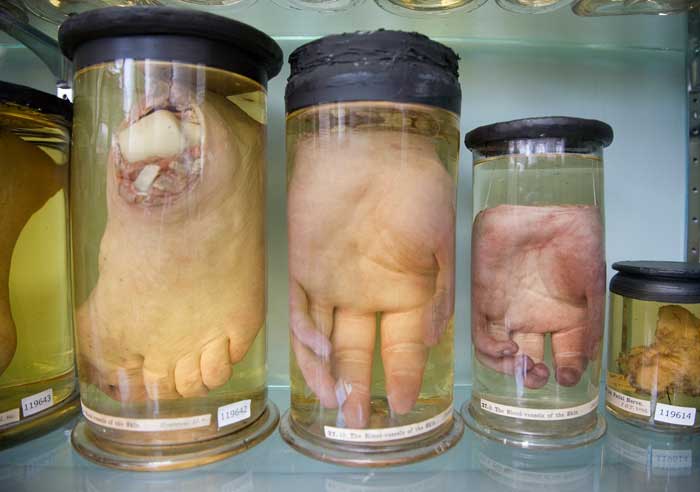
You might have guessed by now that I have a thing for London's secrets, the darker the better. Much of it is inaccessible, whether it be ghost stations on the underground, or long-deceased railways to transport the dead. Not all of it though. My favourite London museum is little-known, teeming with macabre artefacts and brimful with stories.

The Hunterian Museum sits inside the imposing Royal College of Surgeons in Lincoln's Inn Fields, which means it doesn't get much passing trade. I was told about it by a friend and first went to visit in 2005. You climb a few steps of the old building, and make your way in through an unassuming doorway. Then you're met with an amazing, creepy sight: row upon row of preserved human and animal organ specimens floating in jars, like the world's most gruesome pharmacy. It's like a cross between a Damien Hirst installation and the set of a horror movie. Ghoulish, ghostly but also weirdly beautiful.

It's mainly the private collection of one man, John Hunter, a remarkable character who many view as the father of modern day surgery. He spent a life collecting body parts. 14,000 in total. All dissected, studied, then pickled in formaldehyde, and now on view to the public, though from experience most of those walking around tend to be medical students, art students looking for a visceral sketch or too, or crime writers.

You cannot help but gawp in a sort of ghastly awe at the exhibits. A tiny human foot floats free, belonging to a child who died of smallpox, the disease that killed thousands of people in 18th century Britain. The child it belonged to is long forgotten, and you hope that its foot, preserved for the ages, helped to understand and finally eradicate that terrible virus.

Things get more surreal and haunting the deeper you venture and the closer you look. There is a whole shelf of tongues belonging to different animals, whales, baboons and elephants, and the minute body of a dead infant sloth which looks like an alien. There are the sexual organs of a host of animals, many of which were provided by London Zoo, though Hunter had a menagerie of his own. He practically bankrupted his family in his desire to track down specimens for research.

Of course, the human body interested him most and in 18th century Britain people of his ilk were able to obtain the bodies of convicted felons for dissection and study. There was a great competition for these corpses (and of course, to meet demand, the likes of Burke and Hare would later provide the bodies of ordinary folk for those who didn't ask too many questions about the merchandise) and Hunter wasn't above a bit of chicanery. One of the exhibits is the skeleton of 7ft 8 inch Irish 'giant' Charles Byrne. He was a freak show spectacle, one of the foremost celebrities of the day. Because of his huge frame he knew surgeons across the land were queuing up to get their hands on his corpse and see what secrets it would yield. Byrne asked to be buried at sea in a lead coffin to thwart them. His plain failed; when he died, Hunter paid off the undertaker and got his prize. It's still a debate within the museum over whether Byrne's wishes should be honoured and his remains buried. For the moment, he remains an exhibit.

Alongside jars and the skeletons are models and sculptures that tell the story of the early years of modern surgery (his death mask is also part of the collection, and is one of the creepiest things there.) The most gruesome of which is a wax model of a man, fully awake, his left cheek opened up to reveal a tumour, while two disembodied hands work at it with a saw. At first you think, 'That's just a gross bit of sculpture' until you learn that the artist created the work while watching a man undergo that very surgical experience, without the benefit of anaesthetic, his face stern but calm.

There's also enough strange surgical contraptions to give David Cronenberg the conniptions. My favourite being the Clockwork Saw, which never made it past the prototype phase, mainly because it lacked precision, was difficult to control when wound and often ended up slicing and dicing the surgeon's assistant and not the patient. All major failings in a piece of medical equipment.

Hunter had a brother William with a similarly morbid collection, on view at the University of Glasgow. There, the museum is available for hire, so you can enjoy your wedding reception surrounded by pickled embryos, dissected wombs and preserved penises, which should at least cut down on the cost of the buffet.

cheers

Dan - Friday

Thursday, February 25, 2010

I had a Farm in Africa

Cara’s question about fixer-uppers inevitably reminded me of the fixer-upping I was involved in with my partners last year.

It was like this. Three of us share a thatched house with a deck overlooking the Olifants (Elephants) River. The bungalow is one of eighty such units which are scattered throughout a private game reserve which borders the Kruger National Park. Since there are no fences, it essentially is the Kruger National Park as far as the animals and other creatures are concerned. Thatch is a beautiful and clever roofing material widely used from Cape Dutch times and still common today. The high peaked roofs allow hot air to rise which keeps the house relatively cool. Often there is a loft with windows to let the hot air escape. Thatch does have its disadvantages however. One is that it wears out and has to be replaced every twenty years or so. Another is that insurance companies don’t like it.
                                                       
                                The view from the deck
The house used solar power for lighting. There is plenty of sun in that part of the world and solar is attractive since it is both free and green. Unfortunately it couldn’t run appliances like stoves and water heaters. For this we used gas. Any cook will tell you about the desirable features of gas, but it has an undesirable aspect when in close proximity to thatch.


No one is quite sure what happened, but we know one partner left the gas bottle switched on when she left the unit to come home to Johannesburg. This was a mistake, but it shouldn’t have been a disaster. But one of the appliances must have been left on also. Such things have pilot flames. And cooking gas is denser than air so it sinks to the floor and forms a gas lake. If the bungalow had been open, the gas might simply have dissipated. But in the closed up house, the lake slowly filled until it reached the flame...

People in a bungalow across the river heard the explosion which was followed by a fireball rising from the thatch. And thatch is really just dry grass. The staff at the game reserve did their best to save the house, even taking risks to save a few pieces of furniture and the like. But by the next morning nothing was left except ash and the bare, burnt walls.

I remember hearing about it while at dinner meeting. I thought it was a bad joke or some confusion with a minor accident. But on receiving a second call, I realised it was true. The bungalow that had withstood two record floods was no more. It wasn’t really a fixer-upper; we had to start again from scratch. A new design, new features, a new fight with the insurance company, and NO gas. But the new house rose. I think we’ll call it Phoenix.

                                                        The new bungalow


                                                       Sunset in the river
                     
There is a sequel to the story. When we were there last December a unit was struck by lightning. The owners were in the reserve but not at the house. We knew just how they felt as they heard of exploding gas bottles and a brand new land rover consumed in the flames. Two houses burning down in a year was extraordinary.

And, oh yes, our insurance premiums went up.

Michael - Thursday